
EPS Packaging Line: What to Check on Export Packing
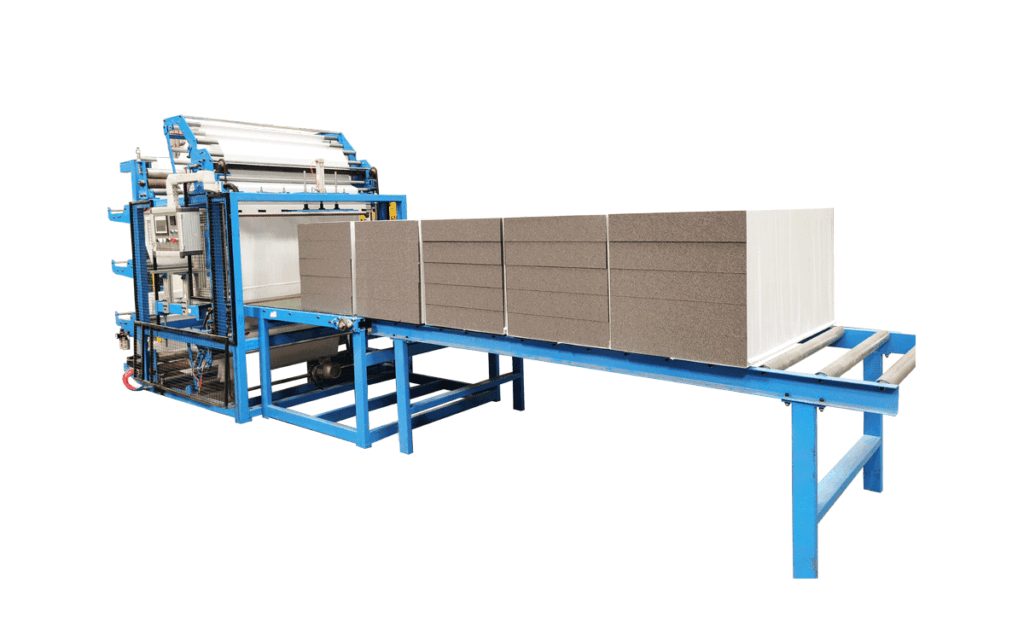
Field notes from the packing station, written just before a container is closed. Most of the complaints we hear about export orders are decided in the last few metres of the line, not back in the moulding hall. Board can be cut perfectly square and still arrive damp, scuffed or loose if the wrap is wrong. The eps packaging machine for block is the last chance to catch it, so this is what I check at the end of a run.
Film thickness: what 0.03 mm actually buys you
On the SPLB-1200 the published figure is about 8 packs/min with PE film at 0.03 mm. That thickness is a compromise: enough to survive handling and strapping, thin enough to keep the roll length and the film cost sensible over a long shipping run. I do not treat 0.03 mm as a target to shave. Thinner film saves a little on the reel and loses a lot when a corner tears in a humid hold. Check the roll label against the machine setting at every change, because a substituted reel is an easy mistake to miss once the line is running at 8 packs/min.
Wrap integrity at speed
At 8 packs/min there is no time to inspect every pack, so sample deliberately. Pull packs at the start, the middle and the end of each roll, and look at the seams and the corners rather than the flat face. A loose end or an unsealed flap is where moisture gets in. Watch the film tracking on the first few packs after a roll change as well; that is when the wrap is most likely to run off-centre, and the fault tends to repeat for the rest of the reel if nobody stops it.
Sea freight, start-up and roll-change waste
A long sea freight is a moisture problem more than a handling problem. Condensation in a container does more damage than a rough crane lift, so the wrap has to be continuous and the pallet has to stay off any damp floor. We also log what the machine wastes: the first packs after start-up and the tail of every roll. It is easy to quote 8 packs/min and forget the film and the few packs that never ship.
- Film gauge confirmed against the 0.03 mm setting after every roll change.
- Seams, corners and end flaps checked on start, middle and end-of-roll samples.
- Film tracking watched for the first packs after a splice.
- Pallets kept clear of container floors and standing moisture.
- Start-up and roll-change waste recorded so the quoted rate matches the shipped count.
None of this is dramatic, and none of it needs a press release. It is a short checklist at the end of the line. If you want to compare notes on a packing setup for your block size, contact our team; the EPS packaging machine for block page carries the published machine figures.