FAQ
Common questions about EPS machines, production lines and after-sales service.
Starting an EPS (Expandable Polystyrene) factory raises one question above all others: which machines do I actually need? This FAQ answers the most common buyer questions and links to the relevant YouXin equipment so you can plan a line that fits your budget and market.
What is the basic EPS production flow?
A typical line runs: pre-expand beads → age/silo → block mold → cure → cut → pack. Each stage has a dedicated machine, and you can start small then add capacity.
Which machine do I need first — pre-expander or block molding?
Both are core. The EPS pre-expander machine turns raw bead into low-density EPS, and a vertical EPS block molding machine fuses it into blocks. You cannot make blocks without pre-expanded bead, so most buyers commission both together.
Do I need a cutting line or a cutting machine?
If you only trim blocks into sheets, a single EPS cutting machine may suffice. If you produce panels, shapes or high volumes, a EPS cutting line — or a CNC cutting machine for complex profiles — pays for itself in speed and accuracy.
What about packing and wrapping?
Finished sheets and shape products need protection. An EPS packaging machine for sheets and an EPS wrapping machine for shape products reduce damage in transit and lift your presentation.
Should I add a recycling system from day one?
It is optional but smart. An EPS recycling machine turns scrap back into reusable material, cutting raw-bead cost and waste disposal fees — often paying back within a year.
How do I choose between vertical and horizontal block molding?
Vertical machines suit compact footprints and easier demolding; horizontal machines suit larger blocks and higher automation. Your available space and target block size decide it.
Can YouXin design a complete plant for me?
Yes. We provide layout drawings, machine selection, installation guidance and training so your factory runs smoothly from commissioning.
How do I get a quote?
Share your target products, capacity and workshop size via our contact page, and we will propose a matched, costed line.
Short answer
An EPS wrapping machine for shape products is a PE film packaging machine that encloses irregular EPS items — cornices, insulation boards, fish boxes, custom molded parts — in film on all six sides in a single automatic cycle. Unlike a block packer, it is built for non-uniform bundles that must be fully sealed before shipping.
How does six-side wrapping actually work?
- Loading. The EPS shape product bundle is placed at the infeed, either manually or by an optional automatic loading system.
- Film pick-up. As the bundle is pushed forward, it draws PE film along with it from the roll.
- Six-side wrap. During the advance, the film is formed around the top, bottom and all four vertical faces of the bundle.
- Sealing and cutting. The film is heat-sealed and cut automatically — foil positioning, fastening, welding and cutting complete in one pass.
- Discharge. The finished, fully enclosed package exits the machine, optionally onto an automatic stacker or through an automatic labelling machine.
Because the seal and cut happen in the same cycle, there is no second manual operation to close the ends.
What sizes can it handle?
On the YouXin Model MT-C1, the packing width is adjustable across roughly 600–800 mm and the packing height across 300–600 mm. A related configuration covers up to 900 mm width with product length around 1500 mm, while another handles product length up to 2000 mm. Always confirm against your largest bundle before ordering.
How fast is it?
It depends on the film and the configuration: around 2–3 packs/min using 0.02 mm PE film at 1200×800×600 mm, or approximately 4–6 packs/min with 0.01 mm HDPE film in the alternate setup. Your real number depends on bundle size and operator loading rhythm, so validate it with your own product.
Which film should I use?
Both PE (around 0.02 mm) and HDPE (around 0.01 mm) are used in this machine class. Thicker film gives better puncture resistance on sharp molded corners; thinner film lowers cost per pack. The machine saves film and tape compared with manual wrapping because film is metered per cycle and no tape is needed.
What is it made of — and will I get spare parts?
The control side uses a Siemens touch screen and PLC with Schneider electronics, Airtec pneumatics and Autonics photo sensors; an alternative build uses Xinje PLC and servo motor with the same Schneider electronics and Autonics sensors. These are widely distributed brands, which keeps replacements straightforward. The machine is CE certified.
Is it the same as a block packaging machine?
No. A block packaging machine handles uniform rectangular blocks. Shape products need the six-side enclosure described above because their profiles vary and their surfaces are more easily damaged.
Can it be automated further?
Yes — options include an automatic stacker, an automatic labelling machine and an automatic loading system. Many plants pair it with an EPS CNC cutting machine upstream and a pre-expander earlier in the line, so the whole process from bead to packed product is continuous.
Daily operation tips
- Keep photo sensors clean — dust from cut EPS is the most common cause of mis-cuts.
- Check seal temperature after any film change; PE and HDPE need different settings.
- Log width/height settings per product family to make changeover repeatable.
Where do I get one?
See the specification and configuration options on the EPS Wrapping Machine for Shape Products page, or contact YouXin with your bundle dimensions and target output.
Buyers comparing an EPS pre-expander machine and a block molding machine ask the same questions. Here are the answers our engineers give most often.
What does an EPS pre-expander machine actually do?
It steams raw polystyrene bead so it expands 20–50x into low-density EPS pearls. These pearls are then aged and fed to molding. Without a stable EPS pre-expander machine, downstream blocks are uneven and weak.
What bead density can be achieved?
Typical pre-expanded density is 10–25 g/L for packaging and 15–30 g/L for construction board. YouXin machines hold density within a tight band via closed-loop steam control.
What is the block molding cycle time?
A vertical EPS block molding machine runs roughly 3–6 minutes per block depending on size and target density. The horizontal styrofoam EPS block molding machine suits longer, continuous block formats.
How do I raise output without buying a second line?
Stabilize pre-expansion first, then reduce cooling time with optimized water/air sequences, and keep bead age consistent. Many plants gain 15–25% output just by tuning the pre-expander and molding parameters.
Pre-expander + block molding, or buy pre-expanded bead?
If you mold at volume, owning the pre-expander protects your supply and cost. For very low volume, bought bead works — but freight on low-density bead is expensive, so in-house expansion usually wins.
What maintenance keeps uptime high?
Daily: drain steam traps, check bead feeders. Weekly: inspect molds and seals. The height-adjustable EPS block molding machine also benefits from periodic guide-rail lubrication.
Need a Sizing Sheet?
Tell us your target block size, density, and daily tonnage. We return a matched pre-expander + block molding configuration with cycle time and power draw.
Need an EPS pre-expander or block molding line priced for your project? Request a quote and we will send you a tailored proposal with lead time and specifications.
Related: What Is an EPS Machine · EPS Block Molding Cost · EPS block molding · EPS pre-expander
What Is an EPS Machine?
An Expandable Polystyrene machine (EPS machine) is a set of integrated equipment that turns tiny solid polystyrene beads into lightweight, rigid foam used for packaging, insulation and construction. “Expandable” means each bead already contains a blowing agent; heat makes it puff up many times its size.
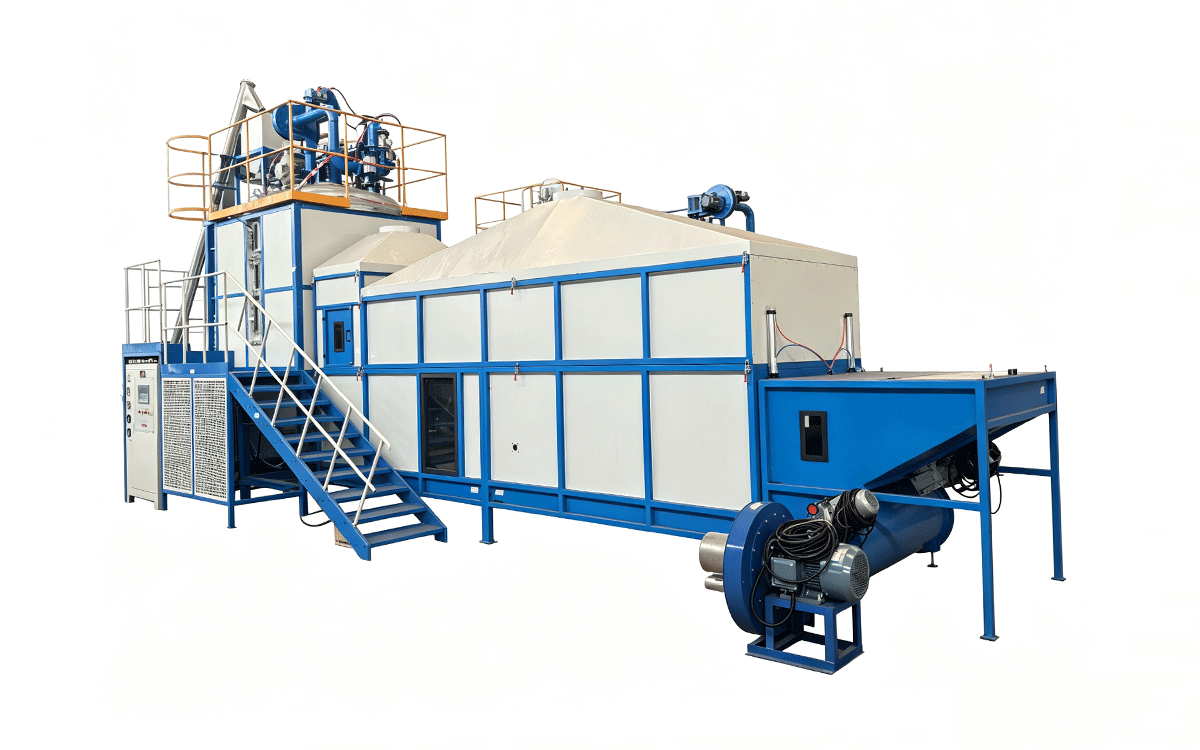
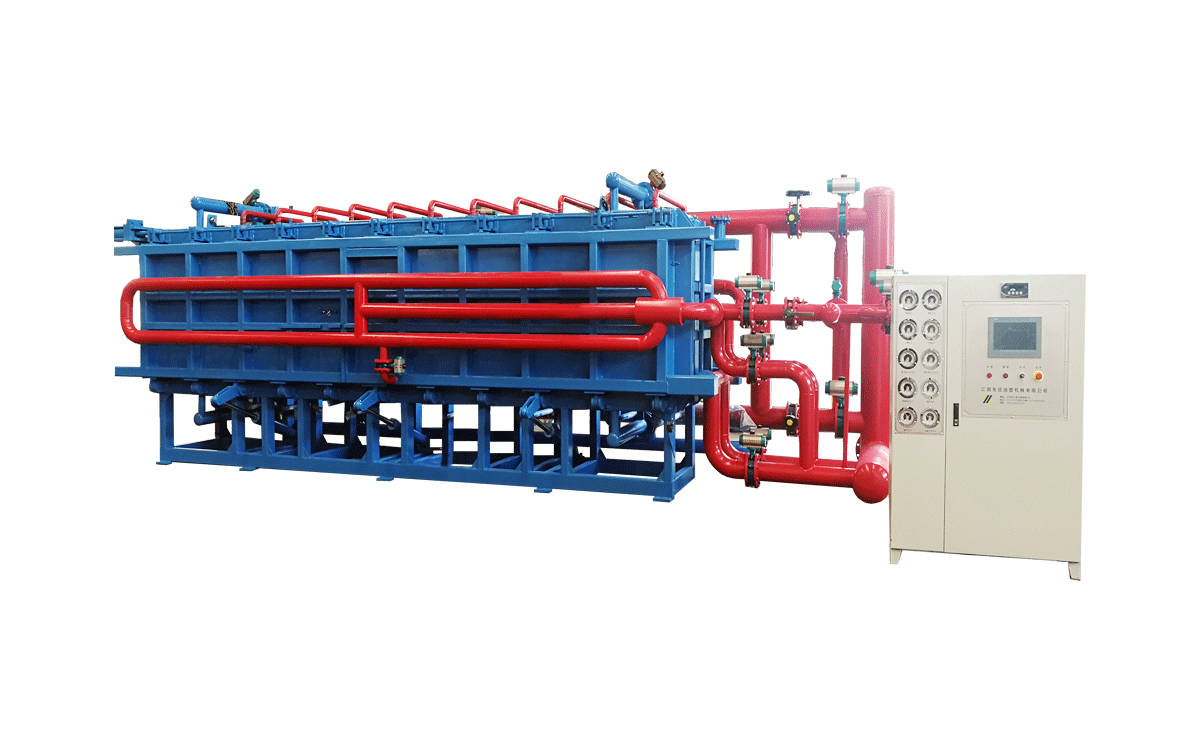
How Does the Production Line Work?
Step 1 — Pre-Expansion
Raw beads meet steam in the pre-expander and expand to the target density.
Step 2 — Maturation
Beads rest in a silo so air stabilises inside the cells (4–12 hours).
Step 3 — Molding
A block molding machine or shape molding machine fuses beads under steam into blocks or custom parts.
Step 4 — Cutting & Finishing
Blocks are cut to size and packed. The whole line is coordinated by PLC control.
Frequently Asked Questions
Is EPS the same as Styrofoam?
No. Styrofoam is extruded polystyrene (XPS); EPS is bead-molded foam. They are made differently and used differently.
What density can an EPS machine produce?
Typical lines cover 10–30 g/L; double-expansion models reach lower densities for specialty uses.
How much steam does it use?
Modern closed-loop YouXin machines recover steam and cut utility cost versus older open-vent units.
Which industries use EPS foam?
Fish boxes, appliance packaging, building insulation, road construction and decorative profiles are the main markets.
Explore YouXin EPS Solutions
See our full EPS machine range or request a quote.
Related: EPS Pre-expander · Choosing a Cutting Line · EPS pre-expander · EPS block molding
Request a quote for a tailored proposal.
We have exported EPS machinery to more than 50 countries across Asia, Europe, the Americas, the Middle East and Africa, including Canada, Brazil, France, Vietnam and Thailand. References and case studies are available on request.
Related: Design a Complete EPS Plant · Operator Training · EPS block molding
Request a quote for a tailored proposal.
Yes. We provide 7×24 after-sales support, documentation and on-site or remote installation and training so your team can run the pre-expander, block molding machine and cutting line safely and efficiently.
Related: After-sales Service · EPS Pre-expander · EPS pre-expander
Request a quote for a tailored proposal.
Consumption varies with machine size and output. Our machines use PID control, frequency-converted motors and heat-recovery features to reduce steam and electricity use. A full line estimate is provided during factory layout design.
Related: Choosing a Cutting Line · Batch vs Continuous Pre-expander · EPS cutting line
Request a quote for a tailored proposal.
Yes. Our EPP pre-expander produces expandable polypropylene beads, and our shape moulding technology supports EPP/ETPU parts. Tell us your material and we will recommend the right pre-expander and moulding configuration.
Related: What Is an EPS Machine · Pre-expander Types · EPP pre-expander
Request a quote for a tailored proposal.
Price depends on block size, automation level and options such as conveyors or tilters. A standard vertical or horizontal machine is typically a fraction of a full turn-key line. Contact our engineers with your block dimensions and target output for an exact quotation – we export to 50+ countries.
Related: Pre-expander & Block FAQ · EPS Pre-expander · EPS block molding
Request a quote for a tailored proposal.
A batch pre-expander processes beads in cycles and offers very accurate density control, ideal for moulding. A continuous pre-expander feeds beads steadily for high-volume block plants. YouXin supplies batch pre-expanders such as the SPJY series and EPP pre-expanders.
Related: EPS Pre-expander · Power Consumption · EPS pre-expander
Request a quote for a tailored proposal.