
Continuous vs Batch EPS Pre-Expander: Which Fits Your Line
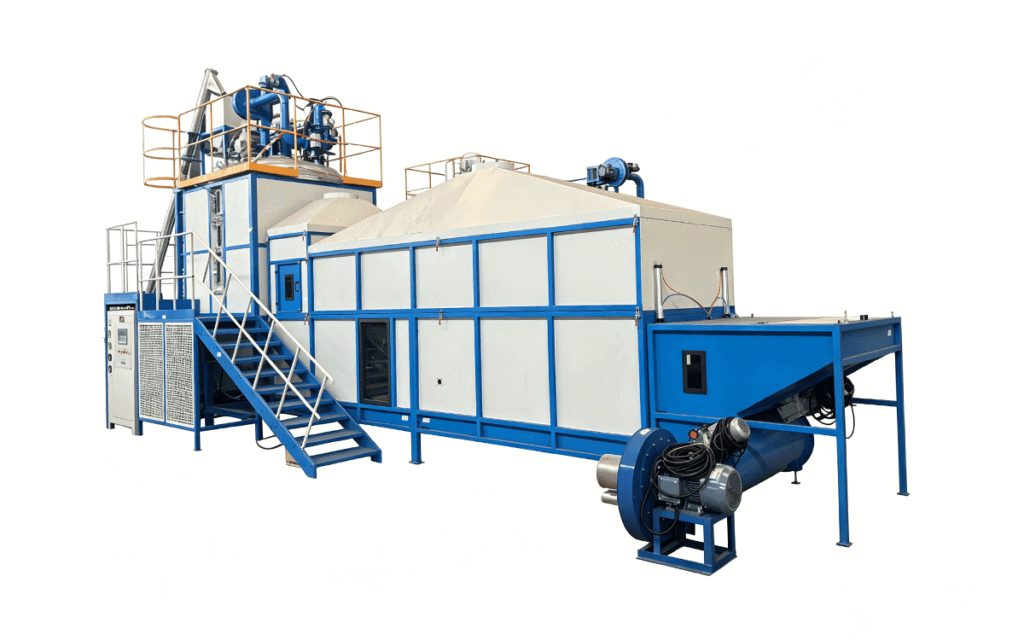
EPS pre-expanders come in two flow styles — continuous (bead moves through steadily) and batch (bead expands in a vessel per cycle). Both raise raw bead to your target density; they differ in how they feed the line and how tightly they hold density. This guide compares them so you pick by throughput and control need, not by habit or by what a neighbour bought, because the wrong flow style quietly fights you every shift.
How a continuous pre-expander works
Bead is fed in at one end and flows through a steamed chamber, expanding as it moves, and discharges at a steady rate. Output is continuous, which suits a line that draws bead all day. An EPS pre-expander machine of this type pairs naturally with a silo that buffers the steady stream for the moulders, so the pre-expander rhythm never dictates the moulder rhythm and a brief stop upstream never reaches the blocks.
How a batch pre-expander works
Bead is loaded into a vessel, steamed to expand, then discharged. Each cycle is a batch, so output is pulsed rather than continuous. Batch units are simpler and easy to tune per grade, which suits plants that change density often or run smaller volumes where a continuous stream would be hard to buffer and where a pulsed output is acceptable because the silo smooths it anyway.
Density control
Continuous units hold density well when tuned, but changeovers take a moment to settle as the chamber fills with the new grade and the old grade clears. Batch units let you lock each batch’s density precisely, which is attractive when you switch grades frequently and cannot afford a transitional lot of off-spec bead. Weighed density control matters in both — it is what holds ±1.5% run to run regardless of flow style, so do not let the flow choice distract from the control method.
| Factor | Continuous | Batch |
|---|---|---|
| Flow | Steady stream | Pulsed per cycle |
| Grade change | Settle time | Per-batch precise |
| Footprint | Longer line | Compact vessel |
| Best for | High, steady volume | Frequent grade changes, lower volume |
Common mistakes
- Buying batch for a steady high-volume line. You fight the pulsed output all day; continuous fits better and buffers more cleanly into the silo with fewer transitions to manage.
- Buying continuous when you swap grades hourly. Batch is easier to tune per grade and avoids the settle-time scrap between runs, which on a tight margin is real lost bead.
- Forgetting the silo. Either style benefits from a buffer so moulding stays independent of pre-expander rhythm and bead ages, which protects block quality in both configurations.
- Assuming one cannot hold density. Both hold ±1.5% with weighed control; the difference is operational, not a quality ceiling, so decide on flow, not on a myth about control.
Reading your own line before you buy
Before choosing flow style, measure what you actually run. Take a week of production and record two numbers: average steady bead demand per hour across a full shift, and how many grade changes you make. If demand is flat and grade changes are rare, continuous wins on buffer and simplicity. If you swap densities several times a day, batch wins on precision and avoids the transitional scrap that continuous sheds while the chamber settles. The data removes the guess and the neighbour’s opinion, and it turns a capital decision into a measured one rather than a copy of someone else’s layout.
Also watch the silo, because it changes the equation. A properly sized silo smooths a pulsed batch output almost as well as a continuous stream, which means batch becomes viable even on a busier line than you might assume, while continuous still wins when volume is high and steady. The flow choice is not permanent — many plants start batch, prove the volume, then add continuous — but starting with the wrong one costs a capital swap. Size to the pattern you measured, not the one on the brochure, and let the silo do the smoothing either way so a stop never reaches the blocks and the shift stays on spec.
A practical tie-breaker: if your offcut recovery already feeds bead back into moulding, a steadier bead stream from continuous makes that blend easier to hold; batch pulses make the blend wobble shift to shift. Factor that into the call if recycling is part of your line, because a wobbling blend is a fusion complaint waiting a week down the road and nobody will trace it back to the pre-expander rhythm.
Commissioning note
Commission the unit against the numbers you measured, not the sales demo. Run a full shift, log bead density at the start and the end of it, and confirm the silo keeps moulders fed through a planned pre-expander stop. If the buffer holds and density stays in band across the shift, the flow choice was right and the line will prove it.
Frequently Asked Questions
Which holds density better?
Both can hold ±1.5% with weighed control. Batch is easier to lock per grade; continuous is steadier once tuned and settled on a grade, so the answer depends on how often you change.
Do I need a silo either way?
Strongly recommended. It decouples pre-expander rhythm from moulder demand and lets bead age, which protects block quality in both configurations and hides the flow difference on busy days.
Which is cheaper to run?
Continuous at high volume; batch at low volume or frequent changeovers. Match to your real pattern, not to a single shift’s output, because the pattern is what decides the running cost.
Can I switch later?
You can, but it is a capital change. Sizing to your dominant pattern now avoids a premature swap, and a silo makes either choice more forgiving during the transition if you do switch.
Does continuous waste bead on grade change?
A little, during settle time, which is why batch wins when changes are frequent. Quantify the transitional loss before assuming continuous is always cheaper at your volume.
Next step
Tell us your hourly bead demand and grade-change frequency and we will recommend continuous or batch. Talk to our team for a configuration sized to your real line and your real mix of grades.