
EPS Block Shrinkage: Causes and How to Prevent It
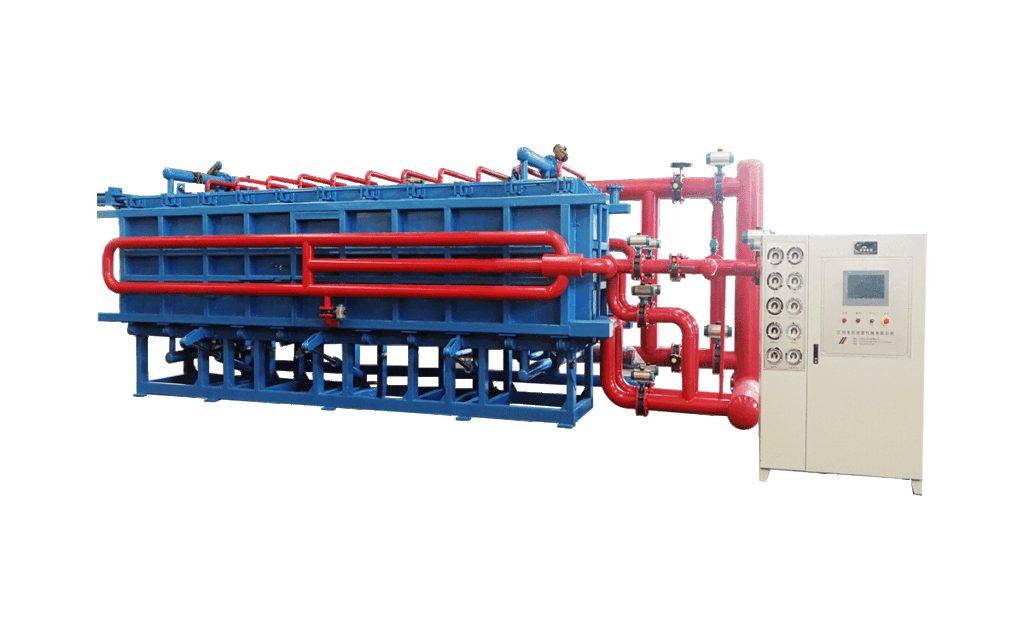
Shrinkage is the most frustrating fault on an eps block molding machine because it often shows up hours after the block has left the mold, when the machine is already running the next cycle. A block that looked square at eject can pull in at the faces, bow along its length or lose dimension on the cutting line. The instinct is to blame the mold, but shrinkage is almost always a material or process problem that the mold merely reveals. This guide maps the common symptoms to their causes, then links the fixes back to bead ageing and expansion, the two upstream steps that decide most of it.
What shrinkage actually is
A fused EPS block is a foam structure with closed cells that still contain gas and a little condensate. Right after fusion the internal pressure and temperature are above ambient. As the block cools, that gas condenses and the pressure drops. If the cell walls are still soft, or if there are not enough of them, the structure cannot hold its shape against the pressure difference and the whole block contracts. Understanding that mechanism is the fastest way to read the symptoms: shrinkage is a sign that the polymer skeleton was not strong or stable enough when the pressure fell.
The timing tells you a lot. Shrinkage seen at eject points to premature demold and a still-hot core. Shrinkage that develops over the following day points to bead condition or density, where the internal pressure keeps relaxing long after the block is stacked. Log when the dimension changes appear, not just that they appeared.
The five causes worth checking first
Most cases trace back to one of five roots. Insufficient bead ageing leaves fresh beads with unsettled blowing agent pressure, so they expand and then contract unpredictably. Density that is too low means too little polymer per unit volume to resist the pressure drop. Poor fusion leaves weak welds between beads, so the block behaves like a loose aggregate rather than a solid. Cooling that is too fast can set up a hard skin over a still-hot core, trapping stress that relaxes later. Wet steam adds free water that later evaporates, leaving voids and dimensional loss. Each has a different signature and a different fix.
Troubleshooting table
Work down the rows in order, because the cheap checks are upstream of the mold. The first two rows live in the material, not the machine.
| Symptom | Likely cause | Where to look | Remedy |
|---|---|---|---|
| Block pulls in evenly on all faces a day after molding | Insufficient bead ageing | Maturation time and bead rest before molding | Extend conditioning and confirm steady residence in the silo |
| Block feels light and dents easily, edges round off | Density set too low | Fill quantity and pre-expansion density | Raise target density and recheck bead weighing |
| Block crumbles at the surface, weak weld lines | Poor fusion | Steam staging, steam pressure and bead coating | Adjust steam steps and confirm dry, even steam |
| Skin is hard but core is soft, block bows later | Cooling too fast or too uneven | Cooling profile and core temperature at eject | Moderate the cooling ramp and let the core equalize |
| Surface marks, damp block, dimensional loss after drying | Wet steam carrying condensate | Steam traps, drainage and line insulation | Improve drainage and deliver drier saturated steam |
Trace it back to the silo and the pre-expander
Two of the five causes are upstream, which is why the mold is the wrong place to start. Beads are expanded on an EPS pre-expander machine, where density is set, and then they rest in an EPS silo system while internal pressure equalizes. A block can only be as stable as the beads fed into it. If the pre-expander is drifting on density or the silo residence is too short, no amount of steam tuning on the mold will fully fix shrinkage. Off-spec blocks can be reground and retested with an EPS recycling machine, but prevention is cheaper than rework.
Talk to the operator, not only the controller. Ask how long beads actually sit between expansion and molding, whether the density check is recorded per batch, and whether steam traps are drained at shift start. Those three answers usually locate the cause faster than a week of mold adjustments.
A five-step prevention sequence
- Record when shrinkage appears, at eject or after storage, to narrow the cause to process or material.
- Verify bead age and residence time in the silo before touching any mold parameter.
- Confirm pre-expansion density against the target and check the weighing record per batch.
- Audit steam quality, drainage and the fusion recipe for even, dry heat.
- Review the cooling ramp and core stability at eject, then change one variable at a time and re-measure.
Common misconceptions
- Shrinkage is a mold defect. It is usually a material or phase-timing problem the mold exposes.
- Adding more steam fixes it. Extra wet steam often adds the moisture that makes dimensional loss worse.
- Do the arithmetic on scrap: a slightly higher density that eliminates an entire off-spec batch is often cheaper per good block than running at the lowest density and reworking or recycling the losses.
- A hard surface means the block is cured. A hard skin over a hot core is a classic setup for delayed bowing.
- Once beads are expanded they are ready. Fresh beads need rest for pressure to equalize before molding.
Frequently Asked Questions
Why does my block shrink a day after molding rather than at eject?
That pattern points to bead condition or density. Internal pressure is still relaxing after the block is stacked, so check ageing time and pre-expansion density first.
Will raising density always stop shrinkage?
It helps when the block is simply too light to hold shape, but it will not fix poor fusion or wet steam. Match the remedy to the symptom.
How do I know if beads are under-aged?
Watch for erratic density, uneven fill and blocks that change dimension after storage. Confirm actual residence time, not just silo size.
Can faster cooling cause shrinkage?
Yes. A rapid ramp can set a hard skin over a soft core, and the trapped stress relaxes later as bowing.
Should I rework shrunken blocks?
They can be recycled, but treat it as a signal. Fix the upstream cause so you are not paying to reprocess the same fault every shift.
Shrinkage on an eps block molding machine is rarely solved by one adjustment; it is solved by reading the symptom and following it upstream. If you share the timing, density and bead-age records from a problem batch, we can help you work through the table. Contact our team to review a specific case.