
EPS Packaging Line: Film Consumption and Cost Control
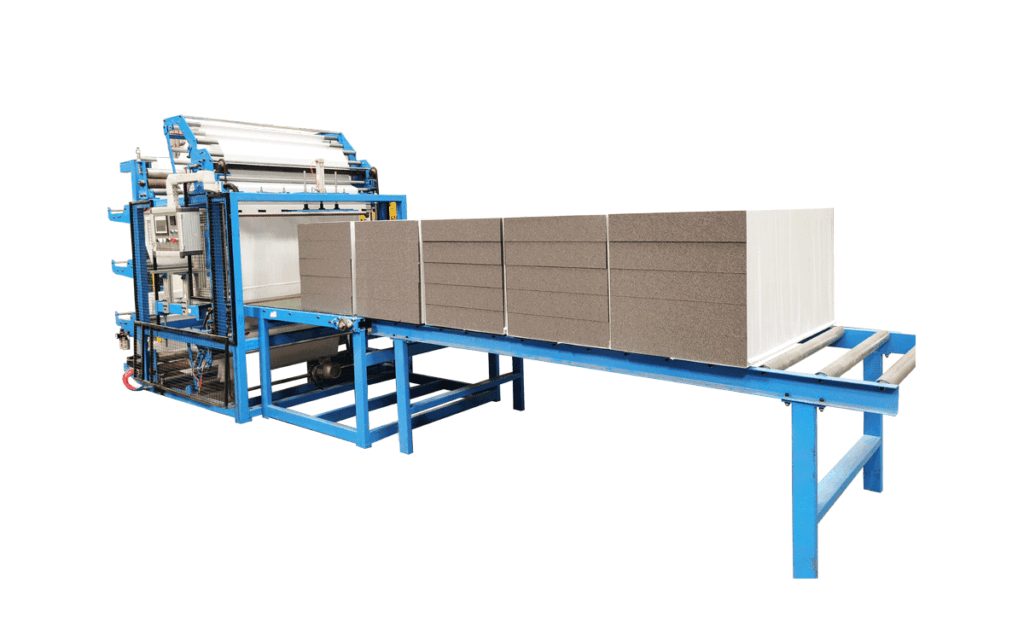
Film is the second-largest consumable on a packaging line after the bead itself, and on an eps packaging machine for block it is almost always the cost line nobody measures. Purchasing sees a film invoice per month. Production sees a roll that runs out at unpredictable intervals. Nobody sees the number that actually matters, which is grams of film per packed cubic metre of product.
Where the film actually goes
On a block packaging line, film is consumed by four different routes and only one of them is the pack itself. The obvious one is the wrap: film paid out around each block or bundle. The second is start-up, where the first packs after a roll change are wrapped loosely or double-wrapped while the operator finds the tension. The third is changeover, when the line stops mid-roll and the film path is re-threaded. The fourth is scrap packs that are rewrapped because the fold was wrong.
If you only count the wrap, you will conclude the machine uses what the datasheet says. If you weigh the rolls, you will usually find a gap of a few percent, and on a two-shift operation a few percent is a real number by the end of the year.
Gauge, wraps and the arithmetic that matters
Film cost per pack is thickness multiplied by area multiplied by price per kilogram. Thickness is the only term most buyers negotiate, which is why it is also the term that gets cut too far. A gauge that is too light saves material per square metre and loses it again in breakages, re-wraps and stopped lines. The useful test is not the cheapest film that survives a trial, but the lightest film that runs a full shift without a break.
| Parameter | SPLB-1200 block packaging | SPLM-CA20 / W800H600 shape wrapping |
|---|---|---|
| Throughput | approx. 8 packs/min | approx. 2 to 3 packs/min |
| PE film gauge | 0.03 mm | 0.02 mm |
| Typical pack | Block or bundle of blocks | Profile, sheet pack or special shape |
| Main cost driver | Wraps per pack multiplied by pack rate | Wrap length around the profile |
The two machines answer different questions. A block line is a rate problem: at roughly eight packs per minute, small savings per pack multiply quickly, and any stop costs film because the seal cycle has to restart. A shape wrapper is a geometry problem: the film length is set by the profile, so the lever is the wrap pattern and the overlap, not the speed.
Start-up, changeover and the waste you cannot see
Count the events, not the packs. How many roll changes per shift, how many product changeovers, how many times the line stops with film in the seal bars. Each of those events has a fixed film cost that has nothing to do with the product and everything to do with how the line is run.
Two changes usually pay for themselves within a month. Standardise roll core size and width so a roll change is a two-minute task instead of a ten-minute one, and put the changeover sequence on the machine so the operator does not improvise the film path. Improvised threading is where most creased and double-fed film comes from.
Storage matters more than it looks. Film stored on a cold floor or in direct sun behaves differently from film stored at room temperature, and a roll that has been standing on end for a month may not track straight. Keep rolls horizontal, off the concrete, and rotate stock so the oldest roll is used first. A wrap that suddenly starts wrinkling after a delivery is often a storage problem, not a machine setting.
Auditing consumption in five steps
- Weigh the rolls, do not read the invoice. Weigh before and after a known production run and divide by packs produced. That is your grams per pack.
- Count packs and stops separately. Log the pack count and every line stop in the same shift. Film per pack and film per hour tell different stories.
- Separate the four consumption routes. Wrap, start-up, changeover and re-wrap should each get a number before anyone negotiates a film price.
- Test one gauge change at a time. Drop from 0.03 mm to a lighter film on one product only, run a full shift, and count breakages rather than judging by feel.
- Recheck after any speed change. Running the machine faster shortens the seal window and is the most common reason a film that worked last quarter now breaks.
Mistakes that quietly raise film cost
- Buying on price per roll. Two rolls of the same weight at different gauges do not wrap the same number of packs. Price per kilogram is the only comparable figure.
- Over-tensioning to make packs look tight. It thins the film at the corners, which is exactly where it fails in transit.
- Ignoring the seal bar condition. A worn or contaminated bar forces longer dwell, and longer dwell at the same rate means slower running and more rejects.
- Letting each operator pick a wrap pattern. Two patterns on one machine means two film consumptions and no way to tell which one is cheaper.
- Assuming film is a fixed cost. On a block line at eight packs per minute, a single avoidable wrap per pack is a measurable share of annual film spend, and it hides inside the pack appearance.
Frequently Asked Questions
What film gauge should a block packaging line use?
The SPLB-1200 is built around 0.03 mm PE film. Lighter film can run, but check breakage rate across a full shift before changing, because a break costs far more than the film saved.
Why does the shape wrapper use thinner film?
The SPLM-CA20 / W800H600 wraps at 0.02 mm because the wrap follows a profile closely with a short path and moderate tension. There is less film span to resist, so a thinner gauge holds.
How much film should a pack consume?
There is no universal figure, because it depends on block size, wrap pattern and overlap. The working number is your own measured grams per pack from a weighed roll, compared against the same figure last quarter.
Does running faster reduce film cost per pack?
Only if the seal keeps up. Above a certain rate the seal window shortens, re-wraps appear, and film per packed unit goes up even though output looks better.
Can one machine handle both blocks and profiles?
Usually not well. The block line is built for rate and the shape wrapper for geometry. Forcing profiles through a block machine is a common source of both film waste and damaged product.
If you are costing a packaging line and want the film number built into the payback rather than added afterwards, contact our team with your block sizes and shift pattern. The block packaging machine and shape wrapping machine pages list the published rates, and the cutting line upstream sets the block tolerance the film has to cover.