
EPS Bead Expansion Ratio: How to Control It
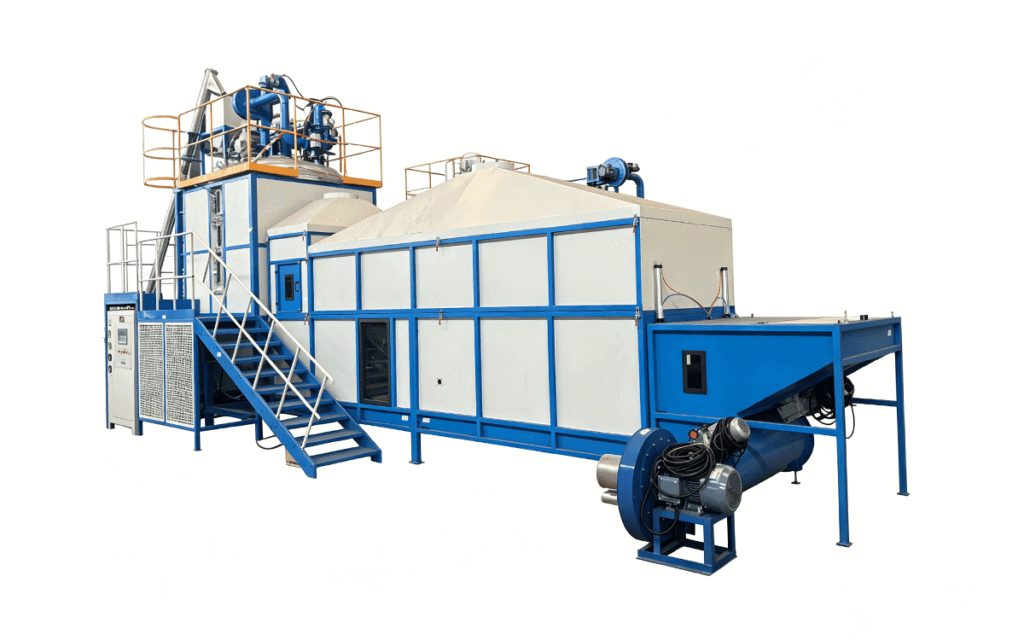
The expansion ratio is the quiet number behind every EPS block: how much volume a bead gains between leaving the bag and leaving the expansion chamber. When it drifts, block density drifts with it, and the drift shows up hours later as off-spec blocks, scrap cuts and arguments between production and sales. This guide explains what the ratio means on an eps pre-expander machine, how it connects to final density, and the controls that keep it stable.
What Expansion Ratio Actually Means
Raw expandable polystyrene bead contains a blowing agent inside a polymer structure that softens under steam. In the pre-expander, steam inflates each bead into a closed-cell sphere many times its raw volume. The ratio between raw volume and expanded volume is the expansion ratio, and it is not a fixed property of the bead: the same raw material can be expanded toward a light 15 kg/m3 block grade or toward denser 20-30 kg/m3 board grades simply by changing how far the process is allowed to run.
Two practical consequences follow. First, the ratio is set in the pre-expander and nowhere else: once beads leave the chamber, no downstream step can change their density. Second, the ratio is a distribution, not a single number. Individual beads in one batch expand differently, which is why both the average density and the bead-to-bead spread matter when you judge a run.
From Ratio to Density: Weighed Control
Modern continuous pre-expanders steer the ratio indirectly through density. The machine draws a sample of expanded beads, weighs it, and compares the measured density with the setpoint, then adjusts residence time and steam input until the sample lands in tolerance. On our SPJY series, weighed density control holds final density to approximately plus or minus 1.5 percent, tight enough that block molding and cutting see a consistent feed. Throughput scales with the target density: roughly 1600 kg/h of beads on the SPJY-1600G and 2200 kg/h on the SPJY-2000G at typical block grades.
| Model | Approx. throughput | Weighed density control |
|---|---|---|
| SPJY-1600G | approx. 1600 kg/h of beads | approx. +/-1.5 percent |
| SPJY-2000G | approx. 2200 kg/h of beads | approx. +/-1.5 percent |
The weighing loop is only as good as its sample. A sample drawn from a non-representative point, or a scale that has drifted out of calibration, will confidently steer the machine toward the wrong density. Calibrate against an independent balance on a fixed schedule and record the result.
Steam Quality: The Lever People Forget
Expansion ratio responds directly to steam condition. Wet steam carries water films that cool the bead surface and slow expansion, so the machine compensates with longer residence time and a wider density spread. Superheated steam behaves differently again and can drive surface cell rupture at high expansion targets. Dry, saturated, pressure-stable steam is the goal: a steam separator and good insulation close to the machine pay for themselves in density stability before they pay for themselves in energy savings.
Ageing: Where the Ratio Settles
Beads leave the chamber hot and slightly under internal pressure; as they cool, the cells contract and air diffuses back in during storage. This ageing happens in silos, and it finishes the job the pre-expander started. If ageing time is cut short, beads continue to shrink inside the silo or inside the block mold, so the measured block density lands heavier than the pre-expander reported. Treat silo residence time as part of the ratio control loop, not a storage afterthought: record silo entry time per batch and give each grade the residence it actually needs before molding.
The same control logic applies to other bead materials. An EPP pre-expander machine works the same weighed-density principle, and EPP grades usually demand stricter ageing discipline because the material remembers its processing history more strongly than EPS does.
A Five-Step Routine to Hold the Ratio
Work through this sequence whenever density drifts or a new grade starts:
- Fix the density setpoint for the grade you are running and lock it. Do not let operators nudge it to make the block feel right; that hides the real problem.
- Verify the weighing loop against an independent balance at the start of each grade change and after any mechanical work near the scale.
- Check steam condition at the machine inlet: dry, saturated, stable pressure. Log it next to the density readings so the two can be compared later.
- Record silo entry time and ageing duration per batch, and sample bead density again after ageing before the beads reach the mold.
- Compare final block density against the pre-expander reported density every week. A growing gap points to ageing or sampling problems rather than the machine itself.
Common Mistakes and Counter-Intuitive Points
- Chasing the lowest possible density. Below the bead stable range, the ratio spread widens and block strength collapses; the cheap bead becomes expensive scrap.
- Judging the ratio from one hand sample. The distribution matters. A good average with a wide spread still makes bad blocks.
- Blaming the pre-expander for density drift that actually started with wet steam or short ageing.
- Skipping scale calibration after cleaning or maintenance, then trusting the numbers the very next morning.
- Assuming throughput is constant. Heavier density targets reduce hourly output on the same machine, so planning capacity on best-case numbers quietly starves the molding line.
Frequently Asked Questions
Is expansion ratio the same thing as density?
They are two views of one result. The ratio describes volume growth per bead; density is what you actually measure on a weighed sample of the batch. Density is the practical control variable on the machine floor, which is why modern pre-expanders steer it directly.
Why does my block weigh more than the pre-expander reported?
Almost always ageing. Beads that enter the block mold before they have finished stabilizing shrink further inside the mold and after demolding, raising final block density above the reported bead density.
Can one machine run both light block grades and dense board grades?
Yes, within the machine working range. Expect throughput to fall at heavier targets and give the operator time to stabilize after a grade change before judging quality.
How does steam pressure stability affect the ratio?
Pressure swings change the energy delivered per unit time, and the control loop reacts late. A stable header pressure close to the machine tightens the density spread more than most process tweaks inside the machine.
What should I record to diagnose ratio problems?
Density setpoint, weighed sample results, steam pressure at the machine inlet, silo entry and exit times, and final block density. The five numbers together isolate whether the drift was born in the machine, in the steam, or in the ageing.
If density drift is costing you blocks, review the whole chain from steam to silo rather than the machine alone. Our team can help you match an eps pre-expander machine and an eps silo system to the grades you actually sell. Contact us to talk through your density targets.