
Hot Wire Cutting Polystyrene (EPS): How It Works, Tools & Best Practices
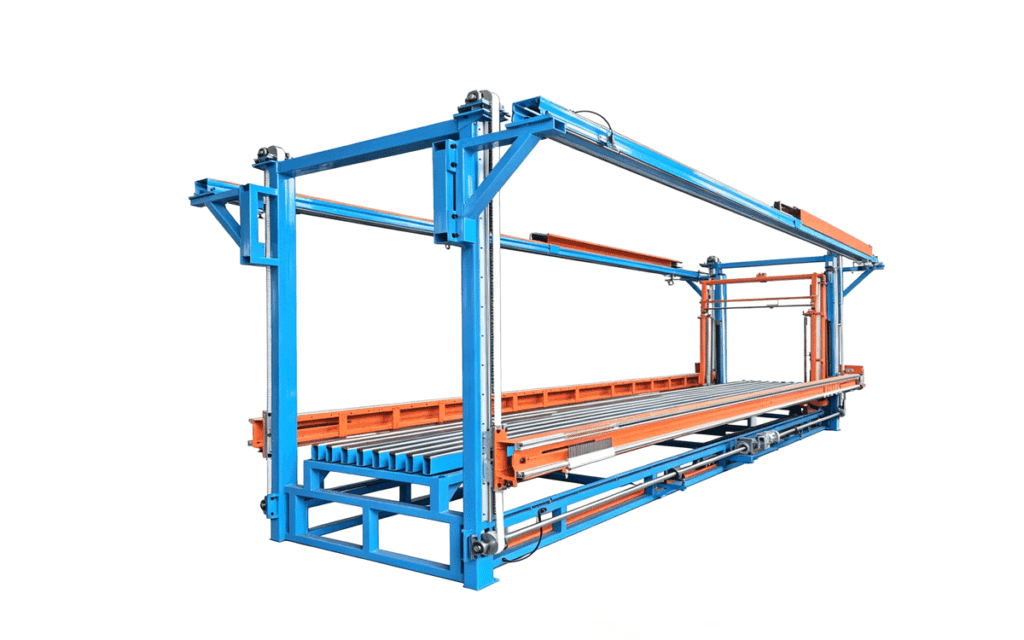
Hot wire cutting is the fastest, cleanest way to shape expanded polystyrene (EPS) foam, styrofoam, and many other lightweight plastic foams. Whether you are a packaging engineer trimming a protective insert, a sign maker cutting letters, or a factory producing insulated panels by the thousand, a heated wire does in seconds what a knife or saw cannot — a smooth, sealed edge with almost no dust.
This guide explains how hot wire cutting works, which materials it handles, the different machines available, and how to choose the right setup for your production.
What Is Hot Wire Cutting?
Hot wire cutting (also called thermal wire cutting) uses a thin, taut resistance wire — usually nichrome (a nickel-chromium alloy) — heated to a few hundred degrees Celsius by an electric current. When the glowing wire touches polystyrene foam, the heat melts the material along a precise path, leaving a clean cut edge. Because the wire is so thin, the kerf (material lost to the cut) is minimal, and the melted edge self-seals, which actually reduces loose beads and airborne dust.
In German-speaking markets this method is widely used and referred to as „Schaumstoff mit heißem Draht schneiden“ (cutting foam with a hot wire). The principle is identical regardless of language or region.
How Does a Hot Wire Cutter Work?
The core components are simple:
- A nichrome wire stretched between two points under tension.
- A low-voltage transformer / power supply that passes current through the wire.
- A temperature or current control so the operator can match the heat to the foam type and thickness.
- A frame or guide system — from a simple handheld bow to a CNC gantry — that keeps the wire straight and the cut accurate.
As current flows, the wire heats up through electrical resistance. The operator moves the foam against the wire (or the wire across the foam). The heat locally melts the polymer; the foam parts with a smooth, slightly fused edge. No blades to sharpen, no dust from grinding.
Which Materials Can Be Cut?
Hot wire cutting works best on thermoplastic foams that melt rather than tear:
- EPS (expanded polystyrene) — the most common, used in packaging, insulation and construction.
- XPS (extruded polystyrene) — denser, also cuts cleanly.
- EPP and EPE — workable with the right temperature.
- General polystyrene sheet and styrofoam.
It is not suitable for materials that do not melt cleanly, such as metals, wood or dense engineering plastics — those need different tools.
Types of Hot Wire Cutting Machines
1. Handheld Hot Wire Cutter / Bow Cutter
A small bow-shaped tool with a short wire, ideal for crafts, prototypes and occasional trimming. Portable and inexpensive, but limited in size and repeatability.
2. Table / Sliding-Table Cutter
A fixed wire with a sliding table or fence lets you make straight, repeatable cuts on sheets and blocks. Common in packaging workshops for cutting insulation boards and protective inserts.
3. Oscillating / Multi-Wire Block Cutter
For production, a block cutter holds many parallel wires and can oscillate them to slice a whole EPS block into sheets of a set thickness in a single pass. This is the workhorse of EPS sheet production.
4. CNC Hot Wire Cutting Machine
A CNC (computer numerical control) system moves the wire — often on two or four axes — along a path programmed from a CAD drawing, producing complex 2D and 3D shapes: letters, architectural models, custom packaging, vehicle interiors. Precision is high and labor is low once the program is set.
How to Cut Polystyrene with a Hot Wire — Step by Step
- Set the right temperature. Start low and raise gradually until the foam cuts smoothly without dragging. Too hot scorches; too cool tears.
- Support the foam. Use a flat surface or table so the piece does not flex into the wire.
- Move steadily. Let the heat do the work — a slow, even pass gives the cleanest edge.
- Match the tool to the shape. Curves need a bow cutter or a CNC path; straight sheets need a guided fence.
- Finishing. Most cuts need no sanding. For an even smoother face, a light scrape or a second hot-knife pass is enough.
Safety: Ventilation and Breathing Protection
Melting polystyrene releases fumes. Always cut in a ventilated area, and for extended or enclosed work wear a particulate mask. Keep the wire away from flammable materials, and never leave a powered cutter unattended. Good ventilation keeps the workspace clear and the operator comfortable.
Choosing the Right Hot Wire Cutting Machine
Your choice depends on volume, shape complexity and material size:
- Occasional, simple shapes → a handheld bow cutter.
- Straight sheets and boards in volume → a sliding-table or oscillating block cutter.
- Complex, repeatable 3D shapes → a CNC hot wire cutting machine.
- Full production lines (pre-expander → moulding → cutting → recycling) → integrate a cutting line into the workflow.
For industrial EPS sheet and block cutting, our EPS Cutting Line combines automatic wire setting, oscillation cutting and scrap recycling in one line. If your work needs precise custom profiles from CAD, the EPS CNC Cutting Machine turns drawings into accurate 3D foam shapes. And the EPS Cutting Machine covers general-purpose hot wire cutting for factories and workshops.
For a complete overview of our machinery, visit the Products page, or contact our team for a recommendation based on your foam type, thickness and output.
Frequently Asked Questions
Q: Can you cut foam with a hot wire?
Yes. Hot wire cutting is the standard method for EPS, XPS and similar foams — faster and cleaner than knives or saws.
Q: What temperature does the wire reach?
Typically a few hundred degrees Celsius — enough to melt polystyrene locally without burning the surrounding material when used correctly.
Q: Is hot wire cutting safe?
Yes, with basic precautions: ventilation, a mask for long sessions, and keeping the hot wire away from flammables.
Q: What is the difference between a hot wire cutter and a CNC foam cutter?
A hot wire cutter is the cutting method; a CNC foam cutter is a machine that automates that method with computer-controlled movement for complex, repeatable shapes.
Conclusion
Hot wire cutting is the most efficient way to shape EPS and polystyrene foam — clean edges, minimal waste, and scalable from a craft bow to a fully automated production line. If you are evaluating equipment for your factory or workshop, our team can help you match the right machine to your production. Reach out through our contact page for a tailored recommendation.