
How an EPS Pre-Expander Works: Bead Expansion and Density Control
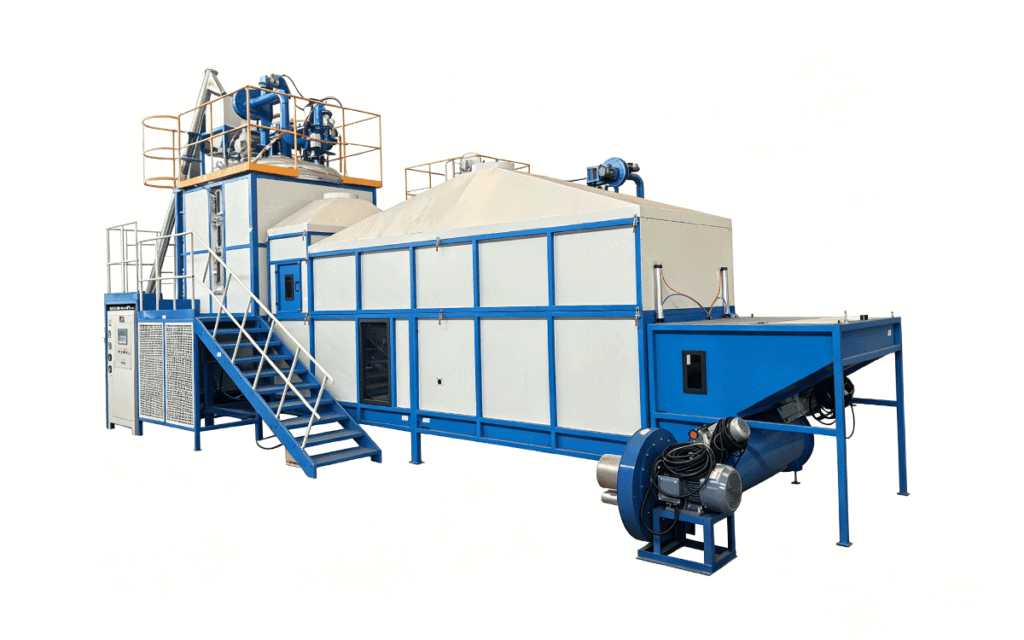
In every EPS production line, the pre-expander is the first machine that turns raw polystyrene resin into the light, closed-cell beads everyone recognizes as “Styrofoam” feedstock. If you are specifying equipment for a new plant or upgrading an older line, understanding how an EPS pre-expander machine actually works — and how it controls density — is the difference between stable block quality and a line that produces endless rejects.
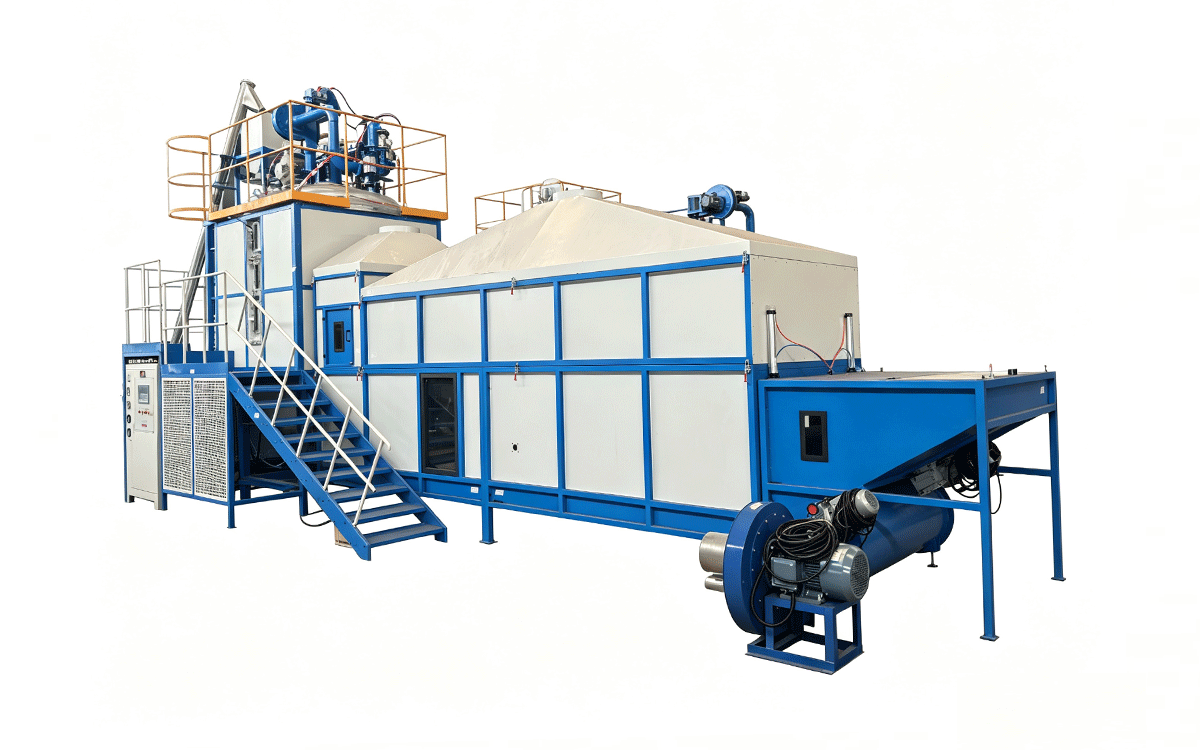
What an EPS Pre-Expander Actually Does
An EPS pre-expander takes solid polystyrene (PS) beads, each impregnated during polymerization with a blowing agent (traditionally pentane). Inside a pressurized steam chamber, the beads are heated so the blowing agent expands, softening the polymer and inflating each bead 20 to 50 times its original volume. The result is the familiar white, feather-light expanded bead with a target bulk density, usually measured in kilograms per cubic metre.
This step is decisive. Every downstream process — block molding, shape molding and cutting — depends on beads arriving at a consistent density. A pre-expander that cannot hold its density window forces the block molding machine to compensate, and that compensation shows up as dimensional drift, weight variance and weak fusion between beads.
The Expansion Process, Step by Step
The physics is simple; the control is where the engineering lives. A typical cycle looks like this:
- Feeding — weighed raw beads drop into the expansion chamber through a rotary feeder that meters a consistent charge.
- Steam heating — low-pressure steam infiltrates the chamber; heat softens the PS and vaporizes the pentane, expanding the bead from the inside out.
- Dwell — the beads rest in the steam atmosphere long enough to reach the target density rather than simply “as big as possible”.
- Cooling and discharge — expanded beads are blown out with air and cooled so they solidify at the new volume without collapsing.
- Maturation — outside the machine, the beads sit for several hours so internal pressure equalizes before they enter the molding press.
The chamber diameter governs how much bead mass the machine can handle per cycle, which is why it is the headline number on any spec sheet. A larger chamber holds more beads and sustains a higher hourly output.
Why Density Tolerance Is the Real Quality Gate
A good pre-expander holds density within ±1.5% across a batch. That tolerance matters because molding windows are narrow: too dense and the block is heavy and costly to make; too light and fusion fails, producing crumbly, low-strength blocks. YouXin pre-expanders hold this window through a closed-loop steam and level control system rather than relying on operator judgement alone, which is what keeps a downstream EPS block molding machine running in specification.
Density also drives cost directly. Because expanded bead is sold by volume but priced against raw resin by weight, a 1 kg/m³ drift across thousands of cubic metres of annual output is a measurable amount of money leaving the plant.
Typical Specifications
The table below shows the current model range for YouXin continuous pre-expanders. Figures are current model ranges and depend on configuration, bead grade and the density target you set; always confirm the exact output for your required density with the engineering team before ordering.
| Model | Chamber Diameter | Chamber Height | Density Tolerance | Output (@15 kg/m³) |
|---|---|---|---|---|
| SPJY-1600G | 1600 mm | 2500 mm | ±1.5% | 1600–1800 kg/h |
| SPJY-2000G | 2000 mm | 2000 mm | ±1.5% | 2000–2200 kg/h |
Both models share the same ±1.5% density tolerance. The 1600 mm chamber is the workhorse for lines up to roughly 1800 kg/h at 15 kg/m³, while the 2000 mm chamber is the choice when throughput or a higher density target pushes demand past that point.
How to Choose an EPS Pre-Expander in 5 Steps
- Define your target density band and daily throughput. Know the densities your block and shape products require and the volume you must hit per shift.
- Match chamber diameter to throughput. A 1600 mm chamber covers roughly 1600–1800 kg/h at 15 kg/m³; a 2000 mm chamber reaches 2000–2200 kg/h. Size for your real density, not the brochure’s lightest case.
- Confirm steam and air supply capacity. The plant boiler and accumulator must deliver steady low-pressure steam without pressure sag during peak demand.
- Check the density-control method. Closed-loop control beats manual adjustment for holding ±1.5% across a full shift.
- Verify maturation silo capacity and certification. Enough silo volume lets beads stabilize, and CE-compliant builds simplify export.
Common Mistakes When Sizing a Pre-Expander
The most common trap is reading the quoted capacity and assuming it applies at your density. Manufacturers quote output at the lowest practical density (15 kg/m³). If you actually run at 20 or 25 kg/m³, real output is materially lower because denser beads need more steam time per kilogram. Size for your actual density, not the brochure’s best case.
A second mistake is ignoring maturation silo capacity. Without enough silo volume, beads go to molding before they stabilize and density drifts hour to hour. A third is treating density tolerance as a nice-to-have; ±1.5% is what keeps the whole line in spec. A fourth is forgetting waste handling — trimmings and rejects are recovered with a dedicated EPS recycling machine instead of being landfilled.
Frequently Asked Questions
What steam pressure does a pre-expander need?
Typically low-pressure steam around 0.2–0.4 MPa, supplied continuously. Size the boiler and steam accumulator so pressure does not sag when several machines draw at once.
Can one pre-expander feed both block and shape molding?
Yes. The expanded bead is a common feedstock for both the block molding machine and shape molding presses, provided the density is matched to each process.
How long do expanded beads need to mature?
Usually several hours at ambient temperature in a vented silo so internal pressure equalizes. Rushing this step causes post-mold shrinkage and dimensional variance.
Does the machine carry CE certification for export?
YouXin equipment is built to CE requirements and has been exported to more than 50 countries; confirm the specific certification for your destination market when you order.
What happens to expansion and molding waste?
Off-cuts, rejects and used protective packaging can be recovered with a dedicated EPS recycling machine rather than discarded, recovering much of the material cost.
Conclusion
A pre-expander is a deceptively simple machine with a tight quality job. Get density control right and the rest of the line runs smoothly; get it wrong and every downstream machine pays for it. To discuss chamber sizes, steam requirements and a complete line layout, contact our engineering team for a specification sheet and a quote.