
How to Choose an EPS CNC Cutting Machine
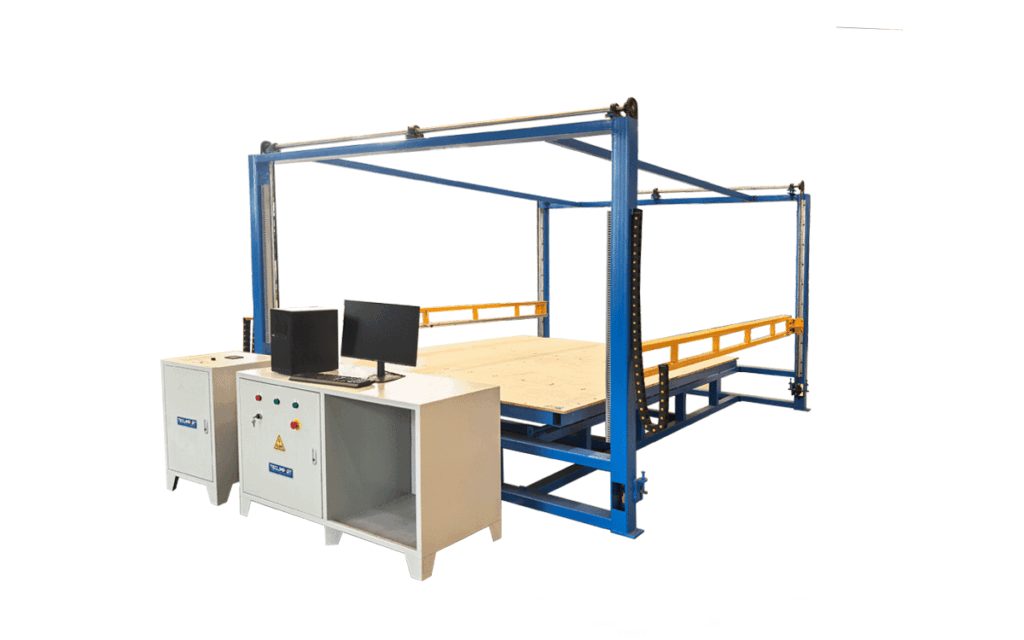
An eps cnc cutting machine is bought for the jobs a straight cutting line cannot do: profiles, radii, moulds for tooling, architectural shapes and one-off parts where drawing a part twice by hand costs more than cutting it once under program control. The purchase decision is rarely about whether the machine cuts. It is about whether the working envelope, the toolpath and the file flow match the work you actually quote.
Start with the envelope, not the price
The envelope is the single specification that cannot be changed later. Our CNC machine works on a 3000 x 2400 x 1200 mm platform, which sets the largest part you can cut in one setup and, just as importantly, how you fixture a block that is smaller than the table. Buyers routinely compare table size and skip the question of whether the parts they quote fit with clearance for the tool and the clamping.
Work backwards from your order book. Take the three largest parts you quoted last year, add the clamping allowance, and check them against the envelope. If they only fit diagonally, they do not fit.
Toolpath, tolerance and what the machine can hold
Two machines with the same envelope can hold very different tolerances, because tolerance on foam is a function of feed rate, wire or tool condition, and how rigidly the block is held. Feed rate is where the honest comparison happens: our machine runs at 0.3 to 0.6 m/min, which is contour speed, not the speed of a straight-line block cutter.
| Item | EPS CNC cutting machine | EPS cutting line (SPQ series) |
|---|---|---|
| Working envelope | 3000 x 2400 x 1200 mm platform | Block length 2000 to 6000 mm |
| Cutting speed | 0.3 to 0.6 m/min | approx. 1.8 to 2.0 m/min at 15 kg/m3 |
| Installed power | 11 kW | Varies with line configuration |
| Typical job | Profiles, radii, tooling, architectural shapes | Straight cuts, sheets, blocks to size |
Read that table as a division of labour, not a ranking. A cutting line will produce far more square metres per hour because every cut is a straight pass. A CNC machine produces the one part the line cannot, and it holds the shape while doing it. Shops that buy CNC to replace a cutting line usually end up running both.
Software and file flow decide the real cost
The machine is the cheap half of the decision. What you feed it is where the hours go. Ask three questions before signing: which file formats the controller accepts natively, whether the CAM step happens in the office or at the machine, and who converts a customer drawing into a toolpath when the customer sends a PDF.
If the answer is that the operator redraws parts at the machine, you have bought a plotter with extra steps. The economics only work when a quote can become a toolpath in the office and the operator’s job is loading, zeroing and cutting.
Also check the density range you will run. Light foam cuts faster and deflects more under tool pressure; blocks at 20 to 30 kg/m3 need a slower pass and a firmer hold. A machine that is fast on 15 kg/m3 sample foam may need to halve its feed on the dense work that actually pays.
Maintenance is a selection criterion
Ask what wears and how often. On a contour machine the consumables are the cutting element and the guides that keep it tracking, and the wear rate depends on density and on how much dust the block carries. A machine whose consumables are standard and locally available runs for years. A machine whose wear parts are proprietary and shipped from one factory stops the whole cell when a shipment is late.
Spare parts and support belong in the comparison table next to the envelope and the feed rate, because a machine that is 10 percent cheaper and needs two weeks for a guide block is the more expensive machine over a five-year hold.
Five-step selection checklist
- List your parts, not your ambitions. Take the last twelve months of orders and find the largest, the smallest and the most complex. Those three set the envelope and the toolpath requirements.
- Confirm the envelope with clamping clearance. A part that fits the table but not the fixture does not fit.
- Test the tolerance on your own density. Send sample blocks at the density you sell, not laboratory foam, and measure the parts that come back.
- Map the file flow end to end. Customer file to office CAM to controller to finished part. Count the manual steps; each one is a recurring cost.
- Price the floor space and the operator. A CNC cell needs clearance around the table and someone who can read a toolpath. Both are part of the capital cost.
Mistakes we see in CNC purchases
- Buying the biggest table available. A large envelope with a slow feed turns small parts into expensive ones. Size to your work.
- Comparing only cutting speed. Contour speed at 0.3 to 0.6 m/min is normal for shape work. What matters is the speed at which the tolerance still holds.
- Assuming software is included in the workflow. The CAM seat, the post-processor and the person who runs them are a separate budget line.
- Forgetting the block quality upstream. A CNC machine cannot cut a square part from a bowed block. If your blocks come off the moulding line out of square, fix that first.
- Ignoring the offcut. Profile cutting generates far more offcut than straight cutting, and offcut handling becomes a real cost per part once volume builds.
Frequently Asked Questions
What is the working envelope of your CNC machine?
The platform is 3000 x 2400 x 1200 mm. That is the cutting volume before clamping allowance, so the practical part size is slightly smaller in each direction.
How fast does it cut?
0.3 to 0.6 m/min, with 11 kW installed. Actual feed depends on density and on the tolerance the part requires; dense blocks run at the lower end.
Can it replace a cutting line?
Not for volume. A CNC machine is for shapes the line cannot produce. Most shops run a cutting line for square work and a CNC machine for profiles.
Which parts suit it best?
Tooling and moulds, architectural profiles, packaging inserts, prototypes and repeat parts with a drawing. Anything that would otherwise be hand-cut twice.
Do I need CAM software?
You need a way to turn a drawing into a toolpath. Whether that sits on a PC in the office or in the controller, the workflow has to exist before the machine is useful.
If you are weighing a CNC cell against a cutting line, contact our team with your part list and densities. The CNC cutting machine page carries the platform figures, and the cutting line and cutting machine pages show what the straight-cut alternative does per hour.