
How to Choose an EPS Pre-Expander: Capacity, Density Control and Steam
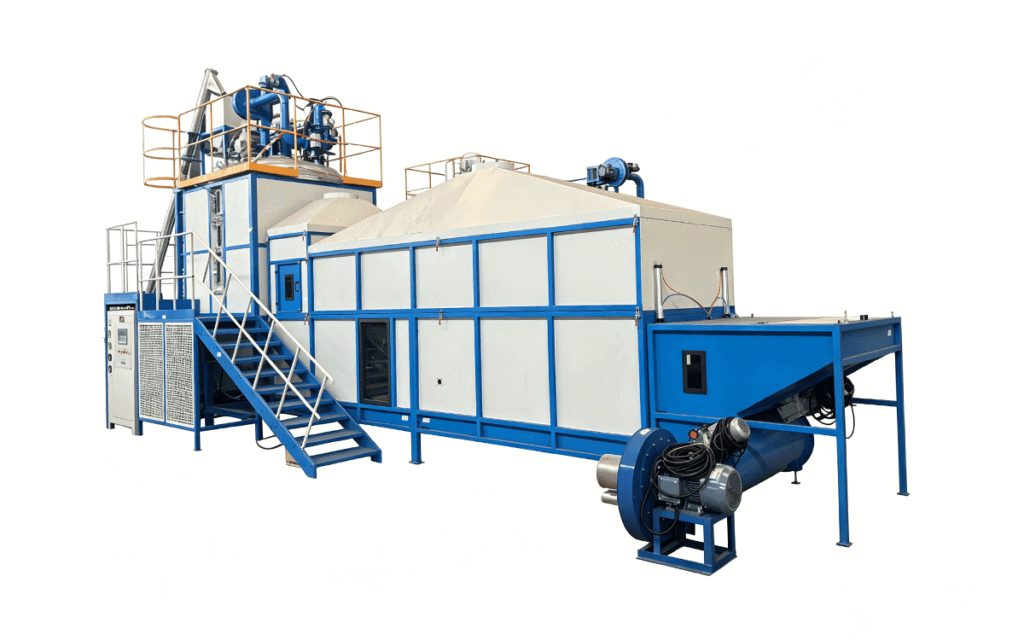
An EPS pre-expander machine sets the density of every bead that flows downstream, so choosing the wrong one quietly degrades every block you ever mould. It is the first real machine in the line, and the only one whose output the rest of the plant cannot fix later. This guide walks through the three numbers that decide the right pre-expander, then a selection checklist and the mistakes that show up months later as out-of-spec blocks or rejected shipments. Read it before you compare catalogue numbers, because the catalogue number is the last thing that should decide the purchase.
What the pre-expander actually does
Raw EPS bead is steamed so it expands to a target bulk density, then rested so internal pressure equalises. The expansion ratio is what defines your final product: low density for packaging and insulation, higher density for structural and shape parts. The machine’s job is to hit that density repeatedly, not just once on a sample. Consistency, not a single good batch, is the product. A pre-expander that drifts by a few percent between morning and afternoon is a machine that is quietly costing you rejected blocks, and nobody on the floor will trace the bad block back to the pre-expander because the block looked fine when it left the mould.
Number 1 — target density range
Know the density window you must hold. A pre-expander sized only for 15 kg/m3 packaging bead will struggle if you later need 25–30 kg/m3 for insulation board or shape parts. Pick a unit whose stable control band covers your real range plus a margin, and confirm the density valve and weighing system can hold it. Density drift here is the single most common cause of block-quality complaints later, because by the time the block is cut and shipped the bead has already been fused at the wrong number and the cause is three machines upstream. Write down your minimum and maximum density now; do not let the supplier guess it from one product you happen to mention.
Number 2 — hourly bead output
Size the pre-expander to feed your moulders, not to a catalogue maximum. Block moulding machines in the SPB-2000 to SPB-6000 range run about 12–15 blocks/hour at 15 kg/m3; that dictates how much expanded bead you need per hour. Match the pre-expander’s steady output to that demand, and let an EPS silo system buffer the difference so a brief pre-expander stop does not starve moulding. Catalogue maxima are peak numbers you will not hold at sixteen hours a day, so size to steady output with headroom. A common failure is buying to the peak line on the brochure and then discovering the real steady number leaves the moulders waiting every afternoon.
| Model range | Bead output | Typical density tolerance | Typical use |
|---|---|---|---|
| SPJY-1600G | ~1600 kg/h bead | ±1.5% (weighed) | Standard block + shape feed |
| SPJY-2000G | ~2200 kg/h bead | ±1.5% (weighed) | High-volume block lines |
Number 3 — density control method
Cheap units guess density by level; better units weigh the batch. Weighed control (the SPJY units use density weighing) is what holds ±1.5% run to run. If your product is sold on density spec, this is not optional — it is the difference between a repeatable block and a lottery. The control loop is only as good as the steam it receives, so the steam side matters as much as the scale, and a good scale on bad steam still drifts.
Steam quality is half the machine
Fusion energy comes from dry saturated steam, not a wet mix of steam and water. Wet steam carries water into the bead bed, cools it locally and scatters density. Size the boiler and traps so the pre-expander sees dry steam at a stable pressure; a sticky trap or an undersized line will undo even a good weighing system. Operators often blame the machine when the real fault is steam dryness, and the fix is a trap, not a new pre-expander. Treat steam dryness as a spec item, not an afterthought.
A 5-step selection checklist
- List your real density window (minimum and maximum you must hold across the year, including seasonal changes in raw bead).
- Add up required expanded-bead kg/h from your moulder throughput, not a single peak hour.
- Pick a model whose steady output covers that, with 10–20% headroom for growth and for the day a moulder runs long.
- Confirm weighed density control and a serviceable, dry steam system with accessible traps.
- Plan the silo buffer so the two processes stay decoupled and bead ages properly before moulding.
Common mistakes
- Buying to peak, not steady, output. Catalogue maxima are not what you run at sixteen hours a day, and you will undersize the line.
- Ignoring steam quality. Wet steam cools the bed and scatters density; dry saturated steam is the whole game.
- No ageing buffer. Bead that is moulded before it rests shrinks after — size the silo for residence time, not just storage.
- Skipping recycling integration. Offcut recovery can feed a percentage of bead back; a recycling machine closes the loop and lowers raw cost.
- Choosing by price alone. The capital gap between level and weighed control is small next to the rejected-block cost it avoids over a year.
Frequently Asked Questions
Can one pre-expander serve both block and shape lines?
Yes, if it holds your full density window. Shape parts often need tighter, sometimes higher density than block, so confirm the control band before mixing the two feeds on one machine, or plan a second silo compartment.
How much silo capacity do I need?
Enough for at least one shift of expanded bead at your peak moulder demand, so a pre-expander stop never stops moulding and the bead ages properly. Size for residence time, not just storage.
Does density tolerance really matter downstream?
It decides block weight, fusion and surface finish. A ±1.5% weighed system pays for itself in rejected-block reduction alone, before you count customer complaints and returned loads.
Is dry steam worth the effort?
Absolutely. Most “pre-expander drift” calls are actually wet-steam calls. Dry, stable steam is the cheapest quality upgrade on the line, and it protects the weighing system’s work.
Should I size for future growth?
Yes, with 10–20% headroom, but do not buy a machine you will not fill for years. Headroom covers a long moulder day; a hugely oversized unit runs inefficiently at your real load.
Next step
Send us your density window and hourly bead demand and we will size the pre-expander and silo together. Talk to our team for a configuration that matches your real line, not a catalogue number.