
How to Size an EPS Cutting Line: Capacity, Density and Throughput
Why sizing matters before you buy
An EPS cutting line is only as good as the match between its envelope and your real daily output. Oversize it and you pay for idle capacity; undersize it and the cutter becomes the bottleneck that backs up your whole block line. This guide walks through the four inputs that decide the right machine, then a capacity check you can run on the back of an envelope.
Step 1 — Know your block dimensions
The cutting envelope is fixed by the largest block you will feed. YouXin EPS cutting lines in the SPQ-2000B to SPQ-6000B range handle block lengths from 2,000 mm to 6,000 mm. If your block moulding machine outputs 4,000 mm blocks, sizing the cutter for 2,000 mm forces you to cut blocks in half first — wasted handling. Match the cutter length to your moulded block length, not to a nominal catalogue number.
Step 2 — Bead density sets the cut speed
Cutting speed is quoted at a reference density (typically 15 kg/m3). Lower-density bead cuts faster; high-density board slows the wire. The SPQ series runs about 1.8–2.0 m/min at 15 kg/m3. If most of your work is 20–30 kg/m3 insulation board, budget closer to the low end and confirm with a sample cut on your real density — see our density and cutting-speed FAQ.
| Model | Block length | Cut speed @15 kg/m3 | Typical use |
|---|---|---|---|
| SPQ-2000B | 2,000 mm | 1.8–2.0 m/min | Small-shape, sample runs |
| SPQ-4000B | 4,000 mm | 1.8–2.0 m/min | Standard block + shape split |
| SPQ-6000B | 6,000 mm | 1.8–2.0 m/min | Long board, high-volume lines |
Step 3 — Convert daily throughput to wire time
Count the metres of cut you need per day, not the number of blocks. A 4,000 mm block sawn into 20 mm boards is 200 cuts x 4 m = 800 metres of travel per block. At 2 m/min that is 400 minutes — almost a full shift for one block. If you process ten such blocks a day, a single-wire line cannot keep up and you need a multi-wire or oscillating configuration, or a second EPS cutting machine for the shape work.
Step 4 — Hot-wire vs CNC by cut type
Straight board slicing is a hot-wire job. Contours, letters and 3-D shape parts need a CNC cutting machine. Many plants run both: a cutting line for board volume and a CNC for shape. Trying to push complex 3-D work through a plain cutting line is the most common capacity mistake we see.
Step 5 — Leave automation headroom
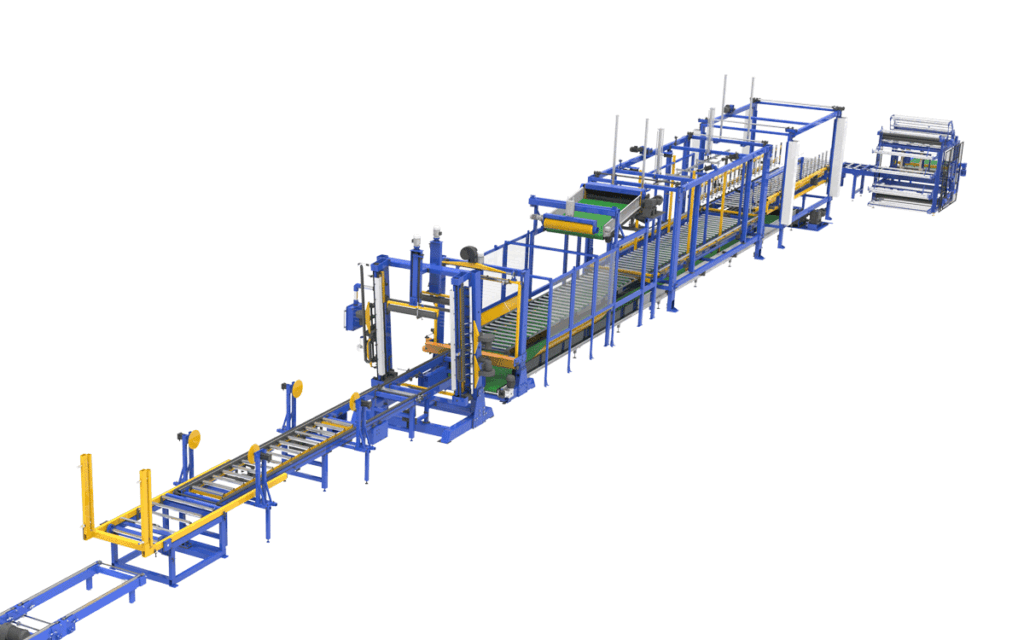
If you will add a conveyor, automatic stacking or a recycling step later, size the line so those bolt on without re-buying the frame. A cutting line is a 10-year asset; buy the envelope one step ahead of today’s volume.
Common sizing mistakes
- Quoting speed at 15 kg/m3 then running 25 kg/m3 board — real output drops ~30%.
- Matching cutter length to catalogue, not to your moulded block — hidden handling cost.
- Counting blocks, not metres of cut — understates wire time by 10x.
- Using a plain line for 3-D shape work — accuracy and throughput both fail.
Frequently asked questions
Can one cutting line do board and shape?
Board yes; precise 3-D shape no. Add a CNC for contours and keep the line on volume board work.
How much floor space does a 6,000 mm line need?
Budget for the block length plus infeed/outfeed clearance — roughly 8–9 m overall, plus stack space.
Do I need a densifier from day one?
Not for capacity, but offcuts add up; a recycling step pays back fast on a busy line.
Get a sized proposal
Tell us your block dimensions, typical density and daily volume and we will size the EPS cutting line to your real numbers — contact our engineering team.