
EPS Pre-Expander Machine Maintenance & Common Faults (Keep Density on Target)
Why maintenance is a density issue
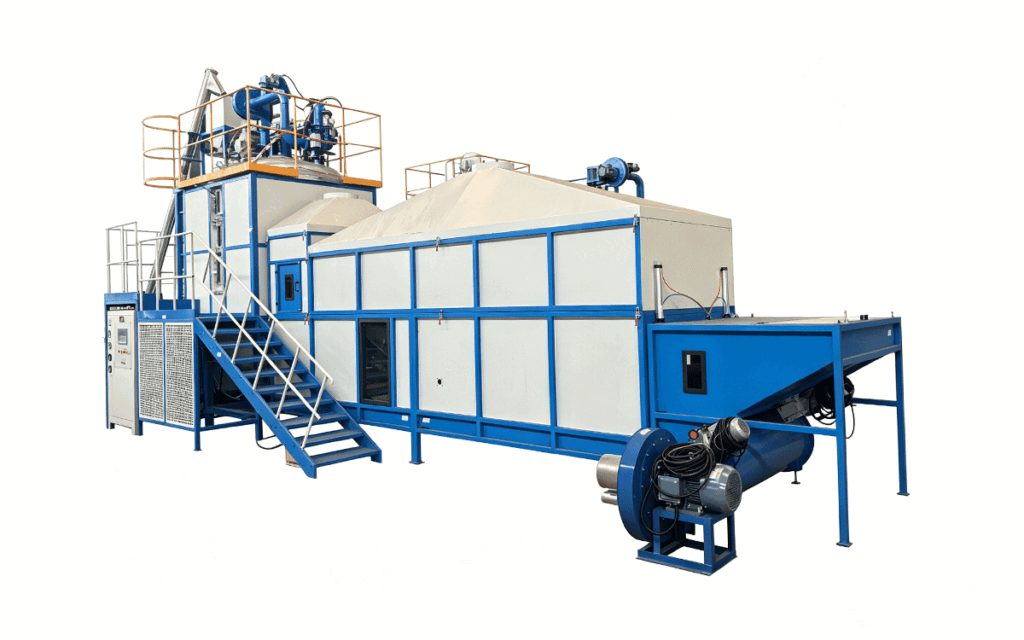
An EPS pre-expander machine lives or dies by density consistency. Most “faults” are really small drifts — a sticky steam valve, a clogged fluid bed, a mis-levelled barrel — that quietly push your bead off spec and wreck downstream block quality. A short, regular maintenance routine keeps density where you set it.
The routine checklist
- Steam system. Check traps, regulators and the density-control valve for sticking or scaling. Steam is the energy that expands the bead; any inconsistency shows up as density scatter.
- Fluidised bed. Keep the bed plate and air distribution clear so bead fluidises evenly. Blockages cause dead zones and uneven expansion.
- Level and calibration. Verify the level sensor and weighing (the SPJY units use density weighting); a drift here means every batch is slightly wrong.
- Dryer and ducts. Clear the drying section and ducts so moisture and fines do not recirculate and coat the machine.
Common faults and quick fixes
| Fault | Likely cause | Fix |
|---|---|---|
| Density drifting high | Steam pressure low / valve sticking | Check regulator, free the density valve, verify steam supply |
| Uneven bead (lumps) | Fluid bed blocked / air uneven | Clean bed plate, balance air distribution |
| Low output | Clogged dryer / undersized steam | Clear ducts, confirm steam capacity at target density |
| Poor ageing later | Bead not rested in silo | Size buffer for residence time, not just storage |
Mistakes that shorten machine life
- Running to failure. A sticky valve ignored becomes a scorched batch and a shut line.
- Skipping calibration. The weighing/density loop is what holds ±1.5%; let it drift and you lose the tolerance.
- No spare steam path. When steam is the bottleneck, a backup regulator keeps you running.
Frequently Asked Questions
How often should I calibrate density?
Verify the weighing/density loop at every changeover and spot-check during long runs; treat drift over ±1.5% as a fault, not noise.
Why does output drop at low density?
Lower density needs more steam per kilogram and longer fluidising; output quoted at 15 kg/m3 falls as you go lighter — confirm at your worst case.
Do I need a silo for maintenance?
A silo lets you batch pre-expand and still feed moulders during a pre-expander service stop.
What feeds the pre-expander upstream?
Raw bead in; the pre-expander is the first step before block molding.
Next step
Consistent density is the cheapest output gain available. Tell us your model and target densities and we will send a maintenance schedule matched to your pre-expander and silo setup — contact our team.