
Pentane in EPS Production: Ventilation and Plant Safety
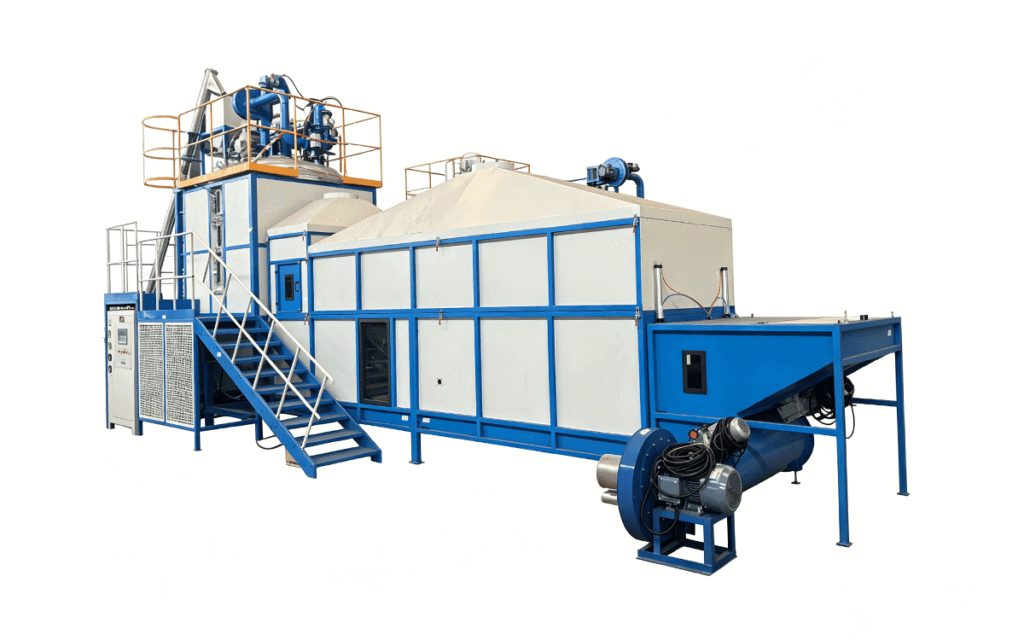
Pentane is the blowing agent carried inside expandable polystyrene beads, and it does not disappear the moment the beads leave the bag. If you operate an eps pre-expander machine, you are handling a material that releases a flammable vapour at several points between the raw bead silo and the finished block. This guide is not a regulatory summary; it is a practical engineering note on where that vapour appears, why ventilation and zoning decide how safely a plant runs, and what a shift-level inspection checklist should cover. Any exposure limits, classifications and legal duties come from your local authority and your safety data sheet, not from an equipment article.
Where pentane actually is in the process
Start with the raw material. Expandable beads arrive containing pentane dissolved in the polymer. While they sit in bags or a feed hopper, a small amount of vapour is always present in the headspace, which is why storage areas are never treated as ordinary dry stores. The first big release comes at pre-expansion: steam heats the beads, the pentane boils, the beads expand, and the vapour-laden air has to go somewhere. An eps pre-expander machine is therefore a point source, and the ducting over and around it matters more than the general room ventilation.
The next stage is often underestimated. Freshly expanded beads are conveyed to maturation silos, where they rest so that air diffuses back into the cells and the internal pressure equalises. During this conditioning the beads continue to give off residual pentane. A large silo farm is a lot of volume with a lot of slow, continuous off-gassing, and the vapour is heavier than air, so it tends to collect low, in pits, trenches, and the bottom of enclosed spaces. This is why an eps silo system should be sited and vented with as much care as the pre-expander itself.
Downstream, block moulding drives off more of what remains and the finished blocks still carry a trace for a while. Cutting with hot wires, any area where blocks are stored warm, and the recycling of scrap all deserve the same attention. In short, pentane is not a single-point hazard at one machine, it follows the material through the whole line.
Why ventilation and zoning matter more than any single device
Pentane vapour is heavier than air and it is flammable within a range of concentrations in air. Those two facts drive the whole plant layout. Heavy vapour sinks, so a ventilated ceiling means little if the low corners, cable trenches and under-machine voids are stagnant. Ignition sources are equally ordinary: a hot wire cutter, a motor that is not rated for the area, a static discharge from fast-moving beads in a duct, a maintenance grinder, even a switched cabinet. Good practice is to assume the vapour will find the lowest point and the most convenient spark.
Zoning is the second half. Rather than trying to make an entire building safe to one standard, divide the plant into areas by how likely a flammable atmosphere is, then match the equipment and the extraction to each zone. The pre-expander, the maturation silos and any enclosed conveying deserve local capture at the source, with general dilution ventilation as a backstop rather than the primary control. Keep the air moving from clean areas toward the process areas, and avoid short-circuiting where supply air blows straight into an extract without sweeping the low spots.
Make-up air matters as much as extract. An extract fan with no planned inlet simply pulls on doors, creates dead zones, and can back-draft through openings you did not expect. Balance supply and extract, and confirm the actual airflow at the low points with a simple smoke test or a velometer reading, not just by listening to the fan.
Practical controls that survive a real shift
Capture at the source first: hoods and ducts at the pre-expander discharge and at silo vents, routed to a safe discharge point. Then maintain general dilution across the room and the low areas. Keep ducts short, grounded and free of ledges where bead dust collects, because dust and vapour together are a bad combination. Fixed vapour detection, set and maintained to the thresholds your competent person specifies, gives an early alarm and can interlock the bead feed; treat it as a warning layer, not as a substitute for ventilation.
Housekeeping is a control, not a chore. Spilled beads slowly release vapour, so sweep or vacuum them promptly, and keep pits and trenches clean and, where possible, filled or ventilated. Control hot work with a permit, isolate and purge before maintenance on ducts or silos, and bond and ground conveying lines so static does not build during pneumatic transport. Motors, switches and instrumentation inside the higher-risk zones should be rated for the area by someone qualified to classify it; do not let a convenient standard motor find its way into a silo enclosure during a quick repair.
Train the people who actually walk the line. An operator who understands why the silo vent must stay clear, or why a low corner smells of solvent, will report a problem far earlier than any detector. Log near-misses and alarm activations and review them, because a rising trend of small events is the cheapest warning you will ever get.
Shift-level inspection checklist
The table below is qualitative on purpose. It contains no exposure limits and no compliance thresholds, because those are defined by your local regulations and your safety data sheet. Use it as a routine prompt and fill in any site-specific limits from your own documented assessment.
| Area | What to check | Sign of trouble | Action | When |
|---|---|---|---|---|
| Pre-expander | Hoods, duct suction, discharge routing around the eps pre-expander machine | Solvent odour at the machine, visible bead dust on ledges, a loose or disconnected duct | Stop feed, restore extraction, clean and reseal before restart | Each shift |
| Maturation silos | Vent lines clear, low-point ventilation, no stagnant enclosed space beneath | Odour at the base, a capped or blocked vent, vapour pooling in a pit | Clear the vent, ventilate the low area, investigate before filling again | Daily |
| General room | Supply and extract balance, airflow at low corners, no short-circuit | Still air in a corner, doors pulling hard, dead zone behind a stack | Rebalance, confirm with a smoke test, log the finding | Weekly |
| Ignition sources | Hot wire cutters, motors, cabinets, static grounding on conveying lines | Unrated equipment in a process area, a missing bond, hot work without a permit | Isolate, replace with rated equipment, reinstate the permit control | Each shift |
| Detection and housekeeping | Alarm function, spilled beads, clean pits and trenches | Alarm fault light, accumulations of bead, cluttered cable trenches | Service the detector, clean up, record the near-miss | Daily |
Putting the controls in place, step by step
- Map the material. Walk the line from raw bead store to pre-expander, silos, moulding and cutting, and mark every point where pentane can escape.
- Classify and zone. Have a competent person define the hazardous areas, then write the zoning onto a plant drawing everyone can see.
- Capture at the source. Fit and balance local extraction at the pre-expander and silo vents before relying on general room ventilation.
- Balance the air. Provide planned make-up air and confirm that low spots and pits are swept, using a smoke test rather than an assumption.
- Control ignition. Bond and ground conveying, use correctly rated equipment in zoned areas, and put hot work behind a permit.
- Inspect and review. Run the checklist each shift, log alarms and near-misses, and re-audit whenever the layout or the bead throughput changes.
Common mistakes and a counterintuitive trap
- Ventilating the ceiling. Pentane vapour is heavier than air; extraction at roof level can leave a flammable layer at floor level completely untouched.
- Treating the pre-expander as the only source. Maturation silos off-gas slowly for hours, and a full silo farm often dominates the total release.
- Buying a detector instead of moving air. Gas detection is a last line of warning; it does nothing to dilute a vapour that is already pooling in a pit.
- Forgetting make-up air. An unbalanced extract creates dead zones and pulls vapour through routes you did not design for.
- The accounting trap: the temptation is to size ventilation once and move on, but the moment bead throughput rises or a new silo is added, the release rate changes while the ductwork stays the same. A cheap periodic re-balance and a smoke test cost far less than a retrofit after an alarm, and far less than the downtime that follows one. Design capacity and current duty are not the same number.
Frequently Asked Questions
Where is pentane present in an EPS plant?
In the raw beads, at the eps pre-expander machine during steam expansion, during silo maturation, at block moulding, and for a short time in finished blocks and scrap. It follows the material rather than sitting at one machine.
Why is low-level ventilation so important?
Pentane vapour is heavier than air and settles into pits, trenches and corners. Extraction placed high in the room can leave these low accumulations untouched, so airflow has to be planned at floor level too.
Is a gas detector enough on its own?
No. A detector warns you that vapour is present; it does not remove it. Source capture, balanced dilution and good housekeeping are the controls, and detection is the alarm layer on top.
Do we need special electrical equipment everywhere?
Not everywhere. Zoning lets you match equipment to the likelihood of a flammable atmosphere in each area, so correctly rated gear goes where it is needed and standard gear elsewhere. A competent person should define the zones.
What should an operator do when they smell solvent?
Treat it as a real signal: follow the site procedure, check the extraction and the nearest low spots, and report it so it is logged. A smell that comes and goes is exactly the kind of near-miss a checklist is meant to catch before it becomes an incident.
Ventilation and zoning are design questions as much as daily habits, and they are easiest to get right when the bead-handling layout is planned together with the extraction. If you are reviewing an eps pre-expander machine, an eps silo system, or a vertical eps block molding machine layout, it is worth raising pentane handling early. You can also contact our team to talk through the bead path in your plant.