
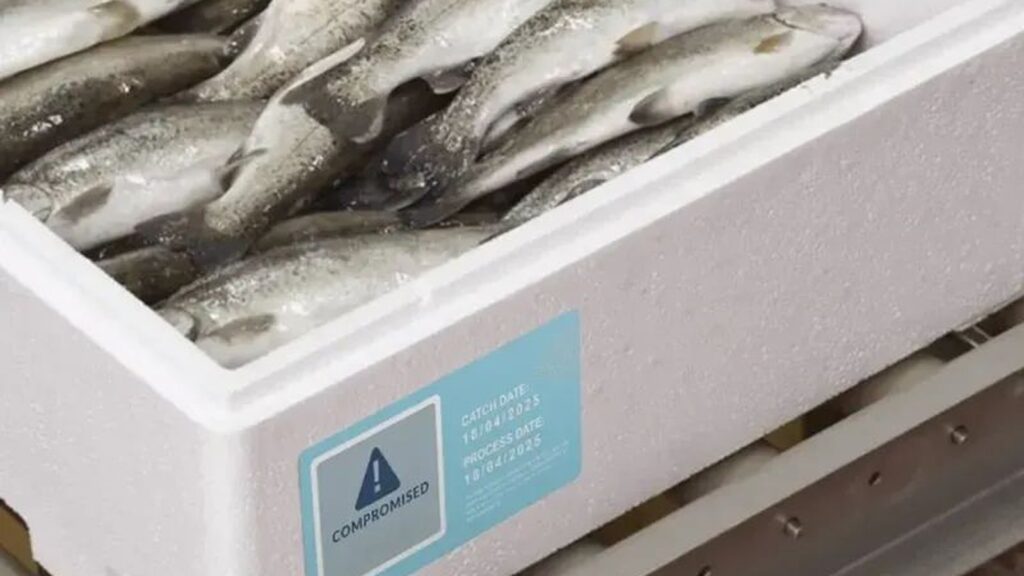
Cold chain packaging is one of the few EPS products that is bought for what it does after day one, not for how it looks on a pallet: a fish box that still holds ice on the third day at sea, a pharmaceutical shipper that keeps 2–8 °C through a summer crossing, a liner that protects frozen produce through a week inside a reefer container. EPS for insulated cold chain packaging has earned that role for three practical reasons — it is the cheapest insulation per unit of thickness, it is closed-cell so it does not absorb water the way fibrous materials do, and it survives wet handling without losing shape.
What cold chain buyers actually specify
Ask a cold chain packaging buyer what matters and the answers are more specific than “good insulation”. They specify against the failure they have already seen:
- Hold time. The box must keep product temperature for a defined window — commonly 24, 48 or 72 hours — through a stated ambient profile. Hold time is set by wall thickness, density, and the thermal bridges at the corners and the lid joint.
- Stacking load. Boxes travel on pallets, sometimes five high inside a reefer. The base box carries the weight of everything above it at chilled temperatures, where EPS is slightly softer than at room temperature.
- Wet handling. Melt water, condensation and direct ice contact. Closed-cell EPS does not wick, but water sitting in corners adds weight and ruins presentation at the receiving dock.
- One-way versus returnable. A one-way fish box is judged on landed cost per trip. A returnable moulded system is judged on trips survived. The economics point in different directions, and the production line follows.
How an insulated box is produced
There are two routes to an insulated box, and most plants commit to one of them:
- Shape moulding. The box walls are moulded as finished parts in an aluminium cavity. Lowest labour per box, highest tooling cost, and every box size needs its own mould.
- Cut-and-assemble. Blocks are moulded, cut into panels on a cutting line, and the panels are joined into boxes. Slower per box, but the same block serves every box size — which is why this route dominates for fish boxes and produce packaging, where sizes change by season and by customer.
Both routes start at the same place: bead density. The thermal conductivity of EPS is largely fixed by the density the pre-expander delivers, so a cold chain line that skips density control is guessing at its own hold time. After moulding, blocks need ageing before cutting — cutting a warm, wet block gives panels that drift out of tolerance as they cool and dry.
The line behind the panel
| Line stage | Machine | What it controls for cold chain |
|---|---|---|
| Bead preparation | EPS pre-expander machine | Bead density — the root variable for thermal conductivity; weight-based control holds it near ±1.5% |
| Block moulding | Vertical block moulding machine | Block uniformity — density variation inside the block becomes hold-time variation between boxes |
| Panel cutting | EPS cutting line | Wall thickness accuracy — the most common hidden cause of under-spec boxes |
| Bundle packing | EPS packaging machine for block | Panels leave the plant clean, dry and unbent — 8 packs/min on 0.03 mm PE film |
| Waste recovery | EPS recycling machine | Trim and rejected panels ground back into bead instead of paid for as waste |
Choosing the line in five steps
- Fix the box programme first. List every box size and its monthly volume. Cut-and-assemble wins when sizes are many and volumes are moderate; shape moulding wins when one or two box designs run continuously.
- Set the density range, not a single number. Fish boxes and pharmaceutical shippers do not want the same density. The pre-expander and silo must hold whichever density the day requires without a long changeover.
- Size the block mould to the cutting line. A moulding output of 12–15 blocks per hour can outrun a line that cuts at 1.8–2.0 m/min at 15 kg/m³ — match the two before buying either.
- Decide packing before installation day. Loose panels stack badly and get rejected on arrival. A bundle wrapper with automatic stacking pays for itself in a segment where the end buyer inspects the packaging.
- Plan the recycling loop now. Panel cutting produces trim at every metre. A grinding and re-beading loop turns that trim into raw material instead of a disposal invoice.
Mistakes that cost money
- Chasing the cheapest density. Lower density uses less bead, but thermal conductivity worsens, so the same hold time needs a thicker wall — and the extra wall costs freight on every single trip. Run the maths on the whole box, not on the bead bill.
- Ignoring thickness tolerance. A wall cut 3 mm thin on a 50 mm specification loses real insulation performance — and the buyer finds it during validation, not on your cutting line.
- Treating corners as free. Hold time is lost fastest at lid joints and corner gaps. Panels cut on a calibrated line fit tighter than panels cut by hand; this is a machine decision, not a craftsmanship plea.
- Forgetting the box is also packaging. A wet, bent panel arrives looking second-hand even when its insulation is intact. In this segment the bundle wrapper is not optional.
Frequently Asked Questions
What density should cold chain panels use?
Higher than construction board, because stacking load and wet handling push the same way. The right number comes from your box test, not from a catalogue. What the line must guarantee is that the density you validated is the density you keep producing — which is a pre-expander and silo question, not a moulding one.
Should we shape mould or cut panels?
If you make fewer than roughly five box designs at high volume, shape moulding is hard to beat. If your box programme changes with seasons and customers, cut-and-assemble on one block size wins, because the block is common to every product you make.
How thick should the walls be?
Wall thickness follows the required hold time and the ambient profile the box will see; validated thermal testing on the finished box is the only honest answer. What production controls is that the thickness you validated is the thickness every panel gets — a cutting accuracy question.
Can one line serve cold chain and construction board?
Yes — block moulding and cutting are common to both. What changes between segments is the density programme and the packing step. Many plants run construction board by day and cold chain panels against orders, with changeover managed at the pre-expander.
How does EPS compare with PUR or EPP for shippers?
PUR panels insulate better per millimetre but cost more and add a lamination step. EPP is the returnable-trips material. EPS remains the default where the box is one-way and landed cost per trip decides the tender.
If you are setting up a cold chain packaging line, or your current boxes are failing hold-time validation, send us the box specification and the monthly volume — we will lay out the machine combination and the changeover plan. Contact our team, or see how the same line serves EPS packaging and fish boxes in agriculture.