
EPS Raw Bead Storage: Pentane Loss, Shelf Life and Handling
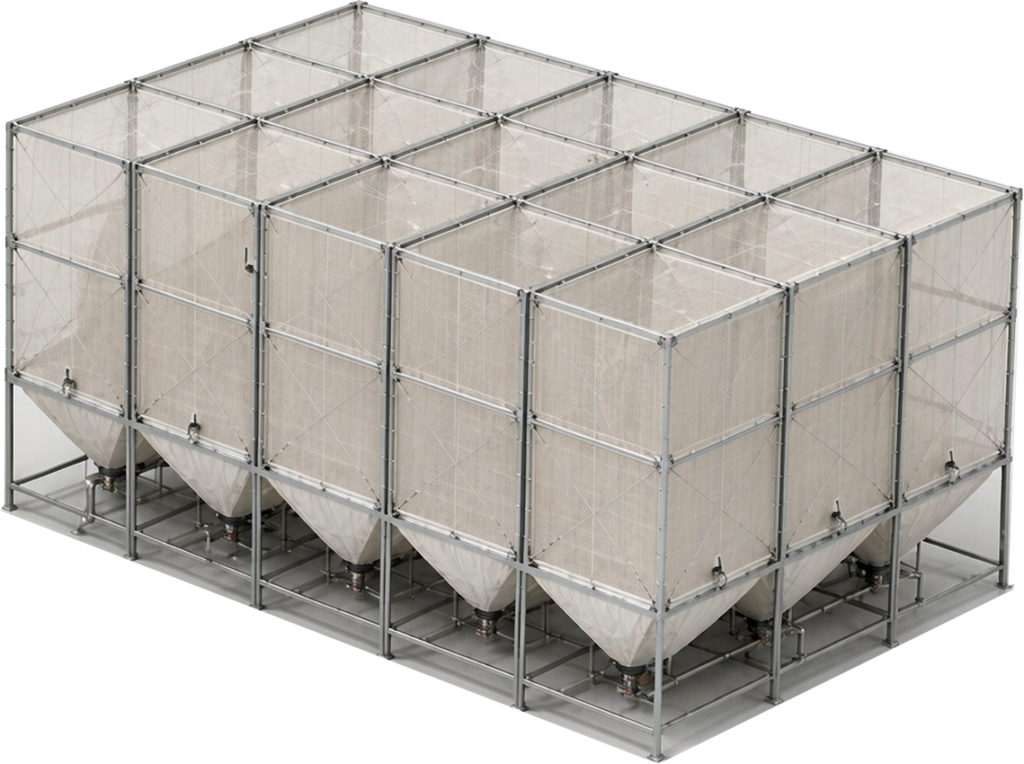
Raw EPS bead and expanded bead look similar in a hopper, but they need almost opposite storage conditions. Raw bead arrives with a blowing agent sealed inside each granule, and the whole job of storage is to keep it there. Expanded bead has already been through steam and now needs to settle and equalise before it will mould consistently. An eps silo system sits in the middle of that transition, and how long material stays in it, and in what order it is drawn, decides how stable the pre-expander feed will be. Get this wrong and the line shows it as density drift rather than as an obvious storage fault, which is why the problem is so often chased in the wrong part of the plant.
Raw bead and expanded bead are two different storage problems
Raw bead is a sealed package. Pentane is dissolved in the polystyrene granule and acts as the blowing agent during pre-expansion. While the bead sits in a bag or a day bin, pentane slowly diffuses out. Heat speeds that up, and a damaged or reopened package speeds it up further. The practical rule is to keep raw bead cool, sealed and moving in first-in-first-out order, and to treat the supplier’s dated storage guidance for the grade as the authority on how long a batch remains within specification. We deliberately do not put a number on that here, because storage life belongs to the grade and the supplier, not to the plant.
Expanded bead is the opposite case. After steam, the granules are warm, moist and carrying pentane that now needs to escape in a controlled way while air diffuses back in. This is the ageing or maturation step. Freshly expanded bead that is pushed straight into the mould behaves differently from bead that has had time to equalise: fusion, block appearance and density stability all shift. The EPS silo system is where this happens, so its job is not simply to hold volume but to give the bead a consistent, calm residence before moulding.
That is exactly why the two materials should never share a bin or a feed line. Raw bead is being protected against loss; expanded bead is being conditioned through controlled loss. Mixing them, or topping up a silo of aged bead with a fresh batch and drawing from a common outlet, creates a feed whose history changes from hour to hour. No amount of machine tuning will fully correct a feed that is inconsistent at the inlet, and the operator ends up adjusting steam settings to compensate for a storage decision made two days earlier.
Why pentane loss changes the expansion ratio
Expansion ratio is simply how much volume a given mass of bead becomes. It is set during pre-expansion by how far the softened granule is allowed to grow, and that growth is driven by the pentane still inside it. Lose blowing agent in storage and the same steam setting produces a denser, heavier bead than the operator expects. The machine has not changed; the raw material has.
The published density-weighing control on the SPJY pre-expanders is about +/-1.5%, which is a tight band. That figure assumes a consistent feed. A weighing system controls the process, not the raw material, so it cannot compensate for a batch whose pentane content has drifted. When the feed changes, the operator ends up chasing density with steam and residence adjustments, and the plant records it as a machine problem rather than a materials problem.
The knock-on effects are easy to trace down the line. Heavier pre-expanded bead changes how a block fills and fuses at 12-15 blocks/hour, and it changes how the wire behaves at 1.8-2.0 m/min at 15 kg/m3. A storage fault therefore surfaces as cutting and moulding complaints, usually in that order. The cheapest correction is upstream, at the bag and the silo, not at the wire. This is worth repeating to anyone troubleshooting a density complaint: check the lot and its storage history before touching the EPS pre-expander machine settings.
FIFO, temperature and silo residence time
First-in-first-out is the single most useful discipline in bead storage. It is not about housekeeping; it is about keeping the age of the material constant at the pre-expander inlet. When new bags are stacked in front of old ones, the old material stays until someone needs it urgently, and by then its behaviour has changed. Mark lots on arrival, draw from the oldest lot first, and record the changeover so a density shift can be matched to a batch instead of guessed at.
Temperature matters for the same reason, and mostly through its swings. A store that is warm in the afternoon and cold at night drives diffusion and condensation cycles inside the package. Keep raw bead away from direct sun, steam lines and boiler walls, and avoid opening bags until the material is about to be used. For expanded bead, what matters is a steady, moderate environment in the silo rather than a fixed target, because the aim is even equalisation across the whole batch. A plant that can hold a stable condition will usually outperform one that chases a setpoint it cannot hold.
Silo residence time is a balancing exercise. Too short and the expanded bead has not equalised; too long and the oldest material in the silo has been sitting while fresh bead keeps arriving on top of it. Both show up as variation within a shift. The practical approach is to size the working volume to the moulder’s consumption and keep the fill level in a narrow band, so the material drawn at the outlet has a similar history from hour to hour. A larger silo is not automatically better. It only adds volume in which material can age unevenly, and a wide fill swing makes the feed less predictable rather than more.
Storage and handling checklist
The table is an inspection checklist rather than a specification sheet. It deliberately contains no storage-life figures, because those come from the bead supplier’s dated guidance for the grade you bought. Use it as a shift-level routine.
| Check point | What to look for | Why it matters | Action if off |
|---|---|---|---|
| Incoming raw bead | Intact sealed bags, readable lot dates, no heat damage in transit | Pentane content starts here | Quarantine the lot and refer to the supplier’s dated guidance |
| Raw bead store | Cool, dry, out of direct sun, away from steam lines, strict FIFO order | Slows blowing-agent loss | Re-stack by lot date and move the oldest forward |
| Bag opening | Opened only immediately before use, resealed if partly used | Limits exposure time | Reseal or transfer to a closed day bin |
| Pre-expander feed | Consistent bead flow, density within the published +/-1.5% control band | First place drift becomes visible | Check the lot first, then the machine settings |
| Expanded bead silo | Steady fill level, no bridging, even discharge | Gives bead an even residence | Adjust working volume and draw-off order |
| Lot changeover | Lot and time recorded when a new batch enters the line | Links a density shift to a batch | Log it before the next density check |
A five-step storage routine
- Log every incoming lot with its arrival date and the supplier’s stated storage guidance for that specific grade.
- Store raw bead sealed, cool and out of direct heat, in strict first-in-first-out order.
- Open bags only at the point of use and keep the pre-expander feed covered between fills.
- Hold expanded bead in the eps silo system at a steady working level so residence time stays consistent across the shift.
- Record lot changeovers and compare them against density checks at the pre-expander and the vertical EPS block molding machine.
Common mistakes in bead storage
- Buying extra raw bead as a buffer for a long run and storing it until it is needed. The older the oldest lot, the more the feed drifts; the buffer meant to protect output is exactly what destabilises it.
- Assuming a bigger silo solves variation. More volume with a wide fill swing gives the bead an uneven history and can make consistency worse, not better.
- Topping up a silo of aged bead with freshly expanded bead and drawing from the shared outlet as if the two were interchangeable.
- Treating a density drift as a pre-expander fault and re-tuning steam instead of checking the lot date and the storage log.
- Quoting one fixed shelf life for all grades. Storage life belongs to the grade and the supplier’s dated guidance, not to a generic plant rule.
Frequently Asked Questions
How long can raw EPS bead be stored?
Follow the dated storage guidance on the supplier’s packaging for the specific grade you bought. It is grade-dependent, and a single plant-wide number would be misleading.
Why does density drift when the machine settings have not changed?
Because the feed changed. Pentane loss in stored raw bead, or uneven silo residence, alters the expansion ratio before the bead ever reaches the mould.
Should raw and expanded bead ever share storage?
No. Raw bead is being protected against blowing-agent loss, while expanded bead is being conditioned to equalise. They need different conditions and different handling.
Does a warmer store always ruin the bead?
Heat and temperature swings accelerate diffusion, so a steady, cool store with disciplined FIFO is safer than a warm one with wide day-night swings.
What is the first thing to check when output varies within a shift?
The lot log and the silo fill level, before touching the pre-expander settings. Storage faults usually present as machine faults.
Good bead storage is mostly discipline rather than equipment: sealed bags, FIFO, a steady silo level and a lot log that someone actually fills in. If you want to review how your raw bead handling and silo sizing fit the line you are running, contact our team and we will work through the checklist with you.