
EPS Insulation Board Density and Thermal Performance
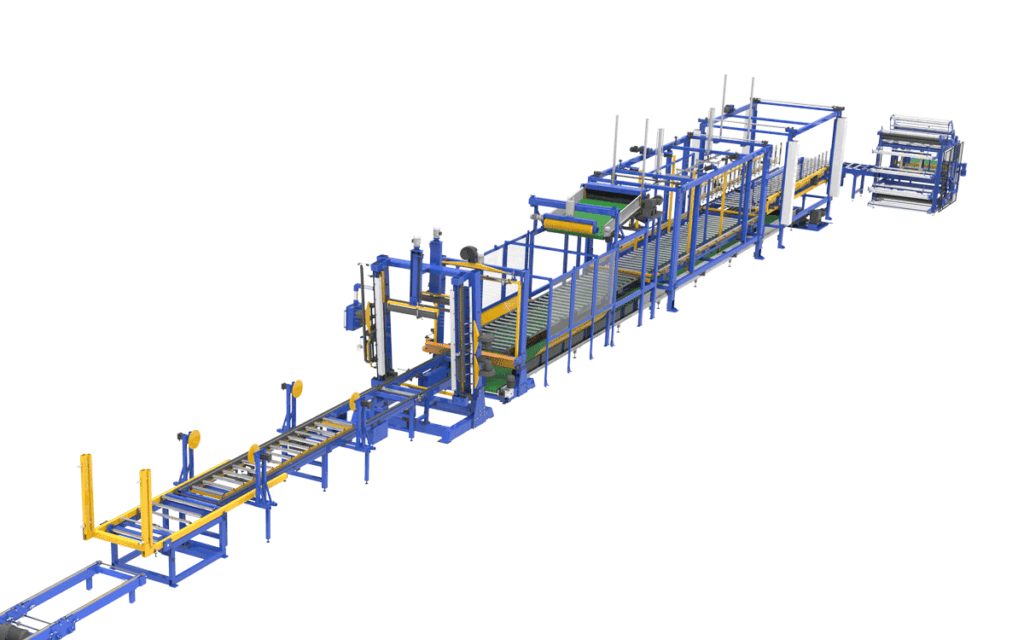
Insulation board enquiries almost always start with a density. A buyer asks for 15 kg/m3 board, or 20, or 30, and expects the thermal performance to follow in a straight line. It does not. Density changes strength, surface quality and how fast an eps cutting line can run, but it moves thermal performance far less than most specifications assume, and the parts of the board that decide real insulation value are decided long before the block reaches the cutter. This guide separates what density controls from what it does not, and shows how to choose a board density and then set the line for it.
What Density Does and Does Not Control
Density is mass per unit volume, and in a molded EPS block it is set by how much pre-expanded bead is filled into the mold and how much that bead expands during steaming. Increase the fill and you get a denser block: more polymer walls per unit volume, more fusion points between beads, a harder surface and higher compressive strength. That is the real value of a higher density, and it is why floor insulation, load-bearing applications and geofoam specify heavier board.
What density does not do is improve insulation in proportion. The thermal resistance of EPS comes mostly from the air trapped inside the closed cells and from the blowing agent that stays in the cell gas. Adding polymer adds solid material that conducts heat better than the gas it replaces, so past a point a denser board can be marginally worse per unit thickness, not better. Between the common densities used for wall and roof board the difference in thermal conductivity is small; the difference in strength, dimensional stability and cost is large. That is the trade a buyer is actually making.
Where Thermal Performance Really Comes From
Three things move the thermal number more than density does. The first is cell structure: fine, uniform cells with intact walls insulate well, while collapsed or open cells let the gas escape and moisture in. Cell structure is set by bead quality, pre-expansion control and steam discipline, not by the density written on the order.
The second is fusion. A block with poor inter-bead fusion has gaps between beads that act as convection paths and as places for water to sit. A 20 kg/m3 block with weak fusion insulates worse than a well-fused 15 kg/m3 block, and it also cuts badly, because weak bonds tear instead of separating cleanly at the wire.
The third is moisture. Water conducts heat many times better than the cell gas, so a board that has absorbed water loses thermal performance regardless of its density. Boards that are cut and packed wet, or stored without protection on site, give performance well below the datasheet, and this is the most common reason a building fails an insulation check while the delivered board was in specification.
Matching Density to the Application
The table below is a starting point for specification conversations. Use it to narrow the choice, then confirm against the project’s structural and fire requirements, which are set by local code rather than by the machine builder.
| Density band | Where it is normally used | What it means for cutting | What to check on the board |
|---|---|---|---|
| Around 15 kg/m3 | Packaging, void fill, light insulation and shape parts | Fastest cutting; a well-tuned line runs near its upper feed range at this density | Fusion at the block surface, since soft board tears easily at the wire entry |
| Around 20 kg/m3 | Wall and roof insulation board, general construction | Moderate reduction in feed rate to hold thickness tolerance | Thickness consistency across the block width and squareness of the cut face |
| 25 to 30 kg/m3 | Floor insulation, load-bearing and geofoam applications | Noticeably slower feed; wire temperature and tension matter more than speed | Taper and wire wander, plus surface tearing from insufficient wire heat |
Setting the Cutting Line for the Density You Chose
A cutting line that is set for one density will not produce good board at another without adjustment. Lower density foam offers less resistance to the wire, so the same feed rate that cuts cleanly at 15 kg/m3 can produce a wavy face at 30 kg/m3 because the wire bows under load and lags behind the carriage. Push the feed rate down, hold wire tension at the upper end of its range, and check the cut face after every change rather than trusting the setting from the last job.
Thickness tolerance is where density and machine settings meet. Thin board at high density is the hardest combination: the wire has little material to stabilise it and any wander shows up immediately as a thickness variation across the sheet. If your tolerance requirement is tight, plan to cut slower and to verify with a gauge on the first few boards of each block, not at the end of the shift.
Five Steps to Choose a Board Density
- Start from the load, not from the thermal target. Establish what compressive strength and creep behaviour the application needs, then find the lowest density that meets it. Choosing high density first and checking strength afterwards adds cost to every square metre.
- Confirm the thermal requirement against the full assembly, not the board alone. Insulation performance depends on thickness, joints, fixings and moisture control as much as on the board itself.
- Check what your pre-expander and mold can hold consistently. A density that a line can only reach at the edge of its control range will drift between batches, and drift is worse for the customer than a slightly lower nominal figure.
- Run a trial block at the chosen density and cut a sample before committing to the order. Measure thickness, squareness and surface fusion on the sample, and keep it as the reference for the production run.
- Agree the tolerance in writing, including how density is measured and on which sample. Most density disputes are measurement disputes: a block sampled at the skin reads differently from one sampled at the core.
Mistakes That Cost Money
- Buying density as a proxy for insulation value. The two are related but not interchangeable, and the premium for heavier board buys strength, not R-value.
- Changing density without changing cutting parameters. The block runs, the boards look acceptable at a glance, and the thickness gauge later shows a drift that has already been packed and shipped.
- Judging fusion from the block surface only. The skin fuses first and looks perfect while the core is still weak, so cut a section and look inside before signing off a new density.
- Storing finished board unwrapped in a humid yard. The board absorbs moisture, the thermal performance drops, and the density on the label is blamed for a storage problem.
- The counter-intuitive one: a slightly lower density with excellent fusion usually outperforms a heavier board with poor fusion on every measure that matters to the customer, including how it cuts and how it holds up on site. Density is easy to specify and hard to verify; fusion is the opposite, which is why buyers keep specifying the easy number.
Frequently Asked Questions
Does higher density always mean better insulation?
No. Thermal resistance depends mainly on the cell gas and cell structure. Beyond the densities normally used for wall and roof board, adding polymer replaces insulating gas with solid material, so the gain flattens out while weight and cost keep rising.
Can one eps cutting line handle 15 and 30 kg/m3 board?
Yes, with different settings. Expect to reduce feed rate and increase wire tension for the heavier board, and to re-check thickness on the first boards of each block. Machines are usually capable of both; the risk is running the light-density recipe on heavy board because nobody changed the program.
Why does my 20 kg/m3 board fail a thickness check when 15 kg/m3 passes?
Higher density puts more load on the wire, so it bows more at the same feed rate. The result is a thickness variation across the sheet that does not appear on lighter foam. Slow the feed, check tension and confirm the wire is clean and at working temperature.
How should density be sampled for a dispute?
Agree the method before the order: sample size, whether the skin is removed, and conditioning before weighing. Then take the sample from the same position in the block every time. A method agreed in advance prevents most arguments, because both sides are measuring the same thing.
Does density affect how the board ages?
Heavier board is generally more dimensionally stable and resists handling damage better, but ageing behaviour is dominated by cell gas diffusion and moisture, which depend on bead quality and on how the board is stored and installed. Density alone is a weak predictor.
If you are choosing a board density for a project, or want to know what a given EPS cutting line can hold across a density range, contact our team with your board sizes and tolerance. We can also quote the upstream side, from pre-expander through block molding to a CNC cutting machine for shaped parts.