
Block Molding vs Shape Molding: When to Use Which EPS Process
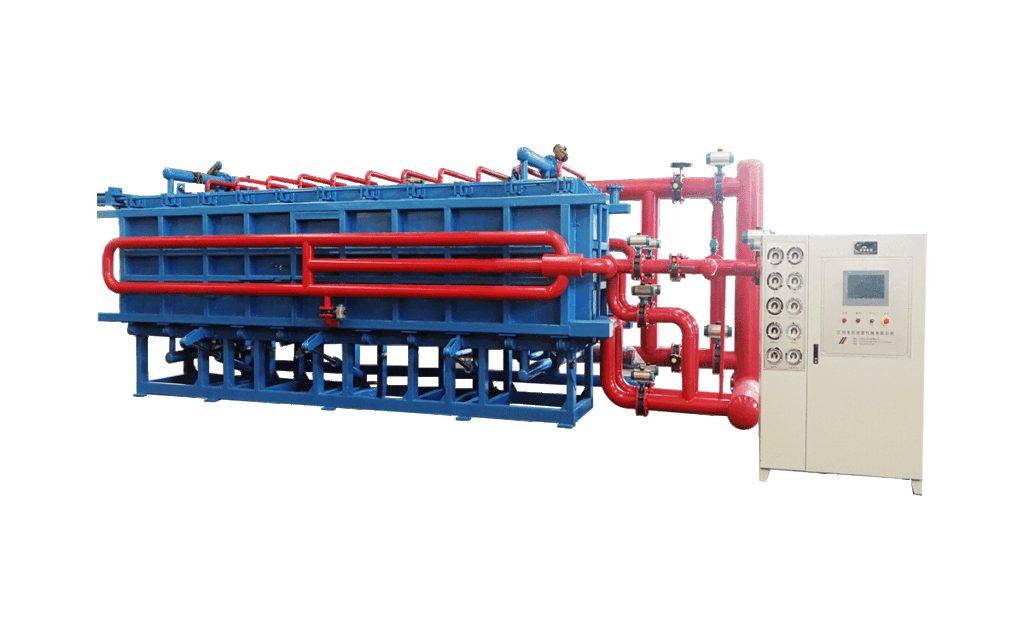
EPS parts are made two ways: block molding fuses bead into a large slab you later cut, and shape molding fuses bead directly into a finished part in an aluminium die. Both start from pre-expanded bead, but the economics and tooling differ in ways that decide your whole cell layout. This guide helps you choose by what you actually sell, not by which process sounds more advanced, because the wrong choice leaves you carrying tooling you cannot pay back or cutting slabs you could have moulded finished.
Block molding: make a slab, then cut
A block molding machine produces large rectangular blocks. Those blocks go to a cutting line that slices them into boards or rough shapes. It is the flexible default: one machine feeds every product that starts as a slab, from insulation board to packaging blanks, and you cut to order as orders arrive, so a new customer request is a new cut program, not a new die and a capital request.
Shape molding: fuse straight to the part
Shape molding blows bead into an aluminium die and steams it to fuse a finished part — a pump volute, an appliance pack, a corner cushion. No cutting step. It needs a die per part, so it suits repeat, known-shape volume where the tooling pays for itself and where the finished part leaves the machine ready to wrap rather than to a cutting table. The die is the commitment; the finished part is the reward.
Comparison
| Factor | Block molding | Shape molding |
|---|---|---|
| Output form | Slab, cut later | Finished part |
| Tooling | One machine, many products | One die per part |
| Flexibility | High (cut to order) | Low (fixed shape) |
| Best for | Insulation, boards, variable shapes | Repeat, known-shape parts |
When each one wins
Block molding wins when your order book is varied, when a single shape has not yet earned a die, or when you are still learning which shapes sell. Shape molding wins when one shape runs often enough that the die beats the cutting cost and the trim, and when the finished part must be exact every time without a cutting tolerance in the loop. Most plants start on block for the flexibility and add shape lines only when a specific part clears the break-even, which keeps the early capital low.
Common mistakes
- Shape-molding a part you only make occasionally. The die cost never pays back; cut from block instead and avoid the tooling altogether until volume justifies it.
- Block-molding a high-volume repeat part. You pay for cutting and trim you could skip with a die, and you generate offcuts you then have to recover through a recycling machine.
- Forgetting fusion quality. Both need even steam; shape dies are less forgiving of pressure sag because the part is the product, not a slab you will trim, so a sag shows directly on the customer’s part.
- Buying both before volume justifies it. Start with block for flexibility; add shape lines only when a specific part clears the die break-even, not because the brochure looked nice.
Mapping your real order book
The block-versus-shape decision is really a volume decision dressed up as a process decision. List your top shapes by annual quantity and mark the ones that clear a plausible die break-even — say, a few thousand units a year where the saved cutting and trim exceed the tooling amortised over that volume. Those go to shape lines. Everything below that line, and every new or one-off shape, stays on block and is cut to order. This simple split keeps your capital on the repeat sellers and your flexibility on the long tail, which is where most plants actually make their margin once the obvious parts are covered by a shape line.
Resist the temptation to shape-mould a part just because it looks impressive on the machine. The die is a commitment that only earns back on repetition, and a part that runs twice a month will carry that cost for years on the books. Equally, do not keep block-cutting a part that runs every day and generates trim you then pay to recover — that is money left on the cutting table and a recovery step you did not need. Revisit the split every quarter as your order book changes; a shape that earns a die this quarter may not have last quarter, and the discipline of re-checking is the point, not a one-time decision made during the first layout that nobody revisits.
Commissioning note
Set the split up honestly by running the first month on block for everything, then promote a shape to a die only after it clears the break-even on real order history. That discipline ties tooling to proven volume and leaves the long tail on the cutter, where a one-off shape belongs until it has earned a die on the books.
Frequently Asked Questions
Which is cheaper to start?
Block molding — one machine serves many products. Shape molding adds die cost per part, which only pays back on volume, so the start-up favourites block for good reason.
Can I do both?
Yes. Many plants run block lines for flexibility and shape lines for high-volume repeat parts, so they cover both custom and steady demand without forcing every job through one process.
When does a die pay off?
When a single shape runs often enough that saved cutting and trim beat the die cost. We can help you model the break-even from your order history instead of guessing at it.
Does block molding waste material?
It generates offcuts, but those recover through a recycling machine, so the “waste” is mostly a recovery step, not disposal, and the recovered bead lowers your raw cost a little.
Which gives better part accuracy?
Shape molding, because there is no cutting tolerance in the loop — the die is the part. Block molding adds a cut tolerance, which matters when the shape must be exact every time.
Next step
Tell us your product mix and we will map block vs shape for your line. Talk to our team for a layout that matches your real order pattern and the shapes you actually run every week.