
Continuous vs Batch EPS Pre-Expander: Which Bead Expansion Method Fits Your Plant
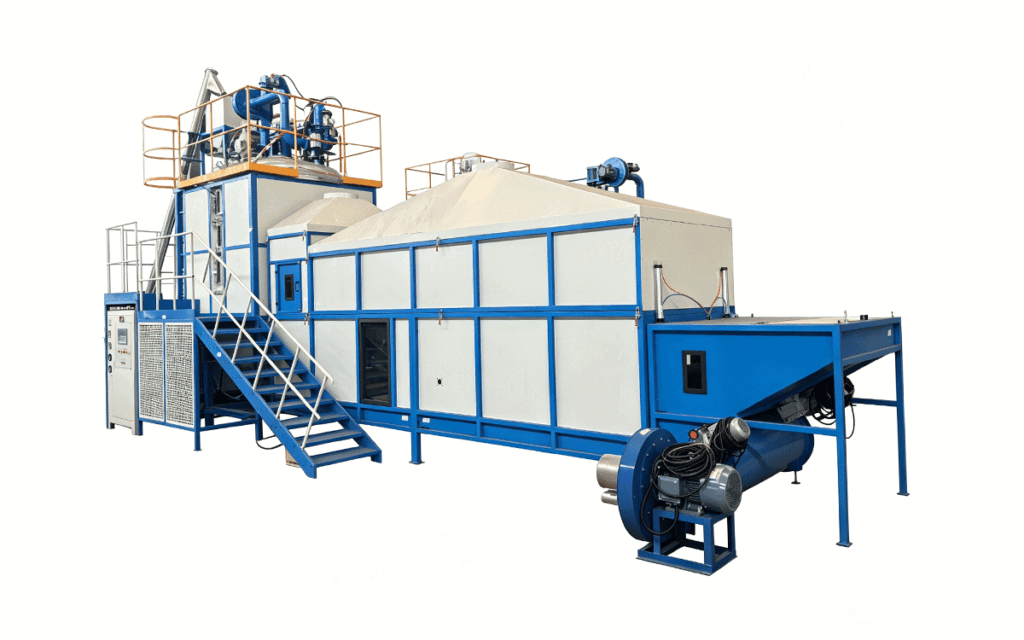
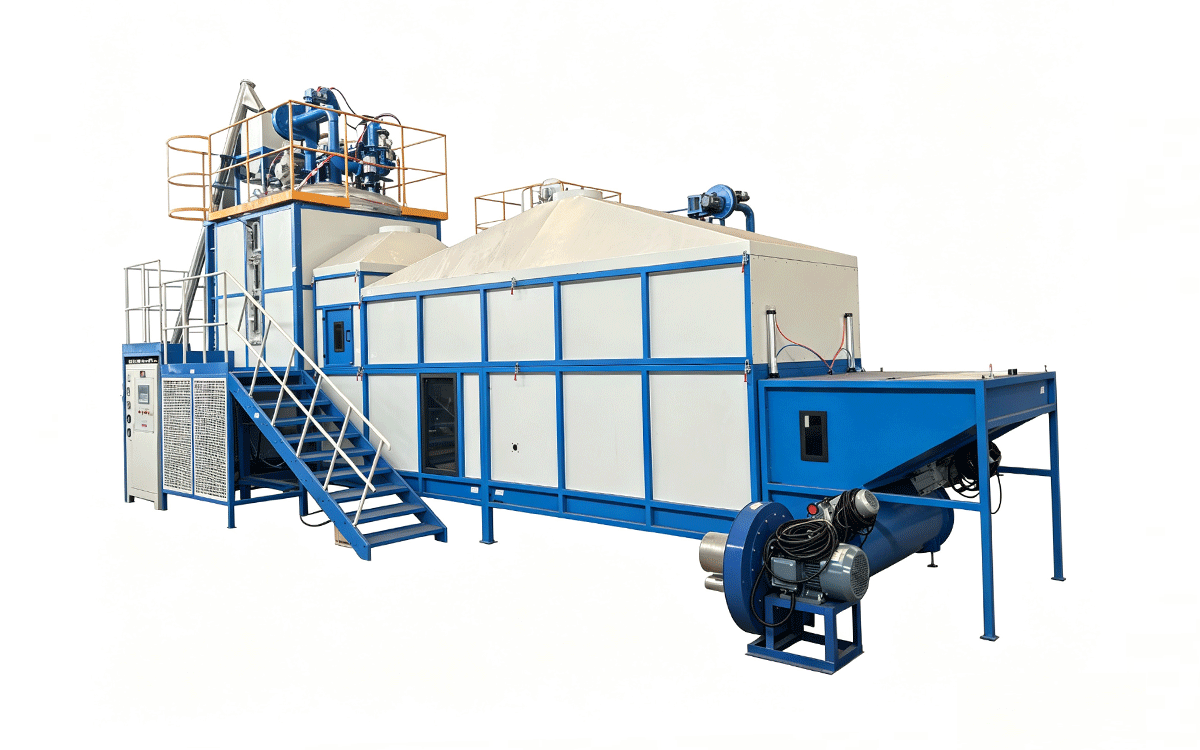
Every EPS plant lives or dies by its pre-expander. This is the machine that takes raw polystyrene bead and, with steam and gentle agitation, swells it into the low-density expandable bead your block molding and shape molding lines depend on. Two families of EPS pre-expander machine dominate the market: the batch type (the universal workhorse) and the continuous type (built for high, steady volume). Choosing wrong means either paying for capacity you never use or starving the line downstream. This guide breaks down how each method expands bead, the real trade-offs, a worked sizing example, and a practical selection path you can apply to your own plant.
What an EPS pre-expander machine actually does
Raw PS bead is dense and inert. Inside the pre-expander chamber, steam penetrates the bead, softens the blowing agent trapped inside, and makes it expand many times over into a near-hollow sphere of closed cells. The result is “pre-expanded” bead at a target density—typically 15–25 kg/m³ for block molding. The machine’s job is to hit that density consistently, bead after bead, without fusing them together or over-expanding them into useless popcorn. Everything else—throughput, tolerance, footprint—follows from how reliably it performs that single task.
Batch vs continuous: how the two methods expand bead
Batch pre-expander. A measured charge of raw bead is loaded into a vertical pressure chamber, steamed, expanded, and discharged before the next charge begins. Each cycle is independent, so you can change density between runs simply by adjusting steam time and bead load. This makes batch machines exceptionally flexible—ideal when you run several densities or change over products during a shift.
Continuous pre-expander. Bead flows through the chamber in a steady stream while steam is applied continuously. Output is constant and very high, but the machine is tuned to a narrower density band. Continuous units shine when you make one or two densities all day, every day, and want maximum throughput per operator hour. The cost is flexibility: every density change is a re-tuning exercise rather than a dial adjustment.
In practice, small and mid-size plants almost always choose batch, because their order book mixes densities. Large, single-product plants—say a dedicated block producer—often justify continuous.
Why this choice drives your whole line
The pre-expander sets the density of every bead that follows it. If density drifts, the molding presses produce blocks that are too light (fragile, oversized) or too heavy (wasted material, slower cycles). So the pre-expander is not an isolated purchase; it is the first link that decides whether your vertical block molding machine runs smoothly. Specifying it well protects quality all the way to the finished block.
Typical specifications (batch reference)
The table below shows a representative batch EPS pre-expander machine range. Figures are current model ranges; exact configuration depends on your target density and bead grade.
| Model | Chamber Diameter | Chamber Height | Density Tolerance | Output (@15 kg/m³) |
|---|---|---|---|---|
| SPJY-1600G | 1600 mm | 2500 mm | ±1.5% | 1600–1800 kg/h |
| SPJY-2000G | 2000 mm | 2000 mm | ±1.5% | 2000–2200 kg/h |
Continuous lines tend to quote higher nominal throughput, but remember the capacity trap below: that number is almost always measured at the lowest practical density.
How to choose the right pre-expander in 5 steps
- Profile your density mix. If you run three or more target densities across the week, a batch EPS pre-expander machine is usually the safer, cheaper fit. Single-density, high-volume plants should weigh continuous.
- Match output to your molding demand. Total bead demand per hour should sit at roughly 70–85% of rated pre-expander capacity. Running flat-out leaves no headroom for grade changes or maintenance.
- Check density tolerance. Block molding wants tight tolerances (±1.5% or better) so blocks come out uniform. Looser tolerance means more scrap and rework downstream.
- Audit your steam and water quality. A pre-expander is only as good as its steam. Unstable pressure or dirty condensate wrecks bead uniformity regardless of machine size.
- Plan for the scrap loop. Bead lost to over-expansion and off-cuts should feed a recycling machine so material cost stays controlled.
A quick sizing worked example
Suppose your molding line consumes 1,200 kg/h of 15 kg/m³ bead. Take 80% of a machine’s rated output as safe working capacity. The SPJY-1600G is rated 1,600–1,800 kg/h, so its comfortable band is about 1,280–1,440 kg/h—enough with modest headroom. The SPJY-2000G would be oversized for this load and cost more to run. If your demand were 1,800 kg/h, the 1600G would be marginal and the 2000G the correct choice. Always size to your real density, not the brochure’s best case.
Common mistakes when specifying a pre-expander
The quoted capacity trap. Manufacturers almost always state output at the lowest density (e.g. 15 kg/m³). If your real production runs at 20–25 kg/m³, actual throughput can drop by 30–40%. Always ask for the capacity curve at your density, not the brochure’s best case.
Ignoring bead fluidization. Poor agitation lets beads clump and fuse. A bigger chamber does not fix bad fluidization—mixing geometry and steam distribution do.
Buying continuous “because it’s faster.” If you change densities often, a continuous line will spend its life being re-tuned, and you will lose the flexibility you actually needed.
Forgetting the silo. Expanded bead needs to age and equalize moisture before molding. Without a silo system, density drifts and blocks come out uneven.
Frequently Asked Questions
Can one EPS pre-expander machine handle multiple densities?
A batch unit can, by adjusting steam time and bead load between cycles. A continuous unit is best kept inside a narrow density band, so multiple densities mean more changeover loss.
What density tolerance do I really need?
For block molding, aim for ±1.5% or tighter. Loose tolerance shows up as uneven blocks and extra scrap at the molding stage.
How much steam does a pre-expander use?
It scales with throughput and target density; the honest answer depends on your bead grade and boiler. Size the boiler from the machine’s rated steam demand at your density, not the lowest-density figure.
Do I need a silo after the pre-expander?
For stable molding you do. A silo system buffers and ages the expanded bead so moisture and density equalize before molding.
What happens to bead that over-expands?
Over-expanded, fused bead is scrap. Route it through a recycling machine so it returns as reusable material instead of landfill cost.
Is batch or continuous better for a new plant?
For a new plant with an uncertain or mixed order book, batch is the lower-risk choice. Move to continuous only once you have a proven, single-density, high-volume product.
Ready to spec a line that fits your density mix and volume? Contact our team for a configuration matched to your plant.