
EPS vs XPS Foam: A Practical Comparison for Buyers
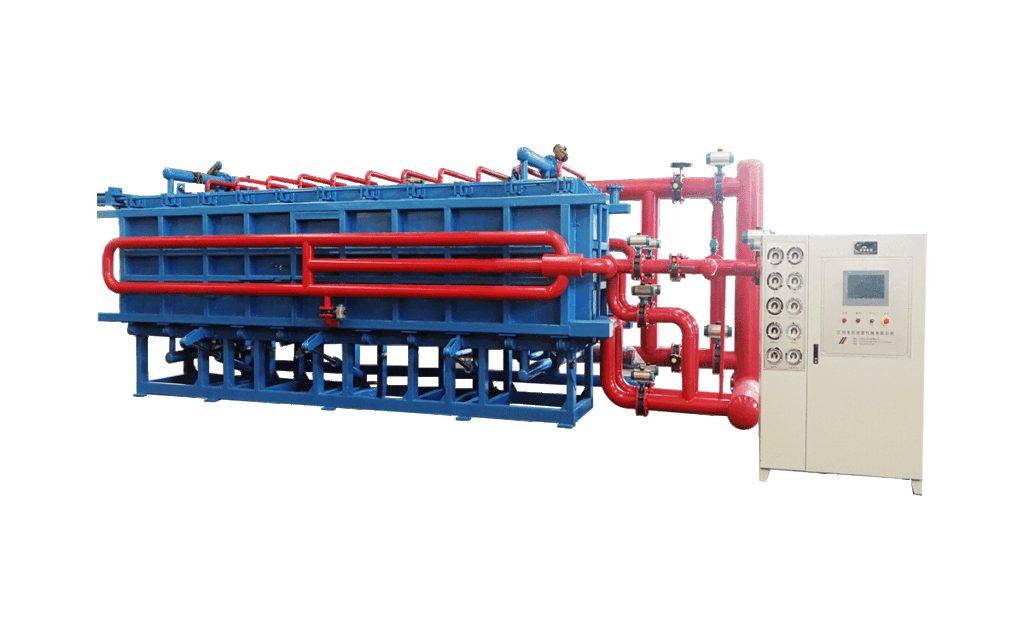
EPS and XPS are both expanded polystyrene foams, but they are made by different processes and behave differently on the floor and on the job. If you are buying foam board or foam parts, the choice affects cutting speed, cost, water uptake and how you shape it. This guide compares the two on the points that actually change your result, so you can specify the right foam instead of the familiar one, and so you can defend the choice when someone asks why you did not buy the more expensive option.
How they are made
EPS (expanded polystyrene) starts as small beads steamed and fused in a mould — exactly what an EPS block molding machine produces. XPS (extruded polystyrene) is extruded as a continuous melt with a blowing agent, giving a closed, uniform skin. The process difference is why their properties diverge and why they are not interchangeable on the same cutting table, the same crane, or the same job specification without re-testing.
Cost
EPS is almost always the lower-cost foam. Bead-based production scales cheaply and the raw material is commodity polystyrene. XPS costs more because extrusion and blowing-agent handling are more involved, and that cost is in every cubic metre whether you use the extra performance or not. For high-volume board and packaging, EPS usually wins on price per cubic metre, and the gap widens as volume rises because EPS scales so cleanly.
Strength and rigidity
XPS has a tighter, more uniform cell and a smooth skin, so it resists compression a bit better at equal density and holds edges well. EPS is more forgiving to shape and its bead structure absorbs impact without a brittle skin. For load-bearing slabs XPS is often specified; for most insulation and packaging EPS is plenty and far cheaper, and its cut edges are clean enough for most assemblies without extra finishing or edge banding.
Insulation value
Both are good insulators. At the same density their thermal resistance is similar; XPS edges slightly higher at low density because of its closed structure, but the gap is small enough that EPS’s cost advantage usually decides it for building insulation. Specifying XPS purely for a fraction of an R-value point rarely survives a life-cycle cost check once you add the price premium across the whole building envelope.
Cutting and shaping
EPS is the easier foam to cut. A hot-wire cutting line slices EPS blocks into boards and shapes cleanly and cheaply. XPS is denser and skins over, so it cuts slower and dulls wire faster, which means more wire changes and more downtime on a high-volume line. If your product needs custom shapes in volume, EPS is the friendlier foam, and the offcuts recycle more simply too, closing a small loop instead of becoming disposal.
| Factor | EPS | XPS |
|---|---|---|
| Cost | Lower | Higher |
| Compressive strength | Good | Slightly better at equal density |
| Insulation | Very good | Very good (slightly higher low-density) |
| Ease of cutting | Easy (hot wire) | Slower, skins over |
| Water uptake | Open-ish beads, absorbs slowly | Closed skin, lower uptake |
Common mistakes
- Paying for XPS where EPS is enough. Most insulation and packaging needs never see XPS’s edge, so the premium is wasted on performance you cannot use.
- Assuming one cuts like the other. XPS wears wire and cuts slower; budget for it or you will throttle the line and miss shipment dates.
- Ignoring offcut recovery. EPS offcuts densify back into feedstock via a recycling machine; XPS recovery is less straightforward and often skipped, adding to disposal cost.
- Specifying on a single property. Decide by the whole job — cost, cutting, recovery — not the one number a salesman leads with on the data sheet.
How to specify without overspending
Start from the product, not the material. If you make insulation board or packaging blanks in volume, EPS is the default and the cutting line is already built around it, so the cell is cheaper and the offcuts recycle. If a specific job specifies XPS for a closed-skin reason, ask what that skin is actually doing — keeping water out, holding an edge, or just matching a legacy spec written before EPS options were compared. In most cases EPS with a vapour barrier or a slightly thicker section does the job for less, and the saving compounds across the whole envelope rather than showing up on one line item.
The honest test is the drop or the load case, not the data-sheet headline. Where XPS genuinely earns its premium is continuously wet service or a tight compressive spec that EPS at your density cannot meet; name that condition explicitly, and if you cannot, you are paying for performance you will not use. Either way, size the cutting step to the foam you pick — EPS cuts fast on a hot-wire line, XPS needs a slower wire and more changes, and that throughput difference is part of the real landed cost that the purchase price hides from the comparison.
Frequently Asked Questions
Which is better for under-slab insulation?
Both work. XPS is common where standing water is a risk because of its closed skin; EPS with a vapour barrier is the cost-effective choice in dry builds and is widely used under slabs.
Can I cut XPS on an EPS cutting line?
You can, but slower and with more wire wear. EPS remains the practical foam for high-volume shaped cutting and the one the line was built around, so keep XPS for the few jobs that truly need it.
Is EPS weaker?
Not for most uses. At the densities used in insulation and packaging, EPS carries the load; XPS wins only at the margin and at a clear price premium that rarely pays back.
Which recycles more easily?
EPS, by a wide margin in practice — clean offcuts densify straight back to feedstock, which also lowers your raw-material bill instead of becoming a waste line.
Does the skin make XPS waterproof?
Lower uptake, not zero. In continuously wet service the closed skin helps, but design the detail with a vapour barrier rather than trusting the foam skin alone to keep water out.
Next step
If your product is EPS board or shaped parts, we can size the whole line from pre-expander to cutting. Talk to our team for a configuration matched to your real volumes and the foams you actually ship.