
EPS vs XPS: Which Insulation Material Should You Choose?
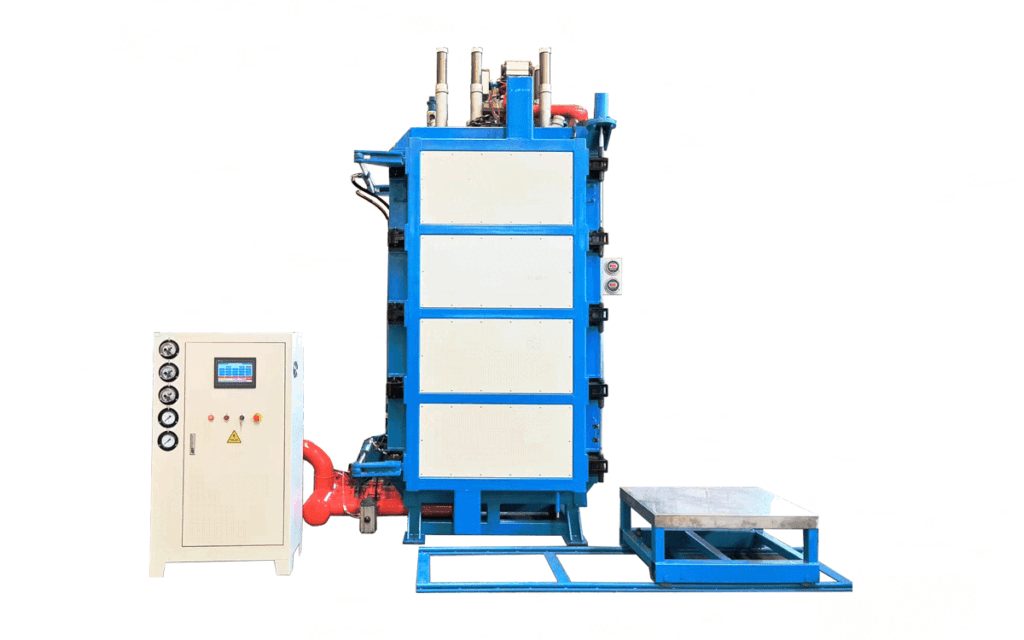
EPS and XPS are often compared as if they were the same product in two colours. They are not. They are made by different processes, they perform differently under load and moisture, and they suit different parts of a building. This guide helps builders, specifiers and EPS producers decide which one fits.

The production difference
EPS (expanded polystyrene) is made by pre-expanding polystyrene beads with steam, ageing them, then fusing them into blocks in a vertical EPS block molding machine. The blocks are then sliced to thickness on an EPS cutting line.
XPS (extruded polystyrene) is produced by melting polystyrene with a blowing agent and extruding it through a die into a continuous board. Extrusion gives XPS a closed, homogeneous skin and slightly higher compressive strength.
Performance comparison
- Thermal performance — both sit in a similar range (roughly 0.032-0.038 W/mK). EPS can be produced at lower densities for the same lambda, which is why it usually wins on cost per R-value
- Compressive strength — XPS is stronger at equal density, which is why it is specified under foundations and in inverted roofs
- Moisture resistance — XPS absorbs less water; EPS absorbs more but drains and dries, and performs well in drained applications
- Workability — EPS is easier to cut on site and can be hot-wire cut to any profile, including decorative shapes on an EPS CNC cutting machine
- Recyclability — EPS is easier to collect and reprocess. Scrap can be returned to production through an EPS recycling machine
- Cost — EPS is generally the lower-cost option per cubic metre
Which should you choose?
Choose EPS for walls, roofs, insulated concrete forms, protective packaging and lightweight fill such as EPS geofoam, where cost, weight and cuttability matter most. Choose XPS where the board sits in permanent contact with water or carries high point loads: foundations, below-grade walls and parking decks.
Our EPS Insulation page covers typical board sizes and applications in more detail, and our team can help you specify the right block density — contact us.
Specification comparison
The figures below are typical published ranges for standard grades, not guarantees. Always confirm against the datasheet of the grade you actually buy, because density and blowing agent change the numbers.
| Property | EPS | XPS | What it means on site |
|---|---|---|---|
| Thermal conductivity | about 0.032–0.038 W/mK | about 0.029–0.035 W/mK | XPS is slightly better per mm; EPS usually wins per unit of cost |
| Compressive strength | Set by density, chosen grade by grade | Higher at equal density | XPS is specified where point loads are high |
| Water absorption | Absorbs more, but drains and dries | Very low | EPS performs well in drained and protected applications |
| Vapour behaviour | Relatively open cell structure | Closed skin, low vapour transmission | Matters in inverted roofs and below grade |
| Cutting and shaping | Hot-wire cuttable to any profile | Cut with blades; profiles are harder | EPS is the practical choice for decorative and shaped work |
| Recycling | Collected and reprocessed back into production | Recyclable, but collection streams are less common | EPS scrap can return through an EPS recycling machine |
A five-step way to specify the right board
- Start from the application, not the material. Wall, roof, floor, below grade, packaging or decorative profile each point to a different answer.
- Check whether the board will sit in water. Permanent moisture contact pushes you towards XPS; drained or protected positions do not.
- Calculate the required R-value and the thickness you can build. If thickness is limited, XPS buys you millimetres; if it is not, EPS buys you cost.
- Confirm load. Foundations, parking decks and inverted roofs need compressive strength; cavity walls and façades usually do not.
- Ask what the site can cut and handle. Hot-wire cutting on site favours EPS; a fixed board size delivered to spec favours either.
Common mistakes
Comparing price per board instead of per R-value. A cheaper board with worse lambda costs more per unit of insulation.
Specifying EPS where it will sit in standing water. EPS drains and dries, but it should not be used as a permanent water-barrier layer.
Choosing XPS for decorative profiles. Complex shapes are far easier to cut from EPS, and a CNC cutter produces them directly from a drawing.
Forgetting density. Both materials are sold by performance class. Ordering “EPS” without a density is how a specification fails on site.
Frequently Asked Questions
Is EPS or XPS better for a wall?
For most wall applications EPS is the better value: lower cost per R-value, easy to cut, and simple to recycle. XPS earns its place below grade and under load.
Can EPS be used under a concrete slab?
Yes, where loads and drainage are designed for it. Where the board sits in permanent moisture or carries high point loads, specifiers usually choose XPS.
Is EPS recyclable after demolition?
Yes. Clean EPS from construction sites is collected, densified and reprocessed. In-plant scrap can go straight back into production through a recycling system.
Which material should an EPS producer invest in?
If you are setting up to make insulation board, EPS equipment covers a far wider product range — board, packaging, shape mouldings and geofoam — from one pre-expander and block moulding line.
Can you help us choose a density?
Yes. Tell us the application and the required performance and we will recommend a grade — contact our team.
Fire performance and code compliance
Both EPS and XPS are organic foams and both are combustible in their basic form; flame-retardant grades exist for both, and neither should be left exposed in a finished building. This matters practically in two ways: the grade you buy has to carry the classification your market requires, and the assembly has to include the protective covering the code expects.
For producers, the implication is that fire classification is a product specification, not a property of the material name. If you supply construction board, confirm the classification your customers need before you set up the grade, and keep the test documentation with the batch records.
Because rules vary by country and by application, treat the standards in your target market as the authority. Our team can help you match a board grade to an application, but the compliance check belongs with your local specifier.
Is EPS safe to use indoors?
Yes, when installed behind the protective covering required by code and supplied in the classification the application calls for. Like any insulation material, it should not be left exposed.
Does EPS contain CFCs or HCFCs?
Modern EPS is expanded with pentane and does not use CFCs or HCFCs as blowing agents. Confirm the details with your raw material supplier for the grade you buy.