
How to Calculate EPS Bead Consumption per Block
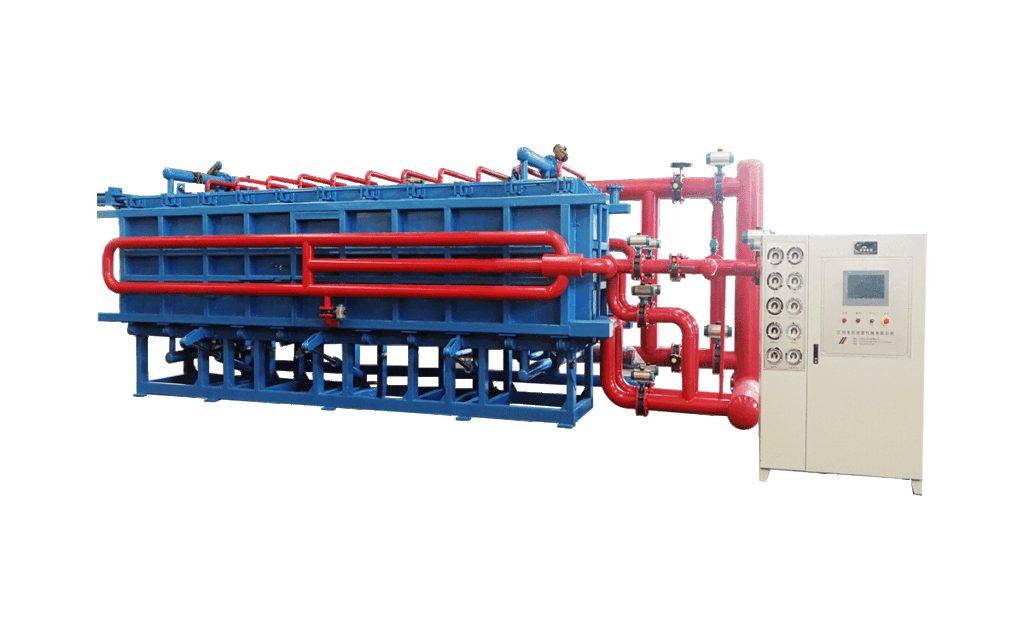
Most plants order raw bead from last month’s consumption and a feeling about how the coming month will run. It works until a mold change, a density change or a run of scrap blocks arrives together, and then the silo is either empty on a Friday or holding three weeks of material that is ageing past its useful life. The fix is a per-block figure you can defend, built from the geometry of the block, the target density and an honest allowance for losses. This guide walks through that calculation on an eps block molding machine, including where the losses actually hide.
The Mass Balance in One Paragraph
Bead consumption is a mass balance, and mass is conserved through the process. The polymer that goes into the mold comes out as the block, plus whatever leaves the system as scrap, dust, spillage or rejected blocks. Pre-expansion changes the volume enormously but the mass hardly at all, so you can work entirely in kilograms and ignore the expansion ratio once you know the block mass. Block mass is simply block volume multiplied by target density. Everything after that is an allowance: how much material is lost between the silo and the finished block, and how much raw bead is needed to deliver the expanded mass you calculated.
A Worked Example
Take a block of 6.0 m by 1.2 m by 0.6 m, which is a normal size for a large block mold. The volume is 6.0 x 1.2 x 0.6 = 4.32 m3. At a target density of 15 kg/m3 the block weighs 4.32 x 15 = 64.8 kg. That is the number you are trying to deliver to the customer, and it is the anchor for everything else.
Now add the losses you can measure. Suppose scrap and offcuts from downstream cutting run at eight percent of molded output, and handling losses between silo and mold add two percent. The material you must mold is then 64.8 x 1.10 = about 71.3 kg per block of equivalent output. If a block is rejected outright and reground, the polymer usually returns to the line, so rejection does not automatically multiply raw bead demand; what it costs you is processing time, energy and a share of the material that ends up as fines.
Finally, convert to raw bead. Pre-expanded bead is much bulkier than raw bead, so the same mass occupies far more volume, but the mass is unchanged apart from blowing agent lost during expansion. Divide the required mass by the bulk density printed on your bead supplier’s datasheet to get the raw volume, then multiply by the packing density of the bag or silo delivery to get bags or tonnes. If the datasheet figure sits around 630 kg/m3 for the grade, 71.3 kg of molded material corresponds to roughly 0.11 m3 of raw bead, which is the kind of figure worth writing on the silo log so operators can sanity-check a delivery.
Consumption Table by Block Size and Density
The table gives nominal block mass for common block sizes at two densities, calculated at nominal dimensions and before any loss allowance. Multiply by your own loss factor to get the material you need to mold.
| Block size (m) | Volume (m3) | Mass at 15 kg/m3 | Mass at 20 kg/m3 | Molding rate at 15 kg/m3 |
|---|---|---|---|---|
| 6.0 x 1.2 x 0.6 | 4.32 | 64.8 kg | 86.4 kg | Roughly 780 to 970 kg/h at 12 to 15 blocks/h |
| 4.0 x 1.2 x 0.6 | 2.88 | 43.2 kg | 57.6 kg | Roughly 520 to 650 kg/h at 12 to 15 blocks/h |
| 3.0 x 1.2 x 0.6 | 2.16 | 32.4 kg | 43.2 kg | Roughly 390 to 485 kg/h at 12 to 15 blocks/h |
| 2.0 x 1.2 x 0.6 | 1.44 | 21.6 kg | 28.8 kg | Roughly 260 to 325 kg/h at 12 to 15 blocks/h |
That last column is the useful cross-check. A 6 m block line running 12 to 15 blocks an hour at 15 kg/m3 demands something close to a tonne of material per hour, which is well inside the range of a pre-expander rated at 1600 kg/h, leaving headroom for scrap, a second product and the recovery loop. If your calculated block demand sits close to the pre-expander’s rated output, you have no room to absorb a bad batch, and the schedule will be fragile from the first week.
Five Steps to Build Your Own Figure
- Measure a real block rather than trusting the nominal drawing. Mold wear and shrinkage mean a 6 m block is rarely exactly 6 m, and a two percent error in each dimension is a six percent error in volume.
- Multiply volume by the density you actually run, taken from a weighed sample, not from the setpoint on the pre-expander display.
- Add measured losses: cutting offcuts, trim, rejects and handling spillage. Measure these for two weeks instead of estimating them once, because they are usually larger than the team believes.
- Convert expanded mass to raw bead using the supplier’s bulk density, and keep that figure on file. When a supplier changes grade, the number changes and the bags-per-block figure moves with it.
- Reconcile monthly. Compare bead issued from the silo with block output times density plus measured scrap. A gap that grows month after month is either an inventory error or an unmeasured loss, and both are worth finding.
Mistakes in Bead Accounting
- Using the pre-expander’s setpoint density as the block density. Setpoint describes the bead, not the block; steam, fill and cycle time all move the final figure.
- Ignoring regrind. Recycled material re-enters the line as polymer, so counting it as pure loss overstates demand and slowly inflates the safety stock.
- Treating scrap as a fixed percentage of output when it is really a function of product mix. A week of thin board at high density produces far more trim than a week of thick block.
- Reconciling in cubic metres instead of kilograms. Volume changes with expansion; mass is the only quantity that balances cleanly across the process.
- The counter-intuitive one: buying bead in larger lots to get a better price often costs more than the discount, because bead has a shelf life and pentane content drifts in storage. Material that ages past its window produces blocks you cannot sell, and the loss is larger than the price break.
Frequently Asked Questions
Does the expansion ratio change bead consumption?
Not the mass. Expansion trades density for volume, so a higher ratio produces a lighter bead from the same polymer mass. What changes is the volume of silo space you need and how long the bead must age before molding, not the kilograms per block.
How much scrap allowance should I plan for?
Measure it. A line producing standard block with a well-set cutting line can run in the mid single digits; a line making thin board with frequent size changes will be higher. Planning from a measured two-week figure beats any rule of thumb, and it forces the losses into view where they can be reduced.
Can I use one figure for all blocks on the line?
Only if the blocks are the same size and density. Otherwise keep a small table like the one above, with the block sizes you actually run and the density for each, and let operators read the material requirement per block straight off it.
Why does my monthly reconciliation never close?
The usual causes are unmeasured spillage at the filling station, regrind counted as loss, and density taken from a setpoint rather than a weighed sample. Fix the measurement before adjusting the calculation, or you will tune the model to compensate for an inventory error.
How does silo design affect consumption?
A silo system that segregates by density and age lets you mold the right bead at the right time, which reduces rejects. Poor segregation pushes old bead into new jobs, and the resulting scrap shows up as consumption rather than as a storage problem.
If you want a consumption and pre-expander sizing check against your actual block list, contact our team with your block sizes, densities and shift pattern. We can model the material balance against a vertical block molding machine or a horizontal line, and include the recycling machine loop if you regrind offcuts.