
How to Calculate EPS Production Line Capacity
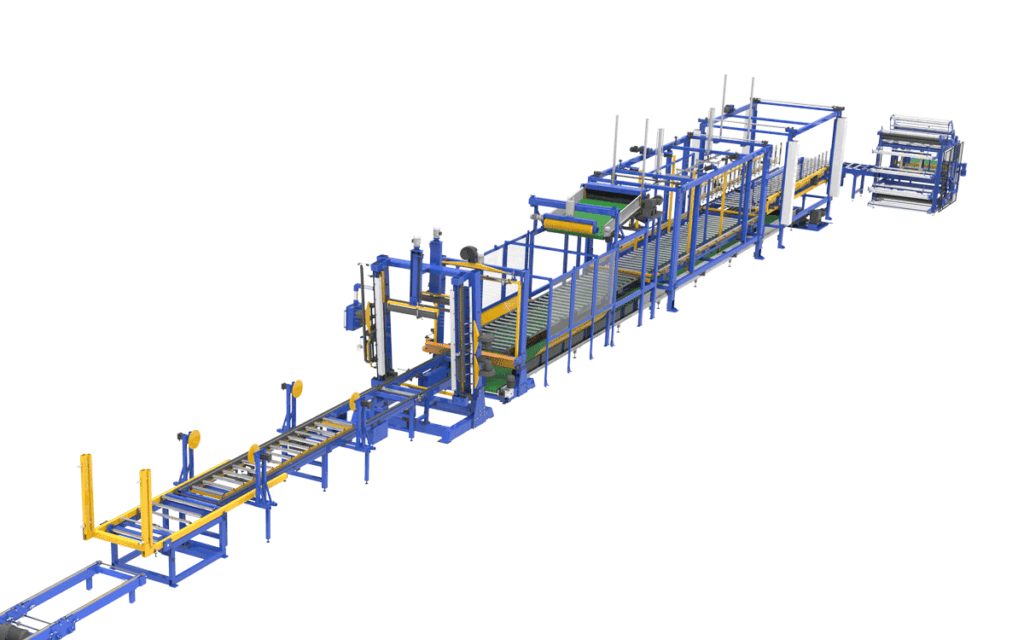
Buyers rarely ask how many kilograms per hour a line can expand. They ask how many cubic metres of saleable board it will ship each month. Those are different numbers, and the gap between them is where most capacity arguments start. This guide shows how to work backwards from sellable cubic metres to the three published machine ratings, and how to identify which stage of an eps cutting line actually sets the ceiling. Run the calculation before you approve a new line, and again whenever an existing plant produces less than the brochure led the owner to expect.
Why nameplate ratings do not equal sellable output
Every stage of an EPS block plant publishes its capacity in a different unit, and none of those units is a cubic metre of finished board. The pre-expander is rated in kilograms of raw bead per hour. The block moulding machine is rated in blocks per hour. The cutting section is rated in metres per minute of wire travel. Comparing the three figures directly is meaningless until they are converted to a common basis, which is the whole point of this exercise.
The conversion hinges on density. A density of 15 kg/m3 is the common reference used in the published ratings, which is convenient, because one cubic metre of foam at that density weighs 15 kg. That single relationship turns a mass flow into a volume flow. Lower-density foam cuts faster on the wire, while 20-30 kg/m3 board has to be run more slowly, so the same machine will not deliver the same sheet count across a mixed product mix. A line balanced for one density is not automatically balanced for another.
There is a second, less obvious reduction. Gross foam is not saleable foam. Trimming the skin, squaring the block, cutting kerf, start-up waste, off-spec density and rejected sheets all remove material before anything reaches a pallet. Published ratings describe the machine at its inlet or at the wire, not the shipped pallet. A workable capacity model therefore has two parts: the ceiling each stage imposes, and the yield loss between that ceiling and the loading bay. Measure your own trim and reject rate instead of assuming one; it varies with the cutting pattern and the product mix far more than with the machine itself.
The three published ratings on one basis
The table below collects the published figures you are allowed to plan against. Everything in it comes from the machine ratings, with no assumed mould sizes or invented cycle times. Read the second column as the equipment class and the third as the ceiling.
| Stage | Published model range | Published rating | Unit | What the number controls |
|---|---|---|---|---|
| Pre-expansion | SPJY-1600G / SPJY-2000G | about 1600 / 2200 | kg/h of bead | Mass ceiling for the whole line; density weighing control about +/-1.5% |
| Block moulding | SPB-2000 to SPB-6000 | about 12-15 | blocks/hour @ 15 kg/m3 | How fast bead becomes block; block length 2000-6000 mm |
| Cutting | SPQ-2000B to SPQ-6000B | about 1.8-2.0 | m/min @ 15 kg/m3 | How fast a block becomes sheets; lower density cuts faster |
Notice that only the first row converts directly into a volume. The moulding and cutting rows need one extra piece of information from your own plant: the volume of your mould, and the wire path your cutting pattern requires. Neither is a machine specification, so neither appears in the table. That is deliberate. A supplier cannot tell you your block volume or how many sheets you cut per block; those come from the product you sell. The EPS pre-expander machine sets the mass ceiling, but the rest of the chain is yours to define.
Worked example: back-calculating from sellable cubic metres
Start from the business side. Let S be the saleable cubic metres per hour the plant must ship. The question is whether the published ratings can support S, and which stage caps it first. Work the chain in reverse.
First, mass. At the 15 kg/m3 reference density, S cubic metres of foam weigh 15 x S kg. Add back the trim, kerf and reject that S excludes, and the pre-expander must feed more than 15 x S kg/h. The published ceiling is about 2200 kg/h on the SPJY-2000G or about 1600 kg/h on the SPJY-1600G. Dividing each by 15 gives roughly 146 m3/h and 106 m3/h of gross foam respectively. Those two numbers are the absolute volume ceiling for the line before a single sheet is trimmed. A sales plan above them is not a scheduling problem; it is a second pre-expander.
Second, blocks. The SPB range is rated about 12-15 blocks/hour at 15 kg/m3. To absorb 146 m3/h, each block would need to be 146 / 15, or about 9.7 m3, at 15 blocks/hour, and 146 / 12, or about 12.2 m3, at 12 blocks/hour. This is worth doing on paper because it tells you what mould size the pre-expander can actually keep fed. If your mould is smaller, the moulding stage is the bottleneck and the extra bead capacity sits idle. If it is larger, the pre-expander is the constraint and a faster moulder will not help. Block length in this class runs 2000-6000 mm, but the cross-section is your mould, so measure it rather than guess.
Third, wire time. The EPS cutting line cuts at about 1.8-2.0 m/min at 15 kg/m3. Cutting time per block is the total wire path divided by that speed. A block sliced into many thin sheets needs more passes than one cut into a few thick slabs, so the same block can consume very different amounts of wire time. If the passes needed per block, at 1.8 m/min, take longer than the four to five minutes implied by 12-15 blocks/hour, the cutting section falls behind the moulder and blocks queue up. Lower-density blocks cut faster; 20-30 kg/m3 board has to be slowed down, which tightens this stage further.
The sellable figure S is the smallest of these three ceilings, reduced by your measured trim and reject rate. In practice, comparing only the pre-expander kg/h is the most common way to overstate what a line will ship. The arithmetic above does not guarantee an output; it shows which stage you must check before you believe a quoted capacity.
Finding the real bottleneck
A bottleneck is not the slowest machine on paper. It is the stage with the smallest converted throughput in your actual product mix. Three checks usually settle it.
Watch the queue in front of each stage over a full shift. Blocks accumulating ahead of cutting mean wire time exceeds the moulding cycle. Bead backing up in the silo means the vertical EPS block molding machine cannot absorb the pre-expander output. A stage with a permanent queue downstream is the constraint, and adding capacity anywhere else only builds a bigger queue.
Check the density mix. A line balanced for 15 kg/m3 will drift out of balance when the schedule shifts toward 20-30 kg/m3 board, because the wire slows while the pre-expander and moulder keep their mass and block ratings. Recompute the ceilings for the heaviest product you actually sell, not the easiest one.
Check yield, not just throughput. If trimming and rejects are high, raising any machine ceiling buys nothing. A plant losing material at the cutting stage needs a cutting-pattern or tension review before it needs a bigger pre-expander. This is the counterintuitive part: the cheapest fix for low saleable output is often at the wire, not at the front of the line.
A five-step capacity calculation
- Define S, the saleable cubic metres per hour, and list the product mix including the heaviest density and the most subdivided cutting pattern.
- Convert S to bead mass with the 15 kg/m3 reference, add your measured trim and reject allowance, and compare the result with the 1600 and 2200 kg/h ratings.
- Convert S to blocks per hour using your measured mould volume, and compare it with the 12-15 blocks/hour moulding range.
- Convert the cutting pattern into total wire path, divide by 1.8-2.0 m/min, and compare the minutes per block with the moulding cycle time.
- Take the smallest of the three ceilings as line capacity, then confirm it with an observed full-shift pallet count before committing to a delivery plan.
Common mistakes when buyers size a line
- Comparing kg/h, blocks/hour and m/min as if they were the same unit. They are not; convert everything to cubic metres per hour first.
- Sizing on the pre-expander alone. At 2200 kg/h the mass ceiling is about 146 m3/h, but a moulder at 12-15 blocks/hour with a small mould may absorb only a fraction of that, so the extra bead capacity is paid for and never used.
- Assuming the published cutting speed applies to every density. The 1.8-2.0 m/min figure is quoted at 15 kg/m3, and 20-30 kg/m3 board needs a slower setting.
- Quoting gross foam as saleable board. Trim, kerf, skin, start-up waste and rejects all sit between the machine and the pallet.
- Adding a second machine at a non-bottleneck stage. If blocks queue before cutting, another moulder only makes the queue longer.
Frequently Asked Questions
What is the quickest way to sanity-check a quoted capacity?
Convert the pre-expander kg/h into cubic metres per hour using the 15 kg/m3 reference, then treat the result as an upper bound rather than a delivery promise. Anything downstream can only lower it.
Why does my line ship less than the pre-expander rating suggests?
Moulding block volume and cutting wire time both cap throughput below the mass ceiling, and yield losses reduce it further. The pre-expander is rarely the binding constraint.
Does a higher density always reduce output?
On the cutting stage, yes. 20-30 kg/m3 board runs slower than 15 kg/m3, while the pre-expander mass rating and the moulder block rating are essentially unchanged.
Should I size the line for the average or the heaviest product?
The heaviest density and the most subdivided cutting pattern, because that is where the wire-time ceiling is lowest. Sizing on the average product is how plants end up short in winter.
Can I verify capacity without a formal time study?
A full-shift queue count at each stage plus a pallet count at the loading bay gives a reliable observed figure. Compare it with the three ceilings above and the bottleneck usually becomes obvious.
If you want a second pair of eyes on the numbers, send us your target saleable output, your mould dimensions and your sheet thickness list. We can work through the three ceilings with you and point at the stage that will really limit the line. contact our team to go through the calculation before you commit to equipment.