
How to Choose the Right EPS Pre-Expander for Your Production Line
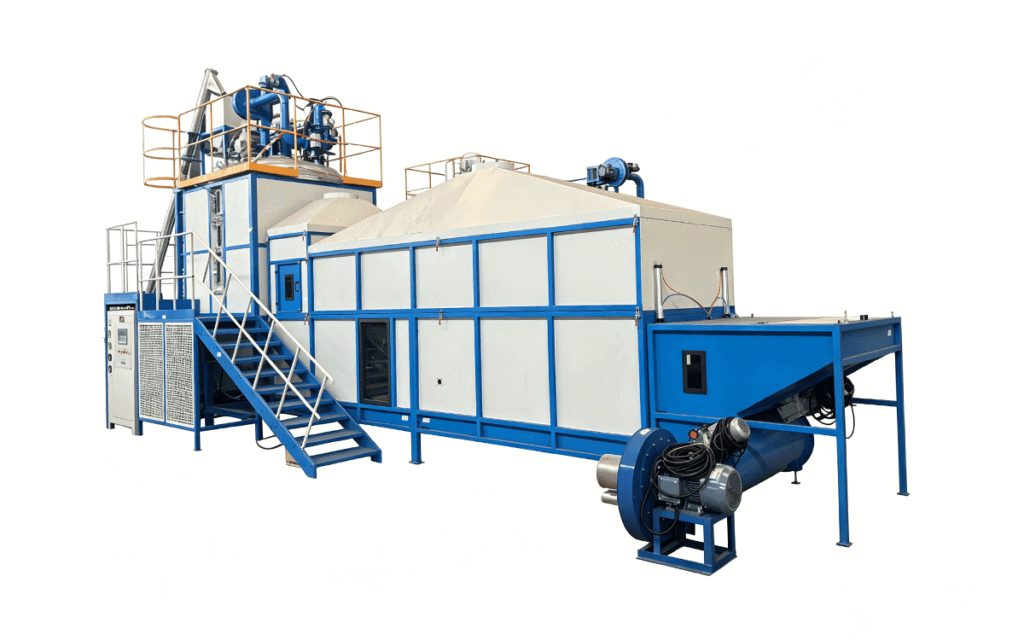
Why the Pre-Expander Is the Heart of Your EPS Line
An Expandable Polystyrene machine production line starts with one critical step: expanding raw EPS beads. The pre-expander determines the final bead density, which directly controls the insulation value, strength and surface quality of every block and shape you mold later. Choosing the wrong unit quietly drains profit through steam waste and off-spec product.
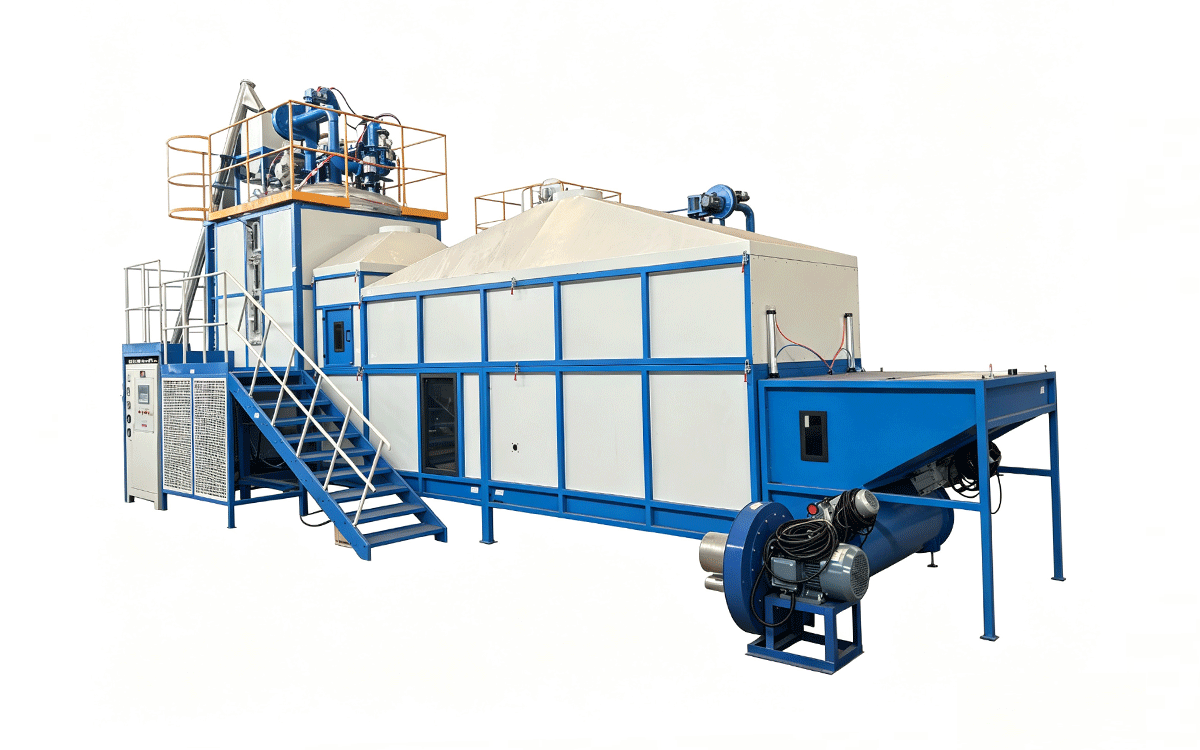
5 Factors to Consider Before You Buy
1. Target Bead Density and Tolerance
Most buyers need beads between 10 and 30 g/L. A good pre-expander holds density within ±1 g/L across a full batch. YouXin units use a steam-pressure balancing chamber so light densities stay stable instead of drifting.
2. Required Throughput
Match capacity to your molding machines, not your ambition. A single EPS block molding machine typically consumes 8–15 m³/h of expanded beads. Size the pre-expander 20% above that to avoid bottlenecking.
3. Steam System and Energy Use
Steam is your largest utility cost. Look for closed-circuit steam recovery and precise solenoid control. YouXin pre-expanders cut steam use roughly 15% versus open-vent designs.
4. Maturation (Aging) Integration
Fresh beads must rest 4–12 hours so air replaces steam inside the cells. An integrated aging silo keeps the line continuous and protects against post-mold shrinkage.
5. Automation and Operator Load
Touchscreen PLC control, automatic density feedback and remote alarms reduce skilled-labor dependence — important for overseas plants.
YouXin Pre-Expander Solutions
Our EPS pre-expander range runs from the SPJY-1600G to the SPJY-2000G, delivering 1600–2200 kg/h at 15 kg/m³, with optional double-expansion for the ultra-light densities used in fish boxes and construction boards. All models share the same spare-part platform to simplify maintenance.
Final Selection Checklist
- Confirm density range vs. your product mix
- Size throughput 20% above molding demand
- Verify steam recovery and local service support
- Request a trial run with your own raw material
Need a matched line? Talk to our engineers for a capacity plan.
Typical specifications
EPS Pre-expander Machine — specification snapshot
| Model | Chamber Diameter | Chamber Height | Density Tolerance | Output (@15 kg/m³) |
|---|---|---|---|---|
| SPJY-1600G | 1600 mm | 2500 mm | ±1.5% | 1600–1800 kg/h |
| SPJY-2000G | 2000 mm | 2000 mm | ±1.5% | 2000–2200 kg/h |
These are YouXin’s current model ranges. Exact configuration depends on block size, density target and the layout you run. Full options: EPS Pre-expander Machine.
Where the pre-expander sits in the line
Expansion is the first step of the process, so every problem it creates travels downstream. Bead leaves the pre-expander, dries in the fluid bed, rests in an EPS silo system, and only then feeds the moulding machines. If density is wrong at the first step, no amount of moulding skill corrects it: blocks come out heavy, uneven or slow to cure.
That is also why the pre-expander should be sized against moulding capacity rather than bought in isolation. It normally runs fewer hours per day than the block moulding machine, so a buffer of aged bead decouples the two stages and keeps density stable from shift to shift.
A five-step sizing check
- Convert your block output into bead demand. Work in kg/h at your target density — densities below 15 kg/m³ need more chamber volume for the same mass.
- Confirm the density window you sell. Quote your lightest and heaviest grade, not your average.
- Check steam stability. Pressure swings translate directly into density spread, whatever the control system promises.
- Size the drying and ageing stages together. A fast expander feeding a small silo simply moves the bottleneck downstream.
- Validate with your own raw bead. Grades differ between suppliers; a trial run is the only honest comparison.
Common mistakes
Buying for peak output. A machine sized for the busiest hour of the year spends most of its life in short bursts, and every restart costs consistency.
Under-estimating the ultra-light grades. Fish box and low-density board grades often need double expansion. If it is not in the specification, it is expensive to add later.
Overlooking the fluid bed dryer. Wet bead bridges in silos and blocks filling guns, and the symptom gets misdiagnosed as a moulding fault.
No steam recovery. Steam is the largest utility cost in an EPS plant. Open-vent designs burn money every hour.
Frequently Asked Questions
What density range should we specify?
Most buyers need 10–30 g/L. State your lightest and heaviest grade so the machine is configured for both, including double expansion if you go below the standard range.
How much throughput do we need?
Size about 20% above your moulding machines’ steady demand. That headroom absorbs shifts, boiler interruptions and grade changes.
How long must bead age before moulding?
Typically 4–12 hours, depending on grade and ambient conditions. Ageing lets air replace steam inside the cells and prevents post-mould shrinkage.
Can the pre-expander handle recycled bead?
Yes, when the recovered material is crushed, de-dusted and blended at a controlled ratio before it enters the machine.
Do you offer a trial with our own material?
Yes — send us your bead grade and target density and we will run it. Talk to our engineers to arrange it.
What to check during a trial run
A trial is worth more than any datasheet. If you run your own bead on a pre-expander, check four things:
- Density spread across the batch — take samples from the start, middle and end of the discharge, not one sample
- Bead condition after the fluid bed — dry and free-flowing, with no agglomerates
- Steam consumption — measure it during the trial, because it is a running cost you will pay for years
- Restart behaviour — stop and restart the machine mid-trial; the first batch after a stop is where inconsistency shows
Ask for the trial to be run at your lightest and heaviest grade. A machine tuned only at the average density will surprise you at both ends.
Does the machine need a dedicated boiler?
Not necessarily, but it needs stable pressure. Sharing a boiler with a moulding machine is normal; the risk is pressure sag when both draw steam at once.
How is density actually measured?
By weighing a known volume of expanded bead. It takes a measuring cylinder and a scale, and it should be done at least once per shift — it is the cheapest quality check in the plant.