
Batch vs Continuous EPS Pre-Expander: A Production Guide
Why the choice matters more than the machine
A pre-expander sets the density of every block, shape and package you make – and density sets your material cost. But the question that actually changes how a plant runs is not "which model" but batch or continuous. That decision drives scheduling, staffing and how tightly you can hold density. Here is how the two compare in real production.
Batch pre-expanders: measure, expand, discharge
A batch machine loads a weighed charge of raw bead, expands it to a target density, then discharges the whole batch before the next cycle. Because every charge is weighed, density is held by a simple loop: weigh, steam, test, adjust. Cycles typically run a few minutes each.
- Strength: you can change density between batches – useful when one line runs insulation blocks at 15 kg/m3 and packaging at 20 kg/m3 on the same day.
- Strength: simple to operate and maintain; a blocked bed plate is easy to spot and clear.
- Trade-off: output is stop-start, so peak throughput is lower than a continuous unit on the same steam input.
Continuous pre-expanders: steady feed, steady density
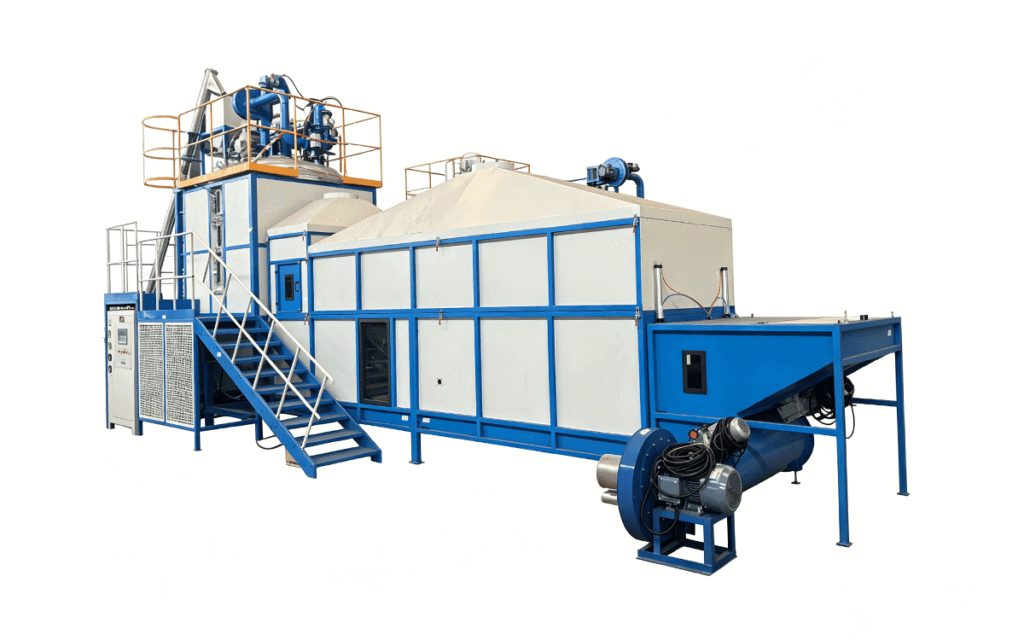
A continuous machine feeds bead steadily through a steam chamber and holds one density for as long as you run it. It is the right tool when volume and consistency matter more than flexibility.
- Strength: higher, even output – ideal for a plant feeding block molding around the clock.
- Strength: less operator intervention per tonne once dialled in.
- Trade-off: density changes need a settling period, so it is not suited to frequent switching.
Batch vs continuous at a glance
| Factor | Batch | Continuous |
|---|---|---|
| Density switching | Fast, between charges | Slow, needs settling |
| Peak throughput | Moderate | High |
| Operator attention | Per batch | Low once set |
| Best for | Mixed, job-shop production | High-volume single density |
| Spares and training | Simple | Slightly more complex |
What to size before you buy
Work back from your moulding line, not from a catalogue number:
- Target density range. A machine that only hits one density will fight you if your product mix varies. Confirm the density window you actually sell.
- Required expanded-bead tonnes per hour. Add up what your block and shape moulders consume at peak, then add an ageing and re-expansion allowance.
- Steam and ageing. Expanded bead must age in a silo system before moulding; size silo volume to your bead throughput, not your machine’s rated output.
- Re-expansion ability. Fine bead densifies as it ages – can the machine re-expand it, or must you buy fresh bead?
Density control: where quality is won or lost
Two faults dominate pre-expansion problems. The first is density drift: if the batch weight or the steam curve is off, bead comes out lighter or heavier than target, and block strength follows. The fix is to test density every batch (or on a schedule for continuous units) and log it, so a drifting steam valve shows up as a trend rather than a mystery defect.
The second is uneven expansion, usually a fluidised-bed problem: a clogged bed plate or low air keeps bead clumped, and clumped bead leaves voids in the block. Clearing the plate and checking air is a five-minute job that saves a whole batch.
Common mistakes
- Buying continuous for a mixed product range, then losing a shift to every density change.
- Sizing for average demand instead of peak moulding draw.
- Ignoring ageing capacity – an undersized silo forces you to run below machine capacity.
- Mixing machine types from different makers, doubling spares and training.
Which should you choose?
If you run one or two densities at high volume, continuous wins on cost per tonne. If your range is broad or your volume is seasonal, batch keeps you flexible without a second machine. Many plants start batch and add continuous as volume grows – the two coexist happily on one line feeding the same bead-expansion workflow.