
EPS Block Density vs Strength: What Actually Changes
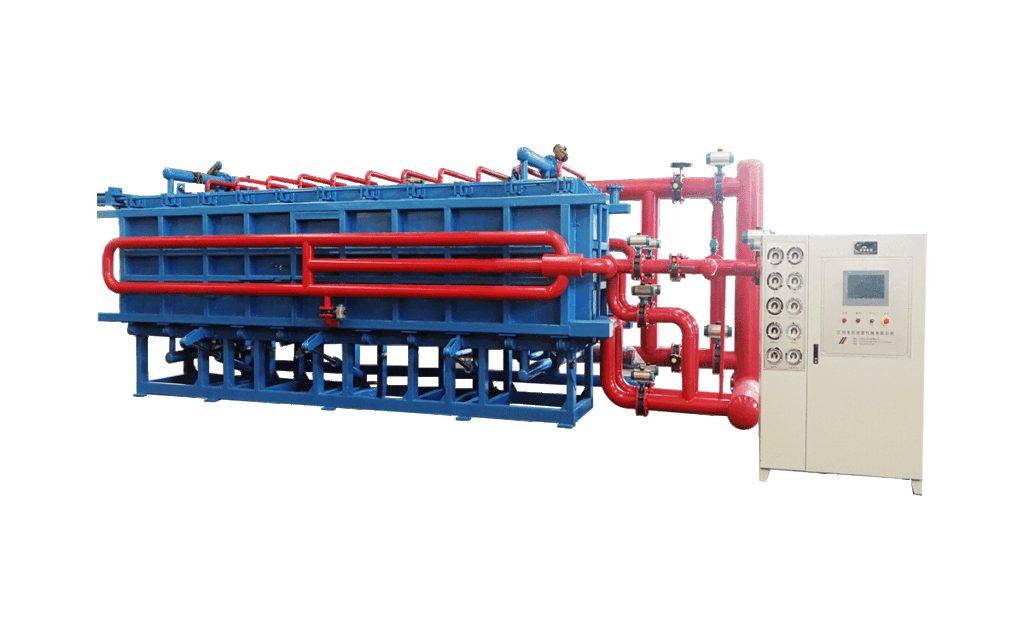
Buyers tend to compare EPS blocks on price per cubic metre, but the property that decides whether a block works for the end application is density. Density drives compressive strength, thermal insulation, block weight on the shop floor, and how fast the saw can run. Getting it wrong is expensive in both directions: blocks that crush under load, or blocks that cost more than the job actually needs. This guide explains what physically changes as density moves, how the molding cycle on an eps block molding machine responds, and how to specify density from the application instead of copying whatever the last order used.
What Density Actually Controls
EPS density is set at the pre-expander: the bead is expanded with steam to a target density, aged in silos, then molded. Everything downstream inherits that decision. Four properties move together when density changes:
- Weight and material cost. Higher density means more raw bead per cubic metre of finished block. Lower density stretches each kilogram of bead across more volume, which is why void-fill blocks are molded light.
- Compressive strength. As a general pattern, strength rises with density. Fusion quality, steam penetration and curing also matter, so two blocks at the same density can test differently.
- Thermal insulation. The trapped air and the bead cell structure do the insulating. Moving lighter helps marginally, but a poorly fused light block with voids can insulate worse than a well-made one.
- Handling and cutting behavior. Light blocks are faster to cut but easier to damage; heavier blocks cut slower and load the saw more.
Because all four move at once, density is a system decision, not a single number to type into a quotation.
The Trade-Offs in One Table
The table below summarizes how the main working density bands behave on the machine side. Output figures refer to SPB-series block machines rated around 15 kg/m3, the common reference density for EPS machinery.
| Density band | Typical use | Effect on the molding cycle | Effect on cutting |
|---|---|---|---|
| Around 15 kg/m3 | General-purpose blocks, construction boards, the reference density for output ratings | The basis for ratings such as 12-15 blocks per hour on SPB-series machines | Cutting at the rated 1.8-2.0 m/min on SPQ-series cutting lines |
| Lighter void-fill densities | Packaging void fill, lightweight fill and flotation | Shorter steam and cooling times are possible; blocks need gentler handling out of the mold | Faster cutting, but more care with block support and stacking |
| 20-30 kg/m3 board grades | Insulation boards and heavier structural applications | Longer steam penetration and drying; output falls below the 15 kg/m3 rating | Cutting speed must be reduced to protect surface quality and wire life |
How Density Changes the Molding Cycle
On the block molding machine side, density shows up mostly as cycle time. A heavier block contains more bead mass per mold, so steam has to transfer more heat and the cooling and vacuum stages run longer before the block is stable enough to eject. The rated 12-15 blocks per hour at 15 kg/m3 will not hold if you move to heavy board densities on the same machine, and planning production on the nameplate figure is one of the most common sizing mistakes we see.
Steam quality matters as much as quantity. At higher densities, wet steam or unstable pressure shows up quickly as unfused centers or wet blocks that deform during curing. If your application pulls you toward the upper density range, it is worth confirming with the machine supplier what the line actually holds at that density, not just at the reference point.
Strength: What the Number Means and What It Does Not
Compressive strength roughly follows density, and this is the relationship most quotations rely on. But the datasheet of the raw bead is not the datasheet of your block. Fusion, molding pressure, steam cycles and curing time all move the final measured value. The pattern we see in practice: a well-fused medium-density block can out-test a badly processed heavier one.
The practical consequence is simple. Whenever the block supports a load, such as under-floor fill or void formwork, test actual cured blocks from your own line rather than relying on bead datasheets, and keep testing as bead lots and seasonal conditions change.
Insulation: Why Lighter Is Not Automatically Better
Because EPS insulates through trapped air, the instinct is that the lightest possible board is the best insulator. Up to a point that holds, but the gain is modest compared with what poor fusion costs you. Voids, collapsed beads and steam channels inside a light block create paths that hurt thermal performance far more than the small benefit of a slightly lower density. Choose the density the application needs and put the effort into fusion quality instead of chasing the bottom of the density range.
Choosing Density: A Five-Step Process
- Start from the end use. Ask the customer what the block must do: carry load, insulate, fill voids, or be cut into shapes. Each answer points to a different density band.
- Confirm the bead grade. Match the bead supplier’s grades to the target density and check the aging time in the silo for that grade.
- Check machine output at that density. Ask what the line actually produces at the target density, not only at the reference rating.
- Plan the cutting side. Agree cutting speeds and block handling for the density with the cutting line supplier so the saw does not become the bottleneck.
- Verify with cured blocks. Measure density and strength on actual cured blocks from the line, and repeat the checks when bead lots change.
Common Mistakes Buyers Make
- Assuming heavier is always better. Paying for density the application never uses raises raw material cost on every cubic metre for the life of the product.
- Reading bead datasheets as block datasheets. The bead grade is a starting point; the molded, cured block is what the customer receives.
- Counting cost per block instead of per accepted block. Molding light stretches each kilogram of bead across more volume, but higher rejection rates from poor fusion can erase the saving. Price the block that ships, not the block that comes out of the mold.
- Planning output on the nameplate. Ratings such as 12-15 blocks per hour assume the reference density. Heavy grades run slower, and the schedule needs to reflect that.
- Treating density as the only variable. Steam quality, aging time and curing all move the same properties. Fixing density problems by only adjusting expansion ratio rarely works.
Frequently Asked Questions
Which density should a new EPS plant start with?
Most plants start around 15 kg/m3 because it covers the widest range of construction and packaging orders and matches the reference ratings of block and cutting equipment. Add heavier board grades as orders justify them.
Does higher density shorten block machine life?
Not if the machine is sized for it. The cycle simply runs longer. Problems appear when a machine rated near 15 kg/m3 is pushed to heavy board densities continuously without reviewing steam supply and cooling capacity.
How do I check density on my own blocks?
Weigh a cured block and divide by its measured volume, and log the result per block. Trending the numbers per shift catches drift in the pre-expander before it shows up as customer complaints.
Can one line produce several densities?
Yes, with bead grade changes and adjusted cycles, but plan the changeover time honestly. Many plants separate product families by machine instead of changing one line back and forth daily.
What equipment does density selection actually involve?
The pre-expander sets the density, the block molding machine consolidates it, the cutting line converts it, and the recycling machine takes back whatever does not ship. The four have to be matched as a system.
If you are planning a new line or moving into a new density range, contact our team with your target densities and block sizes. We will size the block molding machine, cutting line and recycling machine around what your orders actually need.