
EPS Block Molding Machine: Technologies to Expand Production
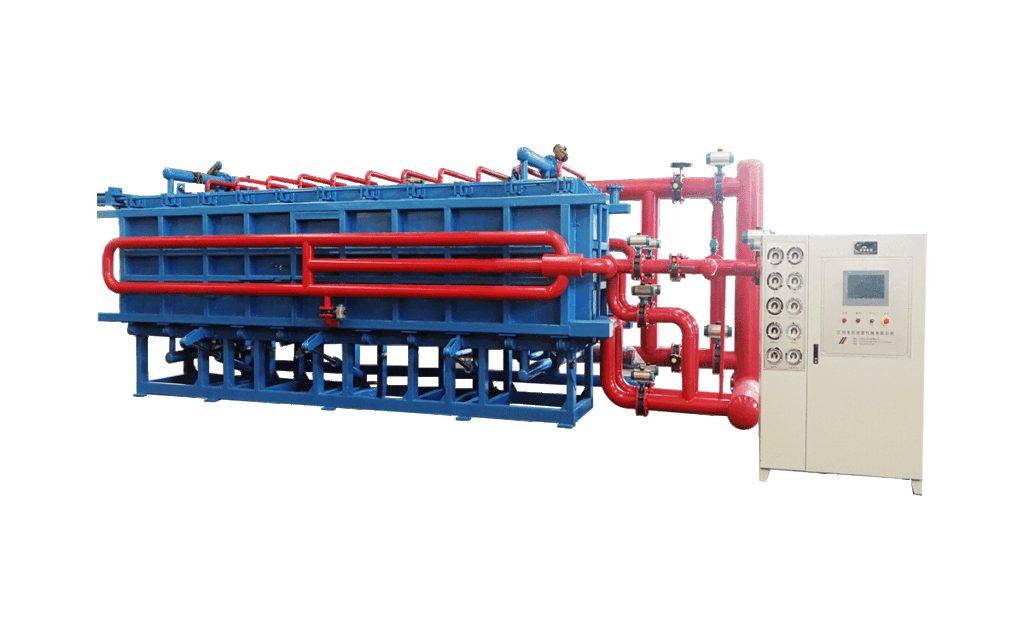
Start by finding the real bottleneck
Before you buy a bigger EPS block molding machine, find where your line actually stalls. Most plants that think they need more moulding capacity are really short on steam, bead supply or handling — and a new moulder just exposes the bottleneck faster. Map the cycle: pre-expansion, ageing in a silo, moulding, cooling, cutting. The slowest stage is what limits you, and that is where the money should go first.
Three layouts and how they scale
Block moulders come in three layouts, and they scale differently:
- Vertical. Fills from the top, compact footprint, the standard workhorse for panels and shapes cut on a cutting line.
- Horizontal (styrofoam). Loads and ejects along the length, better for long blocks and in-line conveyor handling.
- Height-adjustable. One frame changes block height, so you carry fewer mould sizes as volume grows.
For steady expansion, many plants add a second machine of the same layout (simpler training and spares) rather than mixing types.
What capacity actually looks like
| Series | Block length | Output | Fit for scaling |
|---|---|---|---|
| SPB-2000 | 2,000 mm | 12–15 blocks/hour @15 kg/m3 | Entry and satellite lines |
| SPB-4000 | 4,000 mm | 12–15 blocks/hour @15 kg/m3 | Standard high-volume panels |
| SPB-6000 | 6,000 mm | 12–15 blocks/hour @15 kg/m3 | Long-board, continuous feed |
Output is quoted at 15 kg/m3; higher-density blocks take longer per cycle, so size for your real density, not the brochure number.
Steam and automation decide the ceiling
A pre-expander and a steam accumulator feed the moulders; under-sized steam is the most common hidden cap on expansion. Automation — automatic filling, ejection and block handling — raises effective output per machine and cuts the labour that otherwise scales with every new moulder you add.
Mistakes when expanding
- Buying moulders before fixing steam. The new machine just waits on the boiler.
- Ignoring the silo buffer. Without aged-bead storage, adding moulders exposes every pre-expander stop.
- Skipping mould investment. More machines with too few moulds means idle capacity waiting on tooling.
- Forgetting handling. Blocks still have to move; manual handling becomes the bottleneck at volume.
Frequently Asked Questions
Should I add machines or upgrade one?
If your bottleneck is moulding time, a second machine of the same layout is usually cheaper to run than a bigger single unit. If it is steam or handling, fix those first.
How much steam do more moulders need?
Each moulder draws a peak steam load during fusion; size the boiler and accumulator for the combined peak, not the average.
Does block molding need a pre-expander first?
Yes — every block starts as pre-expanded bead from an EPS pre-expander machine, usually buffered in a silo.
Which layout scales best?
Vertical and height-adjustable scale cleanly by adding identical units; horizontal suits plants built around long-block, conveyor-based handling.
Next step
Expansion pays off only when the whole chain scales together. Tell us your current output, density and bottleneck and we will size the block molding, pre-expander and silo to grow without creating a new constraint — contact our team.