
EPS Block Molding Cycle Time Explained: Fill, Steam, Cooling and Eject
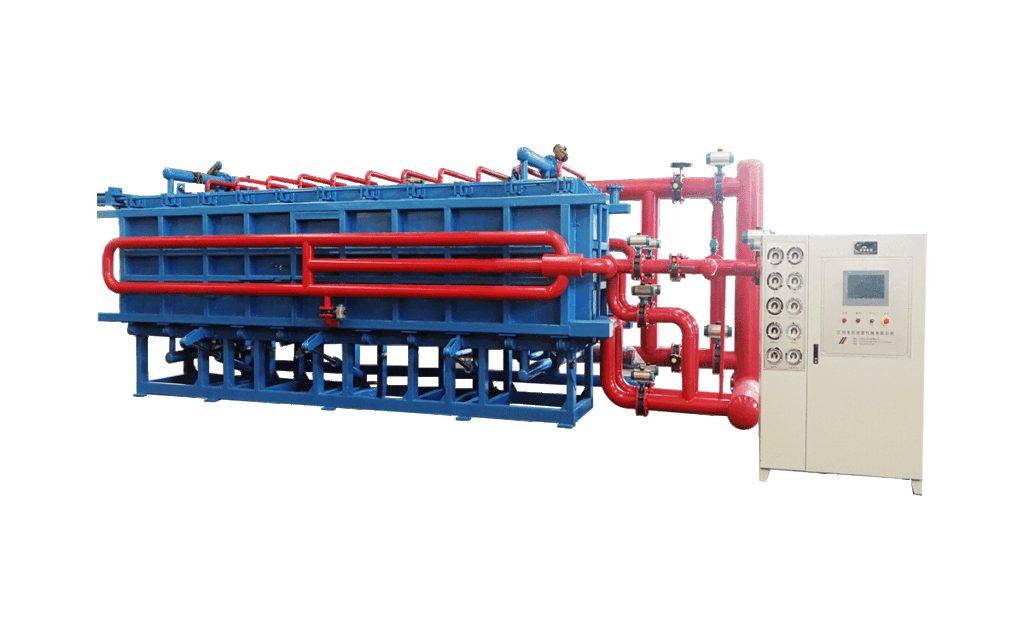
Every plant manager who runs an eps block molding machine eventually asks the same question: why does one block take noticeably longer than another on the same mold and the same material? The answer is almost never the mold. It is the cooling stage. This guide breaks the molding cycle into four phases, fill, steam fusion, cooling and eject, then shows where the time actually goes, how vacuum assist and steam dryness shift the balance, and what to measure before you blame the equipment for a slow line.
Four phases, one bottleneck
The cycle is a sequence, not a single timer. During fill, pre-expanded beads are conveyed into the closed mold cavity and distributed across its full volume. During steam fusion, saturated steam is injected through the mold walls, softening each bead so the surfaces weld into one solid block. During cooling, heat and internal vapor are removed until the block is rigid enough to hold its shape. Only then does the mold open for eject. Each phase has a physical job to finish, and the line cannot advance until that job is done.
In practice the phases are not equal. Fill and eject are mechanical handling steps that take roughly the same effort from block to block. Fusion is bounded by how fast heat travels into the bead mass. Cooling is bounded by how fast heat leaves it, and expanded polystyrene is an excellent insulator. That is the asymmetry that decides your cycle length: the core of a thick block is the last place to cool, and you cannot eject until the core is stable.
Fill: distribution before density
Fill sets the foundation for everything downstream. If beads pack unevenly, some zones end up denser than others, and those zones will fuse and cool at different rates. A block with density bands is a block that warps. Vacuum-assisted fill pulls beads into the far corners of the cavity and evens out the distribution, which is why plants chasing uniform density tend to specify it. The bead condition matters just as much: beads that are still too fresh, still carrying unsettled blowing agent pressure, will not settle and fuse predictably. That is a material problem upstream of the mold, not a mold problem.
It is worth linking the mold back to the equipment that feeds it. Bead expansion happens on an EPS pre-expander machine, and the beads then rest and equalize in an EPS silo system before molding. Get either step wrong and the best mold in the world will still produce inconsistent blocks.
Steam fusion: heat, and water you did not ask for
Steam does two things at once. It delivers the latent heat that softens the polystyrene, and it adds moisture. Dry saturated steam is the efficient case: it gives up its heat at the bead surface and leaves little free water behind. Wet steam, or steam carrying condensate from poorly drained lines, does the heating but also soaks the block with liquid water that must be driven off later.
Steam staging is the usual fix. Rather than one long blast, the controller ramps steam in steps, often from both sides of the mold, so the heat front moves through the bead mass evenly. Over-steaming is a real cost: extra heat has to be removed again, and too much moisture can leave surface marks. The goal is the minimum energy that achieves a sound fusion line across the whole block, nothing more.
Cooling: the phase that sets the clock
Cooling is where cycle time and block quality are decided together. A freshly fused block is hot, soft, and full of steam at pressure above ambient. If you open the mold now, the pressure difference and the softened polymer let the block spring, shrink or collapse. Cooling has to bring the core temperature down and let internal pressure equalize with the room. Vacuum-assisted cooling speeds this by pulling vapor out of the block and flashing off condensate, so the pressure drops faster than passive water cooling alone can manage.
This is the counterintuitive part for buyers: the fastest way to a shorter cycle is rarely a faster fill or a hotter steam burst. It is better heat and vapor removal at the core. That is also why vacuum capability is worth evaluating as a cooling feature, not just a filling feature. A machine such as a vertical EPS block molding machine or a horizontal EPS block molding machine should be compared on how it manages this phase, not on its nameplate alone.
Reading the published specifications
The SPB range is rated by block size and line-level output, not by a per-phase timer. The figures below are the published ones; treat them as a way to size the machine, not as a promise about your cycle, which depends on your density, bead condition and steam quality.
| Parameter | Published value | What it means for the cycle |
|---|---|---|
| Model range | SPB-2000 to SPB-6000 | Larger model, larger cavity and more heat to remove |
| Block length | 2000-6000 mm | Drives mold volume and the distance heat must travel to the core |
| Rated output | about 12-15 blocks/hour at 15 kg/m3 | Plant-level figure, not a phase-by-phase cycle time |
| Reference density | 15 kg/m3 common, 20-30 kg/m3 board cuts slower | Denser blocks hold more heat and need slower downstream handling |
Notice what is absent: a cycle time in seconds. The datasheet cannot give you one, because the number belongs to your material and your utilities. Anyone quoting a fixed cycle without asking about density, steam dryness and bead age is guessing.
How to specify a machine with the cycle in mind
- Fix the target density and block size first, because they determine the heat load the cooling phase must clear.
- Ask how the cavity is filled and whether vacuum assist is available; uneven fill shows up later as density bands.
- Check how steam is generated, drained and staged, and how condensate is kept out of the mold.
- Confirm the cooling method, water, vacuum or both, and how the controller decides the phase is complete.
- Measure a real cycle on your own beads and density before accepting any throughput claim, and log each phase separately.
Common misconceptions
- More steam means faster fusion. Extra wet steam adds water you must remove in cooling, so it can lengthen the cycle.
- Cooling is just waiting for the block to feel cold. It is really about internal pressure equalizing with ambient.
- Do the arithmetic before buying a bigger vacuum pump: if fill, fusion and eject already dominate your cycle, even a large cut in cooling time moves total output only slightly. Pay for the phase that is genuinely the bottleneck.
- A nameplate output figure is a cycle guarantee. It is a rated line figure measured under reference conditions, not a timer.
- Shrinkage after eject is a mold fault. It is far more often a sign that the block was ejected before the core stabilized.
Frequently Asked Questions
Does vacuum assist always shorten the cycle?
Usually on the cooling side, because it removes vapor faster. But it only helps if cooling is the limiting phase; on a line where fill or handling dominates, the gain is small.
Why does my block shrink after it leaves the mold?
Typically the core was still hot and pressurized at eject. Extend cooling until internal pressure equalizes, and check that steam is not soaking the block with condensate.
Is dry steam worth the extra piping and drainage work?
For most plants, yes. Less free water means less to evaporate in cooling and fewer surface defects, which usually outweighs the cost of proper traps and insulation.
Can I set my cycle timer from the 12-15 blocks/hour figure?
No. That is a rated line output at 15 kg/m3, not a per-phase time. Build your own phase log from measured runs.
What should I record to diagnose a slow cycle?
Log fill, steam, cooling and eject durations separately, plus density, bead age, steam condition and any vacuum readings. The bottleneck shows up as the phase that barely changes when you tweak the others.
If you are comparing an eps block molding machine for a new line, the useful conversation is about your material and your steam, not just a nameplate. Share your density, block size and utility conditions with us and we can talk through the cycle in concrete terms. Contact our team to discuss your layout.