
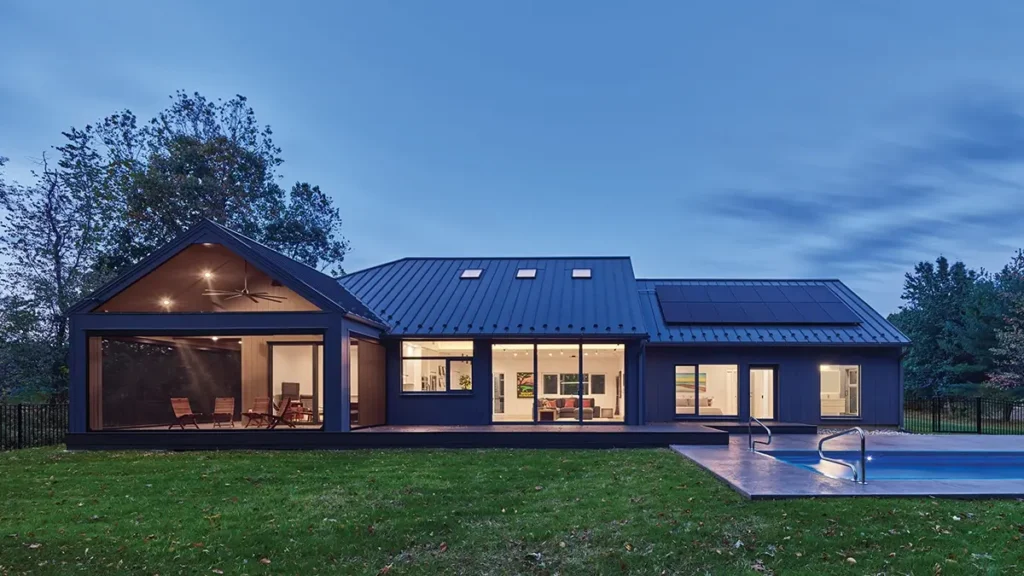
Passive House buildings are designed to hold their heating demand near 15 kWh/m² per year, and in most climates the insulation layer does most of that work. Expanded polystyrene is one of the materials that makes the target practical: it is light, dimensionally stable, moisture resistant, and — at the thickness a Passive House envelope needs — still affordable.
From EPS bead to Passive House insulation board
Every EPS insulation board starts as pre-expanded beads, fused into a large, uniform block by an eps block molding machine and then cut to exact thickness on an EPS cutting line. That two-step route is what Passive House work needs. Density and compressive strength are fixed at the moulding stage; thickness tolerance is fixed at the cutting stage. A producer running the right pair of machines can supply 200 mm, 250 mm or 300 mm boards with the flat, consistent faces that a thick insulation layer depends on.
Where EPS fits in a Passive House envelope
- Exterior walls (ETICS): 200–300 mm of EPS, often graphite-enhanced, fixed to the wall and finished with render.
- Roofs and ceilings: the same material in flat or tapered form, where thickness is usually limited by the build-up height.
- Slab-on-grade and foundations: higher-density EPS under the slab, specified for compressive strength rather than R-value alone.
- Thermal bridge details: window reveals, balcony connections and wall-to-floor junctions, where EPS is cut to shapes a standard board cannot cover.
Why the U-value maths makes thickness accuracy matter
Passive House targets U-values around 0.15 W/(m²K) for opaque elements. At λ = 0.032 W/m·K that means roughly 210 mm of EPS; most designers go to 250 mm for margin. Once boards are that thick, cutting tolerance stops being a cosmetic question — a board that runs 5 mm thin across a whole wall lowers the as-built thermal performance for the life of the building. This is why insulation producers pair an eps block molding machine with a calibrated CNC cutting machine or cutting line, and why block size matters: a larger block means fewer joints and fewer chances of a gap.
Airtightness and moisture
In a Passive House the airtight layer and the insulation layer have separate jobs. EPS is closed-cell and does not wick water, but it loses thermal performance if it stays wet, so the assembly still needs a drained, ventilated rainscreen and correct flashing. Fixed to the outside of a properly detailed airtight structure, EPS provides the continuous thermal envelope; water driven through an open joint is what degrades it.
Choosing machines for insulation board production
Board thickness range, block size and cutting accuracy are the three specifications worth settling first. The eps block molding machine you pick sets the largest block you can produce, and therefore the thickest insulation board — and the widest board — you can supply to a Passive House project. YouXin supplies horizontal, vertical and height-adjustable block moulding machines together with cutting lines sized for insulation board production.
For the wider picture, see our EPS Insulation page, or contact us with your target board thickness and output.