
FAQ
Common questions about EPS machines, production lines and after-sales service.
EPS foam density ranges you will actually meet
Expanded polystyrene (EPS) used for cutting comes in a wide bead-density spread. Most shape and block producers work between 8 kg/m3 (very light packaging) and 40 kg/m3 (structural, insulation, architectural). Specialty grades can reach 60 kg/m3. An EPS Cutting Machine must stay controllable across this whole window, not just at one density.
Hot-wire cutting: adjust temperature and feed speed by density
A resistance hot wire melts and parts the bead strand as it moves. Lower density foam cuts almost effortlessly; higher density needs more heat and a slower pass. As a practical starting point:
| EPS density (kg/m3) | Recommended wire temp | Feed speed | Wire diameter |
|---|---|---|---|
| 8 – 15 | Low – medium | Fast | 0.2 – 0.3 mm |
| 15 – 25 | Medium | Medium | 0.3 – 0.4 mm |
| 25 – 40 | Medium – high | Slow | 0.4 – 0.5 mm |
| 40 – 60 (specialty) | High | Very slow | 0.5 – 0.6 mm |
If you force a fast feed on dense foam, the wire drags and leaves a rough, melted edge. Slow down and raise the temperature a little instead.
CNC routing: the better tool for very high density and 3D
Above roughly 30 kg/m3, or whenever you need true three-dimensional shapes, an EPS CNC cutting machine with an oscillating or spindle blade beats a hot wire. It does not rely on melting, so dense bead stock cuts cleanly without smearing. For architectural cornices, letters and moulds this is the standard choice.
One machine, the full density range
A well-built EPS Cutting Machine pairs a hot-wire contour table with optional CNC routing, so you can run 8 kg/m3 packaging and 40 kg/m3 insulation on the same line by changing the wire setting and feed program. See the full hot-wire vs CNC speeds and maintenance FAQ for day-to-day tuning.
Expanded polystyrene (EPS) foam is combustible, and an EPS Cutting Machine—whether a hot-wire cutter, a CNC router, or a continuous cutting line—constantly generates the heat and friction that can start a fire. That is why every EPS foam plant should keep a fire extinguisher within arm’s reach of each cutting station.
Why an EPS Cutting Machine Creates a Real Fire Risk
Most EPS cutting is done with a heated resistance wire or a high-speed router bit. The hot wire on an EPS Cutting Machine runs at several hundred degrees Celsius; if the wire snaps, touches the machine frame, or cuts too slowly, it can overheat and ignite the foam directly. A CNC router creates fine EPS dust and heat from friction, and that dust is highly flammable in the air. EPS has a low auto-ignition temperature, so a single spark or a blocked extraction system is enough to start a fire that spreads through offcuts quickly.
Which Fire Extinguisher Belongs Next to an EPS Cutting Machine
For EPS foam, an ABC dry chemical (multipurpose) extinguisher is the standard choice—it covers Class A ordinary combustibles, which includes polystyrene. CO₂ extinguishers also work well on small electrical and foam fires without leaving residue. Mount the extinguisher on the wall within 3–5 metres of the EPS Cutting Machine, at a height operators can grab without moving stock, and never let it be blocked by offcuts or pallets.
Fire-Safe Operation Checklist
- Fit one extinguisher per cutting zone, plus a fire blanket near the station.
- Keep the cutting area clear of EPS offcuts and dust; run extraction and ventilation at all times.
- Train every operator to use the extinguisher and locate the emergency stop.
- Inspect extinguishers monthly and never bypass machine guards or thermal cut-outs.
- Set correct wire temperature and feed speed so the EPS Cutting Machine cuts cleanly instead of smouldering.
Choose a Safer, Better-Built Cutting Line
Machine design matters as much as housekeeping. Our EPS Cutting Machine range is built with guarded cutting zones, reliable thermal protection and optional fume extraction to lower fire risk on the shop floor. You can also review our EPS CNC Cutting Machine and the EPS Cutting Machine FAQ for speed, maintenance and safety details.
A fire extinguisher next to your EPS Cutting Machine is the cheapest insurance you can buy—pair it with a well-built machine and trained operators, and your cutting line stays productive and safe.
A well-run EPS line is a chain: the pre-expander, the molding presses, and the cutting equipment all depend on each other. When one link slips, the whole plant slows. This EPS machine maintenance checklist covers the routine care that keeps pre-expander, block molding, and cutting equipment running—and the mistakes that cause the most unplanned downtime.
Why a maintenance checklist matters
EPS plants run steam, moving bead, and hot wire or blade cutting. Each of those has a failure mode that silently degrades quality before it causes a stoppage. A short, repeatable checklist catches drift early, when it is a five-minute fix instead of a lost shift.
Pre-expander care
How often should I inspect the steam system on the pre-expander?
Check steam pressure and condensate daily. Instability here is the most common cause of off-density bead on an EPS pre-expander machine.
What wears out first in a pre-expander?
Steam distribution parts and chamber seals. Inspect them weekly; replace at the first sign of uneven bead or pressure loss.
Block molding care
What should I check on the molding press?
Mold seals, steam valves, and the venting sequence. A vertical block molding machine that leaks steam makes uneven blocks and wastes energy.
How do I avoid fused or short-molded blocks?
Keep steam timing and mold temperature inside the qualified window, and never skip the vent cycle. Drift here is a quality problem long before it becomes a breakdown.
Cutting equipment care
How do I keep cutting quality high?
For hot-wire and cutting line equipment, tension and clean the wires regularly and verify drive calibration. Dull or slack wires drift off dimension within a single shift.
What about CNC cutting machines?
An EPS CNC cutting machine needs clean rails, lubricated drives, and a dust-free control cabinet. Controllers fail from foam dust, not from age.
Cross-line mistakes
What maintenance mistake causes the most downtime?
Running until failure instead of on a schedule. A planned two-hour service beats an unplanned twelve-hour stoppage every time.
Should recycling equipment be on the same plan?
Yes. Your recycling machine crusher blades and densifier wear with volume; track them so scrap doesn’t back up.
How do I document the checklist?
Keep a simple log per machine with dates, readings, and parts changed. It turns guesswork into trend data and makes spare-parts planning easy.
Quick daily checklist
Steam pressure stable · seals intact · wires tensioned · rails clean · safety guards in place. Five minutes per machine, every shift.
Need help building a maintenance plan around your specific machines? Contact our team for guidance matched to your line.
Packaging and wrapping are the last step before your EPS leaves the factory, and the step most likely to cause container claims if done wrong. This FAQ covers the practical questions buyers ask about films, speeds, and export packing for both block packaging machines and wrapping machines for shape products.
Frequently Asked Questions
What is the difference between an EPS packaging machine and a wrapping machine?
An EPS packaging machine wraps regular rectangular blocks in a continuous PE film and seals them into square packs for storage and export. A wrapping machine for shape products wraps irregular pieces on all six sides. Blocks go to the packer; shaped parts go to the wrapper. Many factories run both.
What film thickness should I use for block packaging?
YouXin’s SPLB-1200 block packaging machine uses 0.03 mm PE film as standard. Thinner film saves cost but tears more on sharp corners; thicker film protects better but raises per-pack cost. Match the gauge to how the pack is handled in your warehouse and container.
How fast is an EPS block packaging machine?
Around 8 packs/min at standard density with continuous film. Real speed depends on block size, density, and how quickly packs clear the outfeed table, so plan the downstream handling, not just the sealer.
Can a wrapping machine handle both blocks and shape parts?
A 6-side wrapping machine is built for irregular loads and will wrap a block, but a block packaging machine does rectangular packs faster and squarer. If your output is genuinely mixed, run a packer for blocks and a wrapper for shapes.
Do I need packing equipment if I only make shape parts?
If every order is a shaped profile, a wrapping machine for shape products is enough. A block packaging machine only pays off once block output is steady. Start with the wrapper and add a packer as volume grows.
How do I prepare packs for export containers?
Film-sealed, square packs stack and brace better than loose foam, reducing shift and damage in transit. Keep packs uniform in size, strap or film them so they do not separate, and confirm the film gauge survives handling at both ends of the route.
For a tailored packing setup, see the EPS packaging machine and wrapping machine for shape products, or pair them with a cutting line. Contact YouXin with your block size and daily output.
As EPS production and protective-packaging volumes grow, so does the pile of off-cuts, rejected blocks and used packaging. For a foam that is more than 95% air by volume, that waste is deceptively heavy on logistics even when it is light in weight. An EPS recycling machine turns that bulky waste into a dense, saleable or reusable raw material, converting a disposal cost into a recoverable asset. Below are the questions plant operators and buyers ask most often when they start evaluating one.
Before the detail, one framing point: the goal of any recycling cell is volume reduction first and material recovery second. If you only crush the foam you still cut hauling cost; if you also recover the material into your own loop you start saving on virgin resin. Knowing which outcome you want changes which machine you should buy, so the questions below are ordered around that choice.
How Does an EPS Recycling Machine Work?
The core problem with EPS waste is volume. A full skip of loose foam holds almost no material by weight, so you pay to move air. A recycling machine compacts the foam and forces the air out, producing a dense ingot or granulate that is easy to store, ship and sell. Every system starts by reducing the foam to a manageable form — usually shredding — and then collapsing its volume through either cold compression or heat. The choice between those two paths is the single most important buying decision.
EPS Recycling Machine FAQ
What is the difference between a densifier, a compactor and a melter?
A densifier uses heat and screw pressure to melt EPS into a solid ingot (density around 600–900 kg/m³). A cold compactor grinds and compresses foam without melting, producing a dense granulate that keeps the material in a recyclable form. A melter pushes density even higher for maximum shipping savings but the output is usually burned or repelletized rather than remolded. For a factory that wants to recover material back into production, a cold compactor paired with a pre-expander feed loop is often the cleaner choice because the polymer is not degraded by heat.
What density can recycled EPS reach?
Cold compactors typically deliver 200–400 kg/m³, while thermal densifiers reach 600–900 kg/m³. The higher the density, the lower the freight cost per tonne — but thermal methods change the polymer, so match the method to what you will do with the output. If the ingot will be repelletized by a specialist, maximum density wins; if you want to reuse it yourself, keep it cold.
Do I need a crusher before the densifier?
In most plant layouts, yes. Whole blocks and thick off-cuts should be shredded first so the densifier or compactor feeds evenly. A crusher also maximises the volume reduction you get before the expensive thermal step, which means fewer densifier cycles and lower energy per tonne of recovered material.
Can recycled EPS go back into production?
Cold-compacted granulate can be blended back into certain products at controlled ratios, depending on the application and quality requirements. Thermal ingots are more often sold to downstream recyclers who repelletize them. Either way, an EPS recycling machine converts a disposal cost into a recoverable asset, and many plants use the recovered bead to offset a measurable share of their virgin resin purchases.
How much floor space and power does a recycling line need?
A compact crusher-plus-compactor cell fits in a modest corner of the shop floor and runs on standard three-phase power. Thermal densifiers need more space for the screw and cooling zone and draw more current, so confirm your electrical supply before specifying. Plan for a short infeed conveyor and a small buffer bin so the cell does not become a bottleneck during peak trimming.
Is EPS recycling worth it for a small factory?
It depends on waste volume and local disposal cost. Where landfill or skip hire is expensive, even a small cold compactor pays back quickly by cutting hauling frequency. Larger producers with steady off-cuts usually recover the machine cost within a year or two through material and logistics savings, and the payback shortens further wherever virgin resin prices rise.
What about EPP and other foams?
EPP and other engineered foams behave differently and are not always compatible with an EPS-directed line. If you also run EPP, discuss a dual-purpose or separate system with the equipment supplier so you do not buy the wrong machine and end up with a cell that only handles half your waste stream.
What maintenance does a recycling machine need?
Cold compactors are mechanically simple: periodic bearing lubrication, screen inspection on the grinder, and keeping the feed free of stones or metal. Thermal densifiers need more attention around the screw, heater bands and cooling zone. Budget a short daily check and a monthly service, and keep a spare set of grinder screens on hand so a worn screen never stalls the line.
How do I calculate payback for a recycling cell?
Start with three numbers: the volume of waste you generate per month, the cost to haul or landfill it, and the value of recovered material or avoided virgin resin. Add the cell’s power and maintenance cost, then divide the installed price by the monthly net saving. Plants that already pay to haul full skips several times a week typically see the clearest case, because the hauling saving alone often covers most of the running cost.
Can a recycling machine integrate with my cutting line?
Yes, and that is where the saving compounds. Off-cuts from an EPS cutting machine and trimmings from molding can be conveyed straight into the crusher rather than swept into a skip. Integrating the cell with your existing cutting and molding equipment means waste flows back into the loop automatically instead of piling up and waiting for a separate handling step.
Are there environmental or regulatory drivers?
In many markets, foam packaging waste faces landfill restrictions or extended-producer-responsibility rules, and customers increasingly ask for evidence of recycling. A visible, functioning recycling cell helps with both compliance and sales, because it demonstrates that the protective packaging you supply does not simply become landfill at the end of its life.
What should I ask a supplier before buying?
Ask for the real density and throughput at your actual waste mix, not a best-case figure; confirm the electrical supply requirement; check whether the machine handles your off-cut sizes without pre-cutting; and ask for a reference plant with a similar output. A credible supplier will also help you size the crusher, compactor and buffer as one system rather than selling isolated boxes.
Choosing the Right Configuration
The right EPS recycling machine depends on how much waste you generate, whether you want to reuse the material yourself, and your freight economics. Pair it with your existing cutting and molding equipment so waste flows straight back into the loop instead of piling up, and specify the crusher, compactor and buffer as one integrated cell rather than separate purchases.
Conclusion
Recycling is no longer just a compliance box — it is a direct line to lower material and disposal cost, and a selling point with customers who care where packaging ends up. To size a recycling cell for your output and discuss integration with your current line, contact our team for a layout and quote.
EPS cutting machines cover a wide family of equipment — from a simple hot-wire block slicer to a fully computer-controlled CNC contour cutter. Buyers regularly mix them up, so this FAQ answers the questions YouXin hears most often from new factories and fabricators, and points to the right machine for each job.
EPS Cutting Machine FAQ
What is the difference between a hot-wire cutting machine and a CNC cutter?
A hot-wire cutting machine moves a heated wire in a fixed or guided path to slice blocks into sheets or simple profiles. A CNC cutter is computer-controlled: it follows a digital CAD file along X and Y (and sometimes Z or rotary) axes to produce complex 3D shapes without a mold. Use a plain cutter for volume sheet and block work; use a CNC cutting machine for letters, cornices, and prototypes.
How fast can an EPS cutting machine cut?
Cutting speed depends on foam density. A EPS cutting line typically runs 1.8–2.0 m/min at 15 kg/m3, while a CNC cutter runs 0.3–0.6 m/min because it traces a contour rather than a straight pass. Quoted speeds are almost always measured at the lowest density, so size real throughput against the material you will actually run, not the brochure figure.
What wire should I use for EPS cutting?
Most machines use a NiCr (nickel-chromium) resistance wire because it holds a stable temperature and resists sagging. Wire gauge is a trade-off: thicker wire cuts faster but leaves a wider kerf and more heat-affected edge; thinner wire gives a finer edge but snaps more easily under tension. Keep spares on hand and tension the wire before the first pass of the day.
Can one machine do both straight blocks and 3D shapes?
Not well. A block slicer is built for straight, repeated passes and will not trace a contour. A CNC cutter handles 3D shapes but is slow and wasteful for plain sheet. Most efficient shops run a cutting line for volume sheet work and a CNC cutter for shaped parts, rather than forcing one machine to do both poorly.
How do I maintain the cutting wire and carriage?
Daily: inspect the wire for nicks and correct tension; wipe rails and guides to remove static dust; confirm the table is flat. Weekly: check carriage bearings and the temperature controller calibration. Seasonally: verify table squareness and replace worn guide bushes. Clean extraction is the single biggest factor in long-term accuracy, because EPS dust clogs switches and rails faster than wear does.
Do YouXin cutters come with software and training?
Yes. YouXin EPS cutting machines ship with the CAM software needed to import DXF, STEP, and SVG files, and our team provides operator training so your staff can nest parts, set wire temperature, and run the first production job confidently. Reach the engineering team through the contact page to discuss file formats and training for your parts.
What wire gauge should I keep in stock?
For most EPS work a 0.3–0.5 mm NiCr wire is the everyday choice: fine enough for a clean edge, strong enough to hold tension on a 2–3 m span. Keep a spool of 0.3 mm for detailed CNC contour work and 0.5 mm for high-volume straight slicing, plus a few tension springs. Replacing a fatigued wire before it snaps mid-job avoids a ruined sheet and a half-day of re-threading.
What power supply and floor space does a cutting machine need?
A hot-wire or CNC cutter draws modest current — the wire and drives, not a compressor, are the load — but the table footprint is the real constraint. A 3 m CNC platform needs roughly 4 m of clear floor once you allow access on both sides, plus space for offcut handling and a dust hood. Confirm the supply is grounded and free of voltage drop, because a sagging feed slows the carriage and leaves a wavy edge. If you are laying out a full cutting line, plan the cell as one flow rather than separate islands.
How accurate is the cut, and does it need calibration?
With a rigid frame and a tensioned, temperature-stable wire, edge repeatability is typically within a millimeter across a 3 m panel. Accuracy comes from wire tension, table flatness, and feed consistency more than from the motor spec. Check squareness seasonally and recalibrate the temperature controller when you change foam grade; those two steps prevent the slow drift that shows up as parts that no longer nest together after a few months of running.
Which cutting machine should a new factory start with?
If your first orders are insulation boards or packaging sheets, start with a cutting line. If you already have block molding and need shaped parts — signage, architectural profiles, or packaging inserts — add a CNC cutter. Many shops begin with both a line and a CNC unit once volume justifies it. Our engineers can help you sequence the purchase so each machine pays for itself.
Starting an EPS (Expandable Polystyrene) factory raises one question above all others: which machines do I actually need? This FAQ answers the most common buyer questions and links to the relevant YouXin equipment so you can plan a line that fits your budget and market.
What is the basic EPS production flow?
A typical line runs: pre-expand beads → age/silo → block mold → cure → cut → pack. Each stage has a dedicated machine, and you can start small then add capacity.
Which machine do I need first — pre-expander or block molding?
Both are core. The EPS pre-expander machine turns raw bead into low-density EPS, and a vertical EPS block molding machine fuses it into blocks. You cannot make blocks without pre-expanded bead, so most buyers commission both together.
Do I need a cutting line or a cutting machine?
If you only trim blocks into sheets, a single EPS cutting machine may suffice. If you produce panels, shapes or high volumes, a EPS cutting line — or a CNC cutting machine for complex profiles — pays for itself in speed and accuracy.
What about packing and wrapping?
Finished sheets and shape products need protection. An EPS packaging machine for sheets and an EPS wrapping machine for shape products reduce damage in transit and lift your presentation.
Should I add a recycling system from day one?
It is optional but smart. An EPS recycling machine turns scrap back into reusable material, cutting raw-bead cost and waste disposal fees — often paying back within a year.
How do I choose between vertical and horizontal block molding?
Vertical machines suit compact footprints and easier demolding; horizontal machines suit larger blocks and higher automation. Your available space and target block size decide it.
Can YouXin design a complete plant for me?
Yes. We provide layout drawings, machine selection, installation guidance and training so your factory runs smoothly from commissioning.
How do I get a quote?
Share your target products, capacity and workshop size via our contact page, and we will propose a matched, costed line.
Short answer
An EPS wrapping machine for shape products is a PE film packaging machine that encloses irregular EPS items — cornices, insulation boards, fish boxes, custom molded parts — in film on all six sides in a single automatic cycle. Unlike a block packer, it is built for non-uniform bundles that must be fully sealed before shipping.
How does six-side wrapping actually work?
- Loading. The EPS shape product bundle is placed at the infeed, either manually or by an optional automatic loading system.
- Film pick-up. As the bundle is pushed forward, it draws PE film along with it from the roll.
- Six-side wrap. During the advance, the film is formed around the top, bottom and all four vertical faces of the bundle.
- Sealing and cutting. The film is heat-sealed and cut automatically — foil positioning, fastening, welding and cutting complete in one pass.
- Discharge. The finished, fully enclosed package exits the machine, optionally onto an automatic stacker or through an automatic labelling machine.
Because the seal and cut happen in the same cycle, there is no second manual operation to close the ends.
What sizes can it handle?
On the YouXin Model MT-C1, the packing width is adjustable across roughly 600–800 mm and the packing height across 300–600 mm. A related configuration covers up to 900 mm width with product length around 1500 mm, while another handles product length up to 2000 mm. Always confirm against your largest bundle before ordering.
How fast is it?
It depends on the film and the configuration: around 2–3 packs/min using 0.02 mm PE film at 1200×800×600 mm, or approximately 4–6 packs/min with 0.01 mm HDPE film in the alternate setup. Your real number depends on bundle size and operator loading rhythm, so validate it with your own product.
Which film should I use?
Both PE (around 0.02 mm) and HDPE (around 0.01 mm) are used in this machine class. Thicker film gives better puncture resistance on sharp molded corners; thinner film lowers cost per pack. The machine saves film and tape compared with manual wrapping because film is metered per cycle and no tape is needed.
What is it made of — and will I get spare parts?
The control side uses a Siemens touch screen and PLC with Schneider electronics, Airtec pneumatics and Autonics photo sensors; an alternative build uses Xinje PLC and servo motor with the same Schneider electronics and Autonics sensors. These are widely distributed brands, which keeps replacements straightforward. The machine is CE certified.
Is it the same as a block packaging machine?
No. A block packaging machine handles uniform rectangular blocks. Shape products need the six-side enclosure described above because their profiles vary and their surfaces are more easily damaged.
Can it be automated further?
Yes — options include an automatic stacker, an automatic labelling machine and an automatic loading system. Many plants pair it with an EPS CNC cutting machine upstream and a pre-expander earlier in the line, so the whole process from bead to packed product is continuous.
Daily operation tips
- Keep photo sensors clean — dust from cut EPS is the most common cause of mis-cuts.
- Check seal temperature after any film change; PE and HDPE need different settings.
- Log width/height settings per product family to make changeover repeatable.
Where do I get one?
See the specification and configuration options on the EPS Wrapping Machine for Shape Products page, or contact YouXin with your bundle dimensions and target output.
Buyers comparing an EPS pre-expander machine and a block molding machine ask the same questions. Here are the answers our engineers give most often.
What does an EPS pre-expander machine actually do?
It steams raw polystyrene bead so it expands 20–50x into low-density EPS pearls. These pearls are then aged and fed to molding. Without a stable EPS pre-expander machine, downstream blocks are uneven and weak.
What bead density can be achieved?
Typical pre-expanded density is 10–25 g/L for packaging and 15–30 g/L for construction board. YouXin machines hold density within a tight band via closed-loop steam control.
What is the block molding cycle time?
A vertical EPS block molding machine runs roughly 3–6 minutes per block depending on size and target density. The horizontal styrofoam EPS block molding machine suits longer, continuous block formats.
How do I raise output without buying a second line?
Stabilize pre-expansion first, then reduce cooling time with optimized water/air sequences, and keep bead age consistent. Many plants gain 15–25% output just by tuning the pre-expander and molding parameters.
Pre-expander + block molding, or buy pre-expanded bead?
If you mold at volume, owning the pre-expander protects your supply and cost. For very low volume, bought bead works — but freight on low-density bead is expensive, so in-house expansion usually wins.
What maintenance keeps uptime high?
Daily: drain steam traps, check bead feeders. Weekly: inspect molds and seals. The height-adjustable EPS block molding machine also benefits from periodic guide-rail lubrication.
Need a Sizing Sheet?
Tell us your target block size, density, and daily tonnage. We return a matched pre-expander + block molding configuration with cycle time and power draw.
Need an EPS pre-expander or block molding line priced for your project? Request a quote and we will send you a tailored proposal with lead time and specifications.
Related: What Is an EPS Machine · EPS Block Molding Cost · EPS block molding · EPS pre-expander
What Is an EPS Machine?
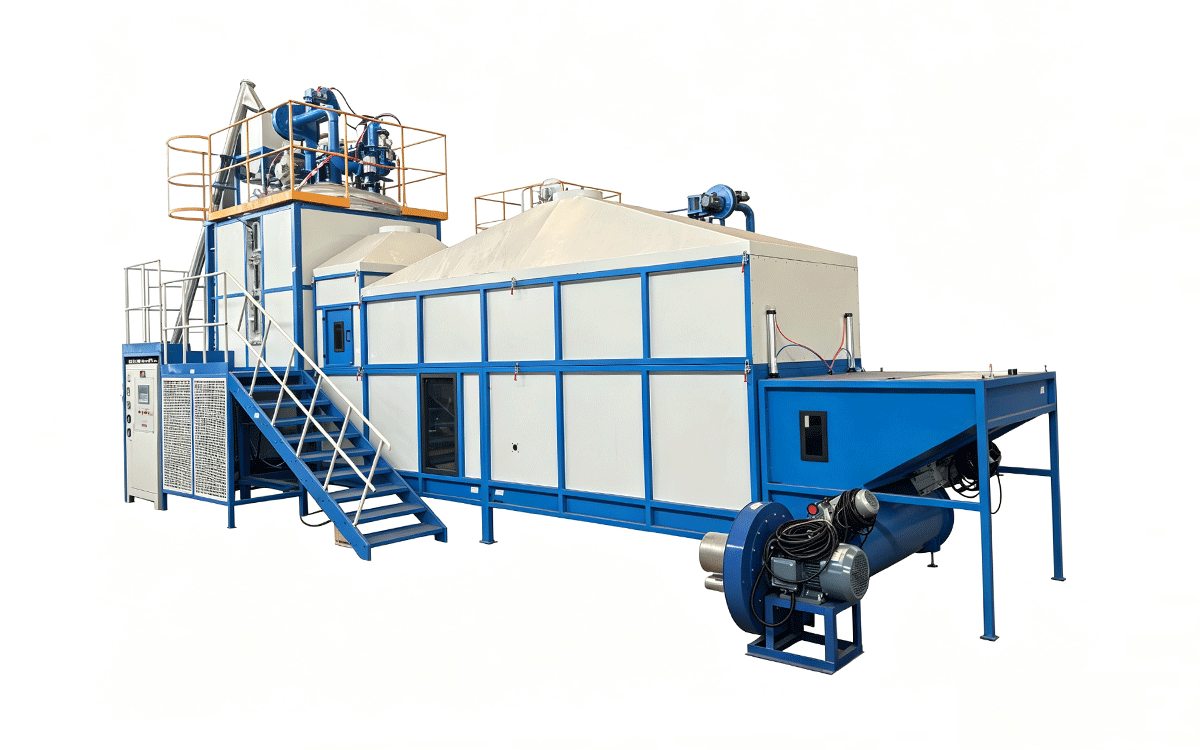
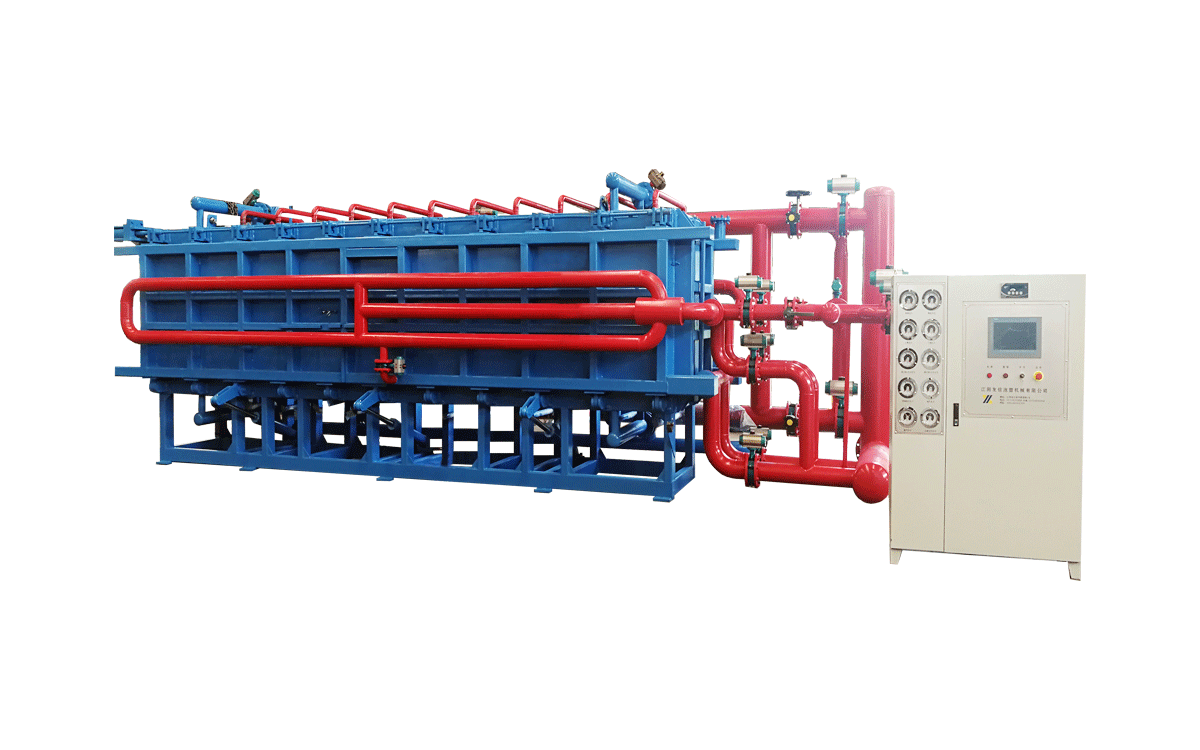
An Expandable Polystyrene machine (EPS machine) is a set of integrated equipment that turns tiny solid polystyrene beads into lightweight, rigid foam used for packaging, insulation and construction. “Expandable” means each bead already contains a blowing agent; heat makes it puff up many times its size.
How Does the Production Line Work?
Step 1 — Pre-Expansion
Raw beads meet steam in the pre-expander and expand to the target density.
Step 2 — Maturation
Beads rest in a silo so air stabilises inside the cells (4–12 hours).
Step 3 — Molding
A block molding machine or shape molding machine fuses beads under steam into blocks or custom parts.
Step 4 — Cutting & Finishing
Blocks are cut to size and packed. The whole line is coordinated by PLC control.
Frequently Asked Questions
Is EPS the same as Styrofoam?
No. Styrofoam is extruded polystyrene (XPS); EPS is bead-molded foam. They are made differently and used differently.
What density can an EPS machine produce?
Typical lines cover 10–30 g/L; double-expansion models reach lower densities for specialty uses.
How much steam does it use?
Modern closed-loop YouXin machines recover steam and cut utility cost versus older open-vent units.
Which industries use EPS foam?
Fish boxes, appliance packaging, building insulation, road construction and decorative profiles are the main markets.
Explore YouXin EPS Solutions
See our full EPS machine range or request a quote.
Related: EPS Pre-expander · Choosing a Cutting Line · EPS pre-expander · EPS block molding
Request a quote for a tailored proposal.