
Vacuum vs Atmospheric EPS Block Molding: Which Fits Your Plant
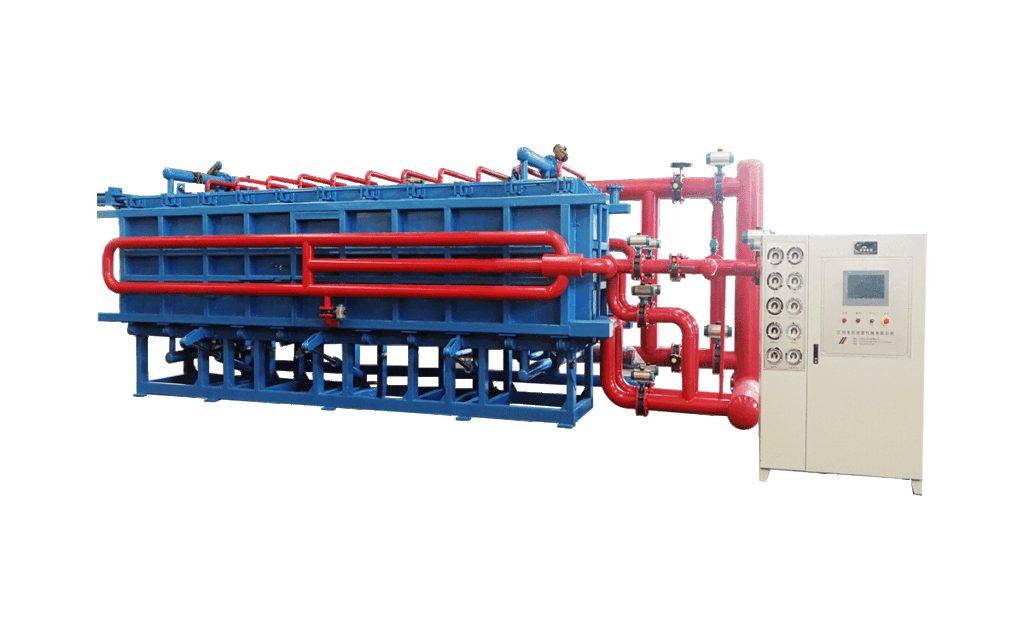
Choosing between vacuum-assisted and atmospheric molding is one of the first decisions a buyer faces when specifying an eps block molding machine, and it is often made on habit rather than on the product you actually sell. Both routes make a sound block, but they differ in how the beads are filled, how steam and vapor are managed, and what the plant has to supply. This guide compares them across cycle time, density uniformity, steam consumption, investment and product structure, then gives a selection checklist you can work through with your own numbers.
What actually changes between the two
In atmospheric, or conventional, molding, beads are blown into the cavity at near ambient pressure and steam is injected to fuse them, while cooling relies on water circulating through the mold walls and on passive venting. It is a simpler loop with fewer components: no vacuum pump, no sealed vent circuit, no extra valves to maintain.
Vacuum-assisted molding adds a low-pressure circuit to the same mold. Vacuum is used to draw beads into the far corners of the cavity during fill, to help steam penetrate the bead mass, and, most importantly, to pull vapor and condensate out of the block during cooling. That last step is what changes the economics, because it attacks the phase that usually dominates the cycle.
Cycle time
Cooling is the slow phase for both designs, since expanded polystyrene insulates well and the core is the last region to stabilize. Vacuum cooling removes vapor faster and encourages condensate to flash off, so the block reaches a stable internal pressure sooner. On a line where cooling is the bottleneck, that translates into more blocks per shift. Where fill, handling or downstream cutting is the bottleneck, the advantage largely disappears. Be honest about which phase limits your line before paying for vacuum capability.
Density uniformity
This is where vacuum fill earns its keep. Pulling beads into the cavity under negative pressure evens out the distribution, especially in tall or long molds where gravity fill can leave thin corners. More uniform fill means more uniform fusion and more uniform cooling, which shows up as a block with fewer density bands and less tendency to warp. Atmospheric fill can produce good blocks too, but it depends more on bead flowability and on careful filling practice. If you cut thin sheets or tight-tolerance panels on an EPS cutting line, uniformity is usually the deciding factor.
Steam consumption and utilities
Vacuum assist often lets the plant reach a sound fusion with less total steam, because steam penetrates a more evenly packed mass and because the vacuum phase removes moisture that would otherwise need extra heat to drive off. The trade is that you now maintain a pump, a condenser or separator, seals and a control valve train. Atmospheric molding has a leaner utility list and is easier for a small maintenance team to keep running. Weigh the steam saving against the added electrical load and the maintenance skill available on site.
Investment and plant fit
A vacuum-equipped machine costs more to buy and needs more space for the pump set and drainage. It also asks for tighter mold sealing and a controller that can sequence vacuum and steam steps, so the program, or recipe, matters more. A vertical EPS block molding machine with vacuum capability is a good example of where the extra hardware has to be planned into the layout rather than added later. Atmospheric machines are the lower-entry-cost option and are common in plants making standard insulation block at moderate volumes. Neither is universally better; the fit depends on throughput target, product mix and how much process control the team can support.
Qualitative comparison
Use this as a checklist, not a scorecard. The right column depends on your product and your utilities, so there are deliberately no numbers in the table.
| Criterion | Atmospheric molding | Vacuum-assisted molding |
|---|---|---|
| Cycle time | Limited by passive cooling, longer where cooling dominates | Shorter where vacuum cooling removes vapor faster |
| Density uniformity | Good with careful filling, more sensitive to bead flow | Higher, especially in tall or long cavities |
| Steam consumption | Higher per block for a given fusion target | Often lower, with moisture removed in the vacuum phase |
| Capital cost | Lower entry cost, simpler utility list | Higher, with pump, seals and control hardware |
| Maintenance | Simpler, fewer components to service | More components and tighter sealing to maintain |
| Best-fit product | Standard insulation block at moderate volume | Tight-tolerance panels and higher-throughput lines |
A five-step selection checklist
- Define the product, block size, target density and how it will be cut downstream.
- Identify your real bottleneck phase by logging fill, steam, cooling and eject separately.
- Audit utilities, steam dryness, drainage, electrical capacity and the maintenance skill on site.
- Compare the two options on uniformity and cycle, not just on purchase price.
- Ask for a trial run on your own beads, then measure density spread and block stability before deciding.
Common misconceptions
- Vacuum always pays for itself. It only pays if cooling or uniformity was costing you output or scrap.
- Atmospheric molding is obsolete. For standard block at moderate volume it is often the most economical choice.
- Do the accounting on total cost, not nameplate price: a cheaper machine that needs more steam and produces more off-spec edge trim can cost more per good block over a year than a vacuum machine that costs more up front.
- Density uniformity is a machine setting. It starts with bead condition in an EPS silo system and with fill distribution, both upstream of the mold.
- A vacuum pump fixes wet steam. It removes moisture, but it cannot replace properly drained, dry steam at the inlet.
Frequently Asked Questions
Which option gives the shorter cycle?
Vacuum-assisted molding usually does, because vacuum cooling shortens the slowest phase. The gain depends on cooling being your bottleneck.
Do I need vacuum for standard insulation block?
Not necessarily. If your density tolerance is wide and volume is moderate, atmospheric molding is often the better economic fit.
Does vacuum reduce steam use?
Often, for a given fusion quality, since steam penetrates a more uniform mass and moisture is removed in the vacuum phase. Your own steam system decides the actual result.
Is the extra maintenance a problem?
It is a real consideration. Pumps, seals and valves need attention, so confirm the local team can support them before specifying.
How do I compare machines fairly?
Run the same beads and density on both, measure density spread across the block, and log each cycle phase. Compare good blocks per shift, not nameplate price.
There is no single right answer, only the right answer for your product mix and your utilities. If you tell us your block size, target density and throughput goal, we can help you weigh a vacuum-equipped height-adjustable EPS block molding machine against an atmospheric setup. Contact our team to talk it through.