
EPS Block Molding Machine: The Complete Buying & Sizing Guide
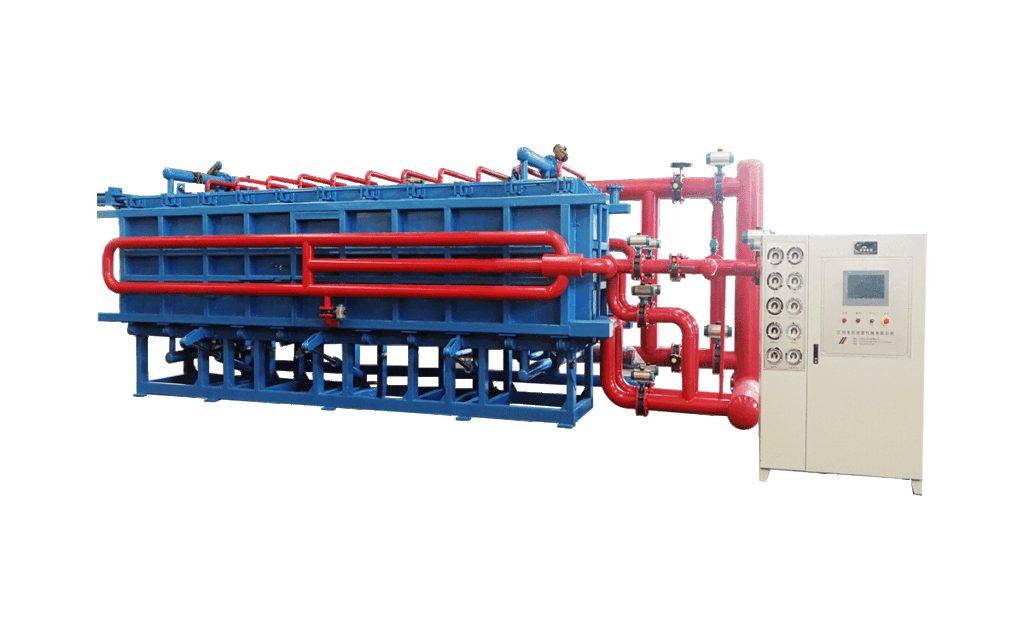
An EPS block molding machine turns pre-expanded bead into the large rigid foam blocks that everything else in your plant is built from. It is the heart of an EPS line: get block quality wrong here and no cutting, shaping or packing step downstream can fix it. This complete guide covers what the machine does, the specifications that actually matter when you buy, vertical vs horizontal layouts, and how to size one to your real daily output.
What an EPS block molding machine does
The machine is essentially a steam-heated pressure mould. Pre-expanded bead (from your pre-expander) is blown into the mould cavity, steam fuses the beads, vacuum drains condensate, and a cured block is ejected. The moulder’s only job is even steam — everything else is plumbing around that fact. The finished block then feeds your cutting line, which slices it into boards and shapes.
The specifications that decide block quality
| Model range | Block length | Throughput @15 kg/m3 | Typical use |
|---|---|---|---|
| SPB-2000 | 2,000 mm | ~12–15 blocks/h | Standard block, sample runs |
| SPB-4000 | 4,000 mm | ~12–15 blocks/h | Standard block + shape split |
| SPB-6000 | 6,000 mm | ~12–15 blocks/h | Long board, high-volume lines |
Match the machine to your moulded block length, not a catalogue number. Sizing the moulder for a shorter block than you actually run forces you to cut blocks in half first — wasted handling. Steam quality at the die, not boiler pressure, decides fusion; see our molding steam system guide.
Vertical vs horizontal
Both a vertical EPS block molding machine and a horizontal (styrofoam) block molding machine make blocks — the difference is orientation, fill and handling. Vertical fills from the top with a compact footprint; horizontal loads along the length and suits long, heavy blocks and in-line automation. The height-adjustable variant changes block height in one frame, cutting the number of mould sizes you need. Our vertical vs horizontal comparison walks the trade-offs.
Where it sits in the line
The block moulder is fed by the pre-expander and buffered by the silo (bead must age before moulding or blocks shrink). Downstream it feeds the cutting line, then packing and, for offcuts, the recycling machine. A balanced line sizes all five together, not the moulder alone.
How to size it
Start from daily block demand, then add one machine of headroom so a mould change never stops the whole plant. Confirm ceiling height (vertical) or floor span (horizontal), a stable three-phase supply, and steam + drainage capacity before you commit. Our installation checklist covers civil works to first block.
Buying checklist
- PLC recipe storage per product (holds density across shifts)
- Steam pressure staging (low then high) for even fusion
- Automated block handling to cut labour and damage
- Spare mould frames / adjustable height to cover your block sizes
Consistency is the product. A line that holds density and fusion while you are not watching ships salable blocks at 2 a.m. Talk to our team for a configuration matched to your output and staffing.