
Many people call white foam packaging, food containers, and coolers “Styrofoam.” While the term is common in everyday speech, it is not technically accurate in most cases.
EPS foam and Styrofoam are both polystyrene-based materials, but they are not the same product. Understanding the difference matters for packaging selection, insulation projects, waste handling, and recycling decisions.
What Is EPS Foam?
EPS stands for expanded polystyrene. It is a lightweight, rigid cellular plastic made by expanding small polystyrene beads with steam. The beads fuse together to create a foam material containing a large amount of trapped air.
This structure gives EPS several useful properties:
- Low weight
- Shock absorption
- Thermal insulation
- Moisture resistance
- Cost-effective production
- Easy shaping and molding
EPS is widely used for protective packaging, insulated boxes, appliance packaging, construction insulation, marine flotation, and cold-chain transport.
What Is Styrofoam?
Styrofoam is a trademarked brand name associated with extruded polystyrene, or XPS, insulation. XPS is manufactured through a different process from EPS. Instead of expanding separate beads, the polystyrene material is extruded into a continuous closed-cell foam board.
Styrofoam Brand XPS is commonly used in building insulation applications, including walls, roofs, foundations, and other construction assemblies. According to the brand owner, the familiar white foam cups, packaging, and coolers commonly called “Styrofoam” are generally made from EPS, not Styrofoam Brand XPS. EPS Foam vs. Styrofoam: The Main Difference
The most important distinction is simple:
- EPS foam is an expanded-bead polystyrene material.
- Styrofoam Brand refers to extruded polystyrene (XPS) insulation.
EPS usually has a visible bead structure and is often white. XPS is typically more uniform in appearance and is commonly supplied as rigid insulation boards. Both materials can provide insulation and low weight, but their manufacturing methods, physical properties, and intended applications differ.
Why the Names Are Often Confused
The word “Styrofoam” has become a generic term in many markets, much like people use a brand name to describe an entire product category. This happens because EPS packaging and XPS insulation can both look like lightweight foam plastic.
However, using the correct name can improve communication between manufacturers, buyers, waste-management teams, and recycling facilities. A recycling partner may accept EPS, XPS, or both, but the material should be identified accurately before processing.
Can EPS Foam Be Recycled?
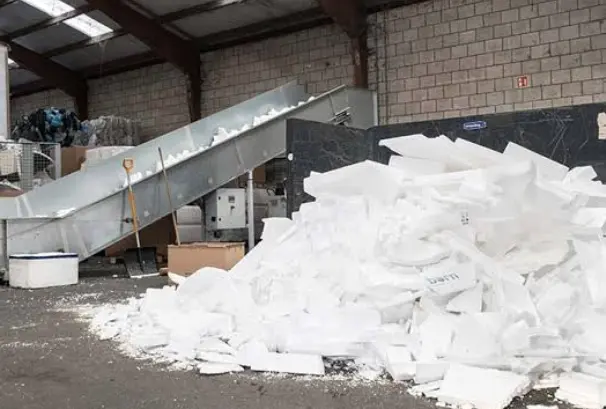
Yes. Clean EPS foam can be recycled, although its low density makes collection and transport challenging. Large volumes of loose foam occupy significant storage space while containing relatively little material by weight.
This is where an eps foam compactor can be useful. A compactor reduces the volume of EPS by compressing loose foam into dense blocks or logs. The compacted material is easier to store, transport, and send to recycling processors.
The recovered polystyrene can be used as feedstock for new products, depending on local collection systems, contamination levels, and recycling-market requirements.
How an EPS Foam Compactor Works
An eps foam compactor typically processes material in several stages:
- Clean EPS foam is loaded into a hopper.
- The machine breaks down or crushes the foam.
- A screw or hydraulic system compresses the material.
- Dense EPS blocks or logs are produced for handling and transport.
Compaction does not change EPS into a new plastic. It reduces the material’s volume, helping businesses manage storage and logistics more efficiently.
Warehouses, appliance retailers, seafood suppliers, packaging companies, distribution centers, and recycling facilities may use compactors when they generate consistent volumes of clean EPS waste.
EPS Foam Recycling Best Practices
For better recycling results, separate EPS from general waste and keep it as clean as possible. Food residue, labels, tape, mixed plastics, and excessive moisture can reduce the value or recyclability of the material.
Before investing in an eps foam compactor, businesses should assess their foam volume, available space, local recycling options, collection requirements, and expected transportation costs. The right machine capacity should match the actual throughput of the operation.
Conclusion
EPS foam is not simply Styrofoam. EPS is expanded polystyrene, a lightweight bead-based material widely used for packaging and insulation. Styrofoam is a trademarked brand associated with extruded polystyrene, or XPS, insulation.
Using the correct terminology helps businesses select appropriate materials and manage waste more effectively. For organizations handling large quantities of clean EPS packaging, an eps foam compactor can reduce volume and support a more practical recycling process.
Post time: 07-22-2026