
EPS Production Line: From Bead to Finished Block (Complete Guide)
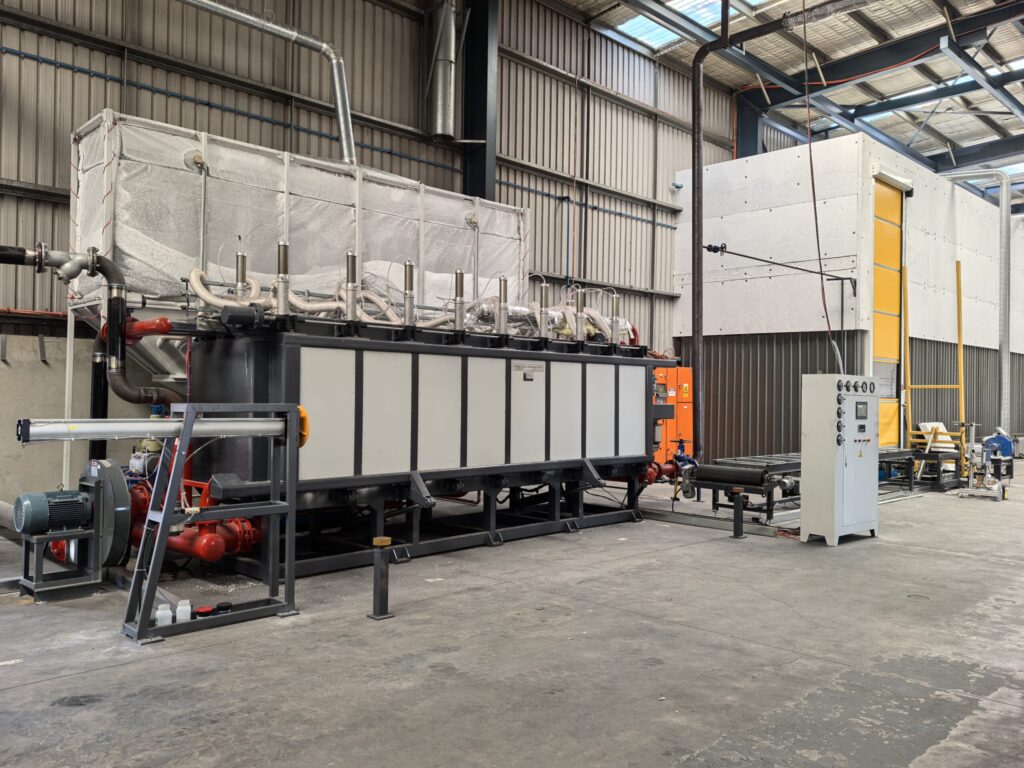
An EPS production line is a chain of machines that turns raw polystyrene bead into finished foam block, shape or board. Buyers often price one machine at a time and wonder later why the plant bottlenecks; the line only works as a balanced system. This guide maps every stage, what each machine does, and how to size them so no single step starves the rest.
Stage 1 — Pre-expansion
Raw bead is steamed in an EPS pre-expander machine to a target density (lower = lighter, higher = stronger). Density set here decides the quality of every block you ever mould, so weighed density control that holds ±1.5% is the first quality gate. How to choose a pre-expander.
Stage 2 — Ageing (silo)
Expanded bead must rest so internal pressure equalises. The EPS silo system buffers bead between pre-expander and moulder and provides that residence time. Skip it and you get post-mould shrinkage. Silo guide.
Stage 3 — Molding
A block molding machine fuses bead into slabs; a shape moulder fuses it into finished parts. Pick by what you sell — see block vs shape molding. Steam is what fuses the bead; our steam system guide explains the accumulator, staging and drainage that decide fusion.
Stage 4 — Cutting
The EPS cutting line slices blocks into boards and rough shapes; a CNC cutting machine cuts finished 3D parts. Size the cutter to your moulded block length. How to size a cutting line.
Stage 5 — Packing & wrapping
Blocks go to a packing machine; shape parts to a wrapping machine for 6-side PE film. Packing for block foam.
Stage 6 — Recycling
Offcuts from cutting return through an EPS recycling machine as reusable bead or ingot. How EPS recycling works.
How to balance the line
Size from daily finished output backwards: block demand → moulder throughput → bead demand → pre-expander + silo buffer → cutting capacity. Leave one machine of headroom at the moulder so a changeover never stops the plant. A map of EPS machine types helps you see the whole cell before you buy any one piece.
Common mistakes
- Buying the moulder first, then discovering the pre-expander cannot feed it
- No silo — every pre-expander stop immediately starves moulding
- Undersized cutting line — moulded blocks queue behind a slow cutter
For a configuration matched to your output, talk to our team.